A cold-winter capital in southern Brazil: a large apartment market with rising rents, a low yield, no beach, and prices that stalled in 2026 after a steep run.
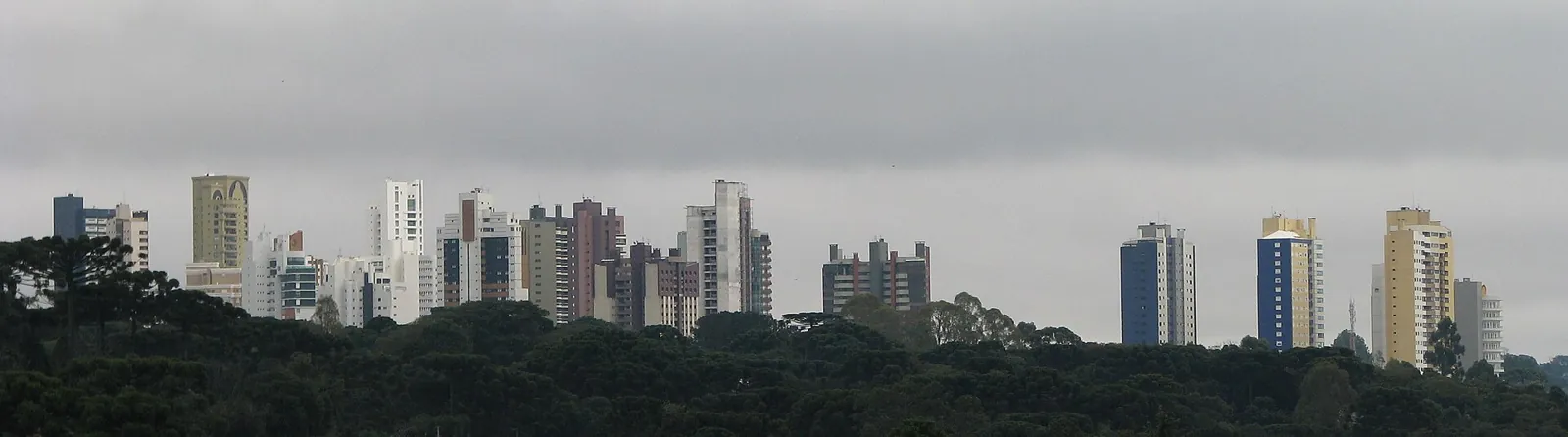
The small, expensive core southwest of downtown, where old houses under preservation rules stand beside high-rises, malls and the city's busiest nightlife.
FipeZAP's September 2026 figure of about R$ 17,575 per m² is the highest it publishes in Curitiba, 49% above the city average, and it fell 0.7% over 12 months.
Avenida do Batel: Main avenue, with Pátio Batel, restaurants and clubs; lively at night and among the priciest addresses.
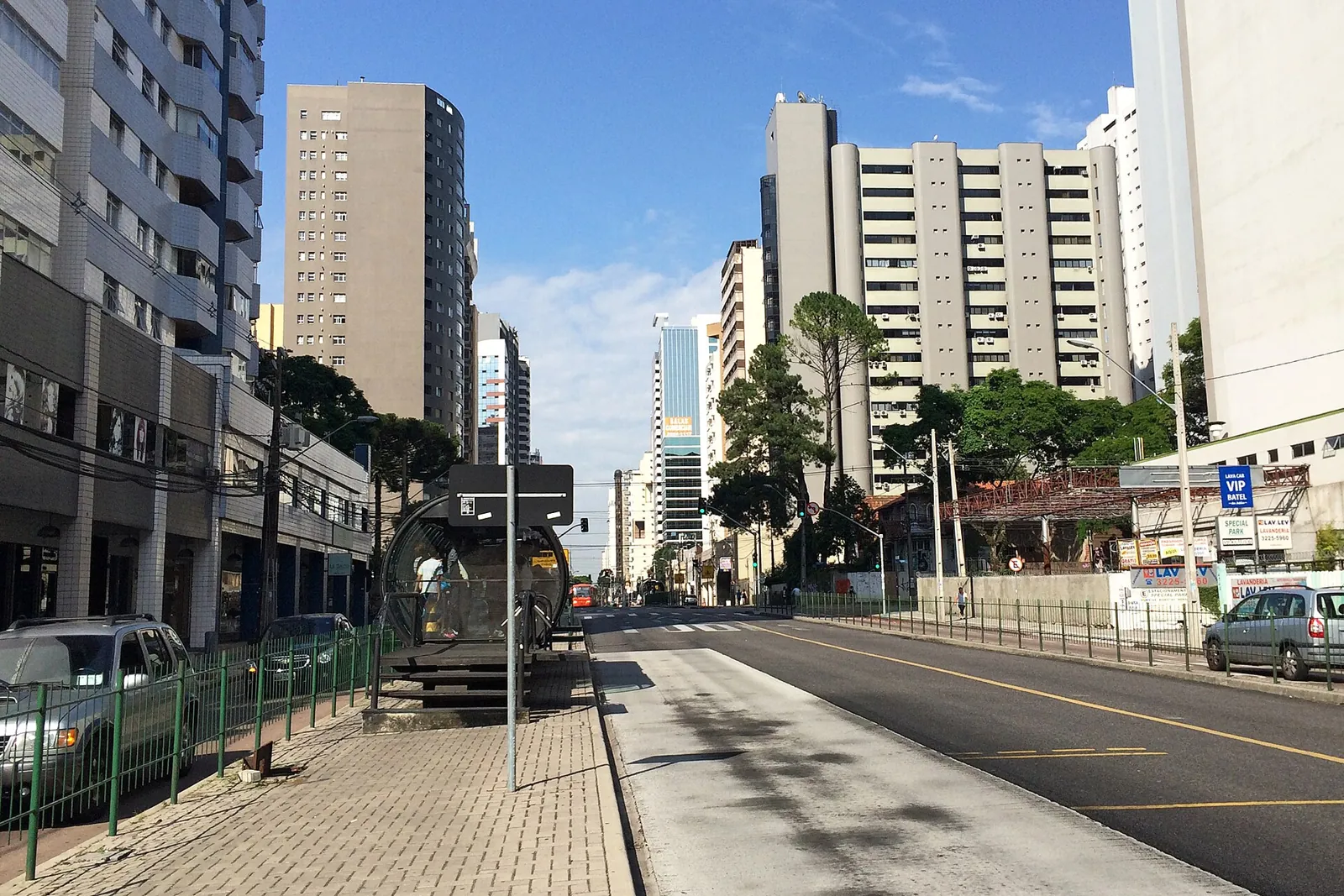
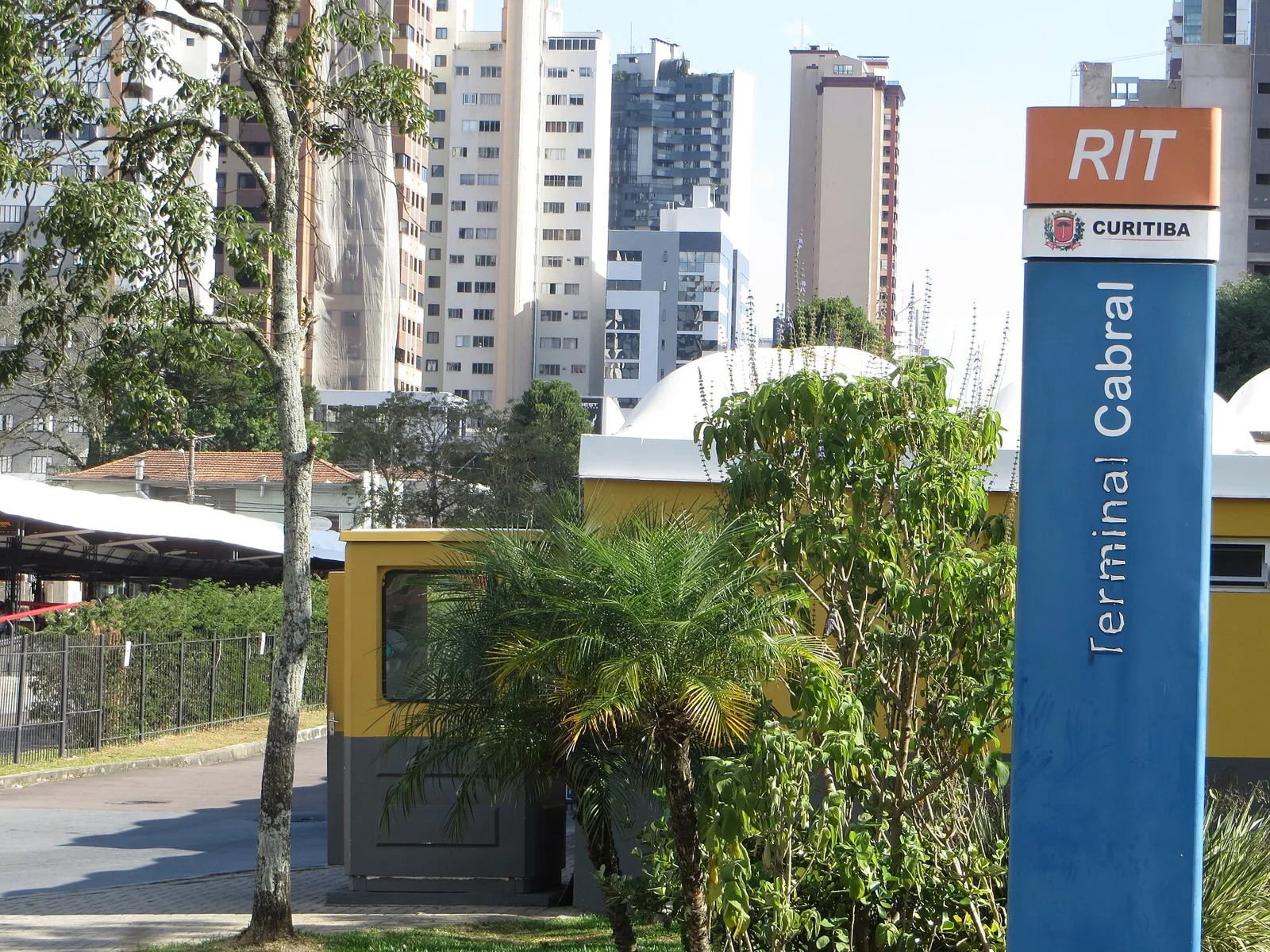
Avenida Sete de Setembro: Bus lane, Bento Viana tube station, hotels and banks; best transit, most traffic.
Avenida Vicente Machado: Runs toward Centro with offices, restaurants and bars; mixed use and night noise.
Rua Bispo Dom José: Nightlife strip and the Colégio Marista Paranaense; check the block before buying.
Avenida Visconde de Guarapuava: Near Shopping Curitiba; newer buildings with small units.
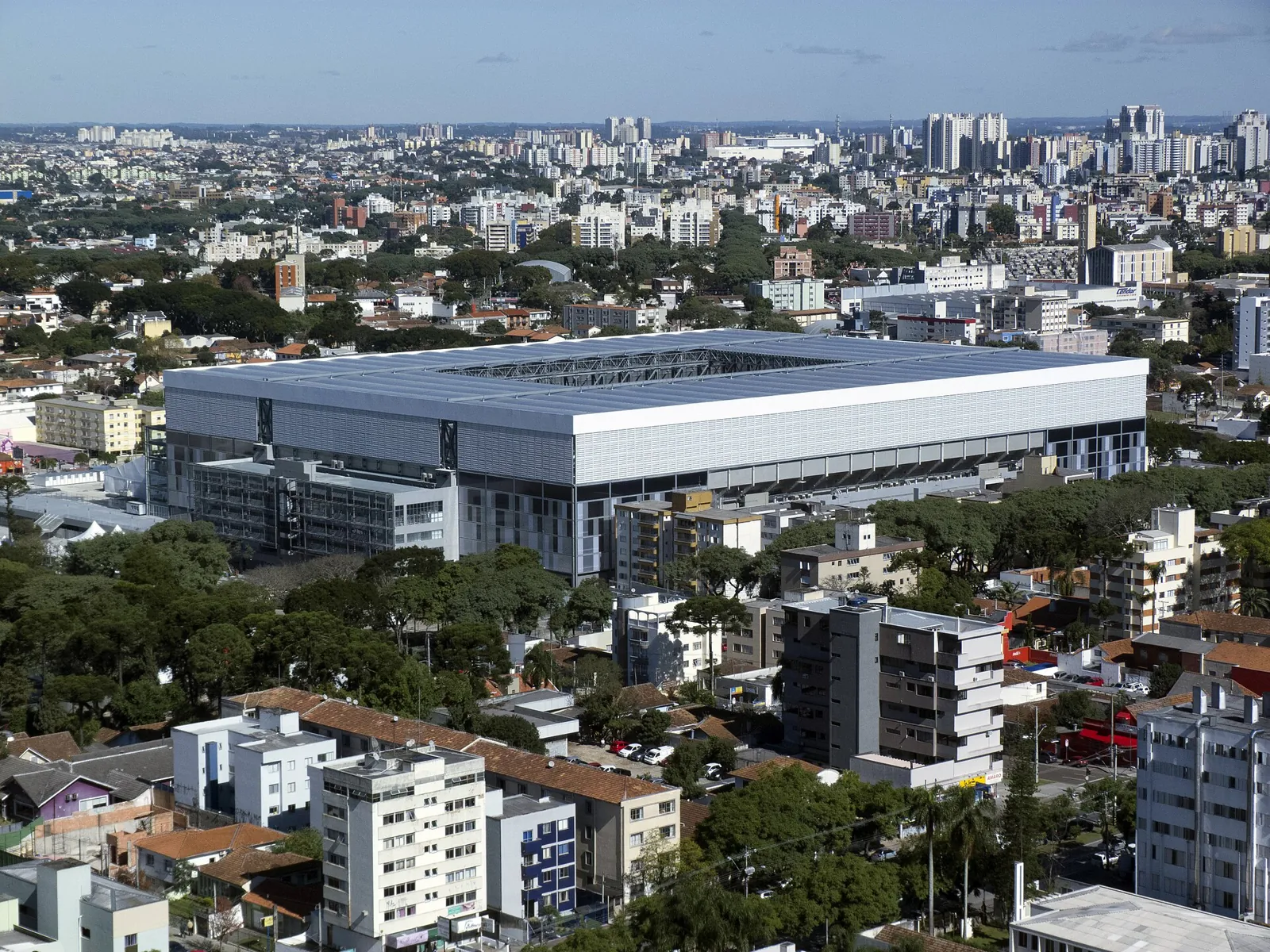
A large, dense apartment district south of Batel, with the city's most listings, a football stadium, strong tenant demand and a documented record of street flooding.
FipeZAP shows about R$ 12,500 per m² for September 2026, a 1.3% rise over 12 months that leaves it about 6% above the city average, with little price gap between small and large units.
Avenida República Argentina: Main commercial street, over 4 km with a bike lane; all services, more noise.
Avenida Sete de Setembro: Northern edge with the bus lane; convenient, loud on the front side.
Avenida Iguaçu: Crosses the north side, with restaurants and a food hall.
Rua Brigadeiro Franco: Interbairros I buses, restaurants and bakeries, per MySide.
Avenida dos Estados: Restaurants, including a Mexican bar MySide names; check the noise at night.
Photo: Arenadabaixada2 by Gustavo Paolo, CC0, via Wikimedia Commons, resized
West of downtown toward Parque Barigui, known locally as Champagnat: a flat grid of high-rises and tree-lined streets, with a bus-lane rebuild now under way on its main street.
FipeZAP shows about R$ 13,408 per m² in September 2026, down 3.4% in 12 months; MySide's text swaps this entry with Ahú, but FipeZAP's own report confirms this figure.
Rua Padre Anchieta: Main corridor with the BRT lane; 2026 works, heavy traffic, good transit.
Rua Martim Afonso: One-way street with apartment buildings, used as a route to Centro.
Rua Padre Agostinho: One-way main road, per MySide.
Rua Princesa Izabel: Tree-lined street picked out in a 2022 sponsored article.
An old family neighborhood northeast of downtown, built around a church, a country club and a bus terminal that ranks among the city's largest, with big apartments and few bars.
The September 2026 FipeZAP reading is about R$ 12,264 per m², having risen 1.3% over 12 months, and sits roughly 4% above the city average, though listings over 150 m² ask noticeably more.
Avenida João Gualberto: Named by QuintoAndar as a main avenue next door in Juvevê; check the noise.
Rua Munhoz da Rocha: Bars, restaurants and a mall at number 853; the neighborhood's night out.
Rua Itupava: Popular for bars and restaurants, per QuintoAndar.
Rua João Américo de Oliveira: The Apto off-plan portal lists it among the most sought-after streets.
Rua Belém: Also on the off-plan portal's list of sought-after streets.
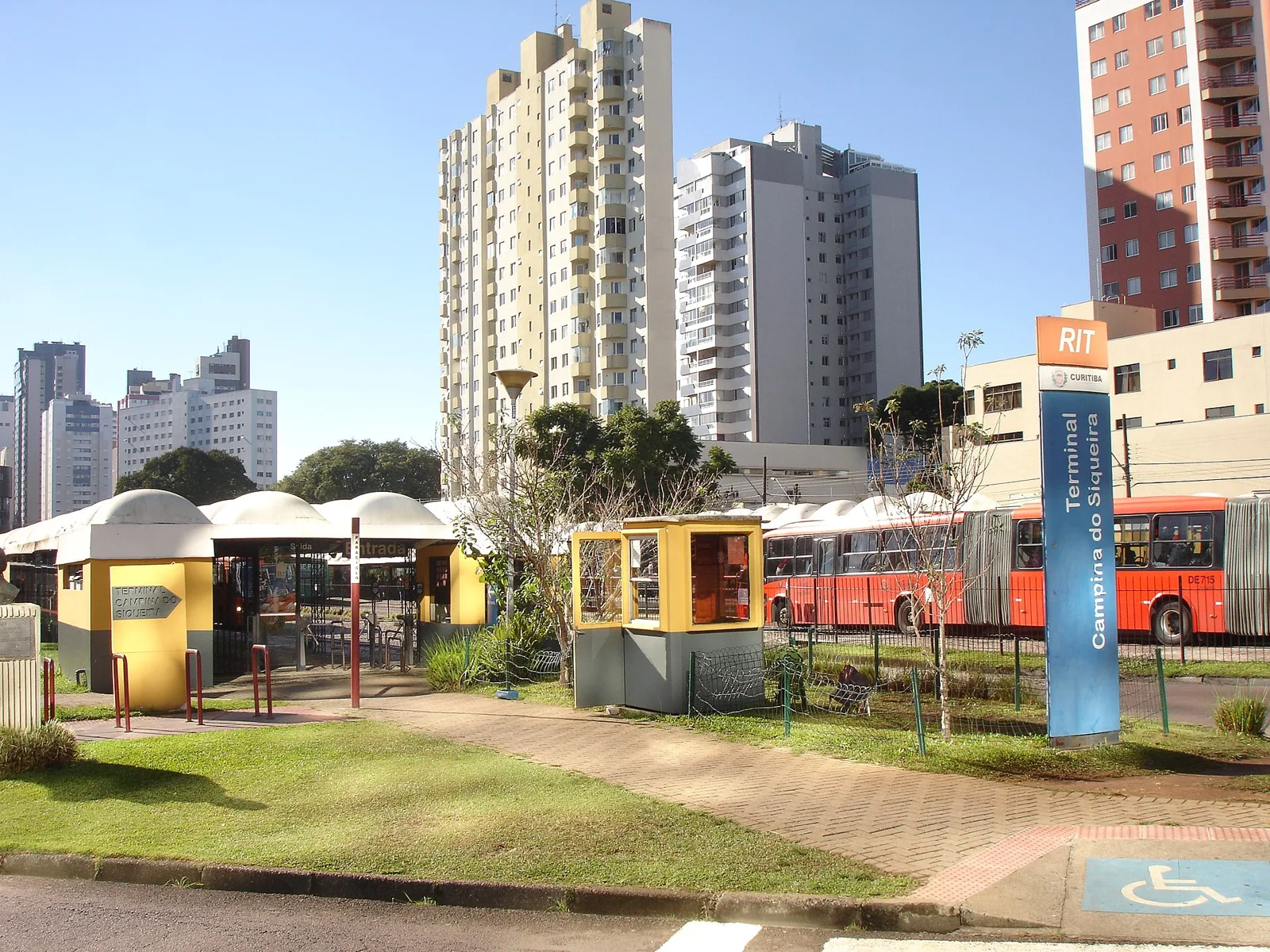
A marketing name, not an official neighborhood: the high-rise western edge across Campina do Siqueira, Campo Comprido and Mossunguê, with large units, a university, a mall and few reasons to walk.
Mossunguê's asking median was R$ 11,660 per m² and the listings labeled Ecoville R$ 12,713 in November 2026, while Loft's figure for January 2026 was R$ 13,339, so check which boundary a price uses.
Rua Deputado Heitor Alencar Furtado: Rua do Outono, the main axis with the express bus lane; ask about works; UTFPR campus at number 5000.
Rua Professor Pedro Viriato Parigot de Souza: Parallel main street with many high-rises and access to Park Shopping Barigui.
Avenida Cândido Hartmann: Road link toward the center of the city.
Rua Monsenhor Ivo Zanlorenzi: Named by the Apto off-plan portal among the popular streets.
Rua José Izidoro Biazetto: Also on the Apto portal's list of popular streets.
Photo: Ecoville by Felipe Timmermann, Public domain, via Wikimedia Commons, resized
Suits
Families and long-term residents who want schools, hospitals and bus corridors close by
Landlords who want year-round tenants and accept a yield under 5%
Buyers comfortable reading zoning, because building rights move land prices here
Look elsewhere for
Anyone who wants a beach nearby or holiday-let income
Buyers chasing high gross yields: the northeast capitals publish far higher ones
People who need many nonstop long-haul flights
The market after the 2024 jump
FipeZAP, the listing-based index, had Curitiba's average at R$ 11,766/m² for September 2026, roughly US$ 2,170, just 1.86% above its level 12 months earlier and 0.36% up since January. Rents behave differently: R$ 49.44/m² monthly, 8.94% above the previous year, which gives the index's gross yield of 4.92%.
FipeZAP Curitiba, 12-month change in asking prices
Period
R$ per m²
12-month change
December 2019
6,019
-2.66%
December 2021
7,509
+15.41%
December 2023
9,079
+6.40%
December 2024
10,713
+18.00%
December 2025
11,686
+9.08%
September 2026
11,766
+1.86%
So the average asking price nearly doubled in under seven years, then stopped. No published study found for this guide pins the 2026 pause on one cause, and you should distrust anyone who is sure. Three documented facts sit beside it. Interest rates were high: the Selic stood at 15% before the cuts that took it to 13.75% on 16 September 2026, and Bem Paraná reports that 69.2% of Curitiba deals involve a mortgage, without naming who measured it. The head of market intelligence at Ademi-PR, the developers' association, links the high average ticket and the small low-price segment to harder buying and more demand for renting, which fits rents rising faster than prices. And the supply mix changed: about 70% of the 1,863 apartments launched between January and March 2026 were compact units.
Not every measure shows a pause. Loft, comparing about 33,000 listings from January to May 2026 with the same months of 2025, found average asking tickets up 14.5%, and 16.6% for homes over 125 m². An average ticket moves when larger or newer homes come to market, so treat that as a different measure from FipeZAP and not a contradiction to be settled. Both are asking prices. Neither is a sale.
Who is building and buying
Ademi-PR counted about R$ 7.4 billion in new-apartment sales in Curitiba in 2025: about 10,200 units sold against just over 10,000 launched, with launches down 19%. Only about 5% of launches came under the federal low-income program Minha Casa Minha Vida, against about 50% nationally, which is the clearest sign of how upmarket new supply is. Bem Paraná put stock at about 10,600 units in early 2026, with absorption expected in under 12 months. Statewide, the biggest quarter in recent years for new-apartment sales was the second quarter of 2026, when they passed 3,400 units, and launches shifted toward lower-priced housing while studios and high-end projects lost share.
New sales cluster where zoning allows height. Over the year Ademi reported in November 2025, it ranked Centro first with 1,792 units, then Água Verde with 830, Pinheirinho with 790, Novo Mundo with 695 and Bigorrilho with 480. Ecoville sold 226 and Batel 198, yet both ranked in the top five by sales value because the units are so expensive. Nobody seems to publish a count of foreign purchases here. Treat claims about foreign demand with care and check who the likely resale buyer is before you pay for a feature only a foreigner would want.
FipeZAP sale index, September 2026 report. 2026 is the 12 months to September. Inflation is not removed.
How zoning draws the map
The 2022 census counted 1,773,718 residents and IBGE estimated 1,830,795 for 2025. The city has 75 official neighborhoods. The main thing a buyer needs to understand is that height here follows named corridors, so two streets a few blocks apart can carry very different land values and very different futures.
The zoning law is Lei 15.511 of 2019. The city's tax decrees use its categories, which is handy, because they show what each zone is worth to the assessor. The Eixo Estrutural is the structural axis along the main bus corridors. The Eixo Nova Curitiba appears in the western neighborhoods that make up Ecoville. ZR4 is the higher-density residential zone, and ZR3, ZR2 and ZR1 step down from there. The table uses the land values in the 2024 assessment decree. They are tax values, far below market prices, but the ratios inside each neighborhood are what matter.
City land values for IPTU, 2024, R$ per m² of land
Read Cabral's row: the axis is worth about twice the ZR4 and more than twice the ZR3 behind it. That gap is why a quiet house street can sit one block from a line of high-rises, and why a seller of an old house on the right lot may be pricing land, not the house. Distances are short by Brazilian big-city standards. A Corrida dos Bairros, a neighborhood data site, puts Bigorrilho about 2.8 km from downtown, Água Verde 2.9 km and Cabral 3.3 km, with Mossunguê about 5.9 km and the part it labels Ecoville about 8.4 km.
The zones also tell you who your neighbors will be in ten years. In Batel and Alto da XV, the base rule reported when the additional-rights law passed in 2020 was six floors and a coefficient of 2, with four more floors and an extra 0.5 available for purchase. On Avenida Presidente Affonso Camargo the same law took the limit from four floors to ten. Ask for the Consulta Informativa de Lote, the city's lot report formerly called the Guia Amarela, before you assume that the view or the winter sun will last.
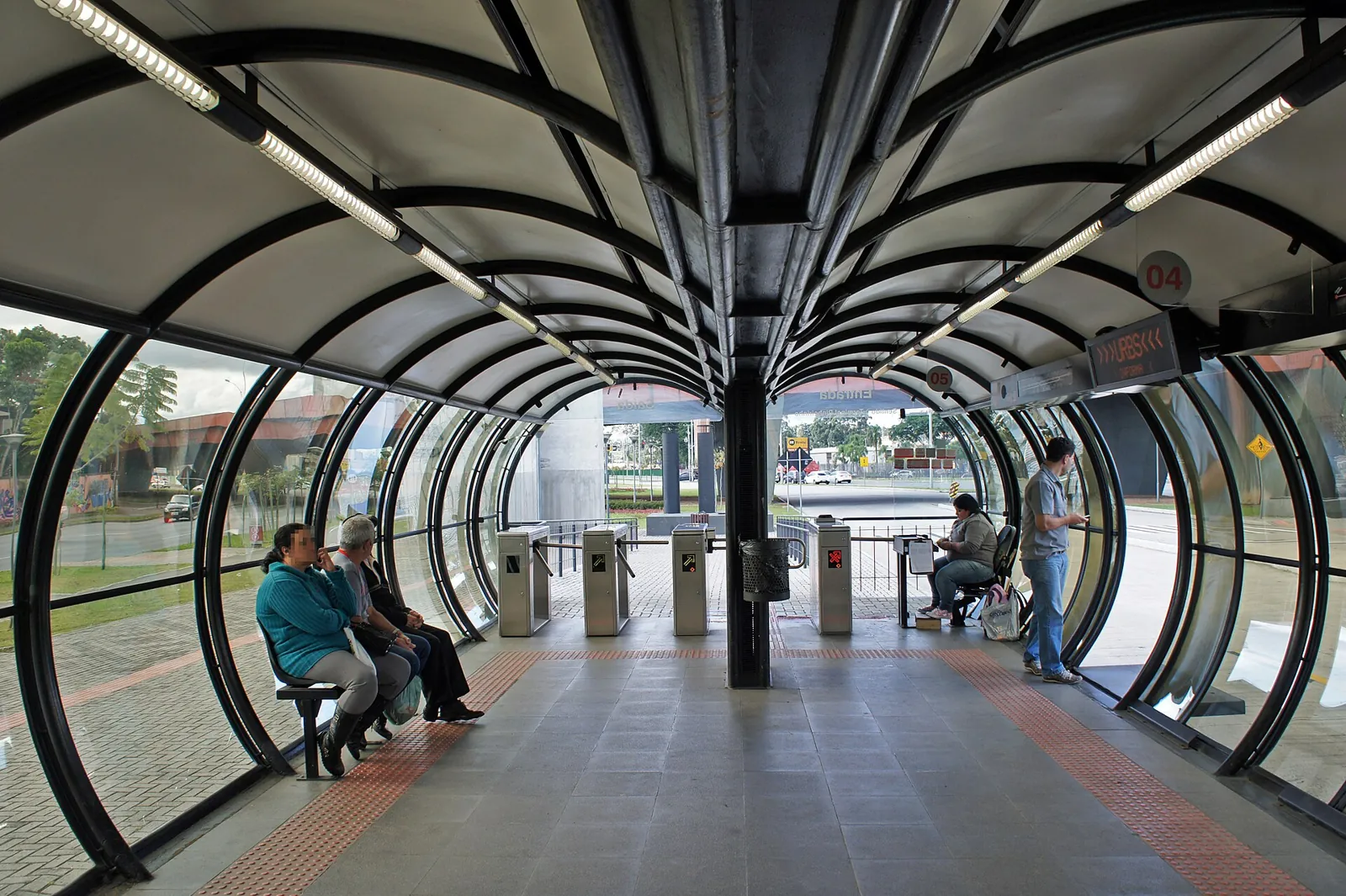
High-rises line Avenida Sete de Setembro, a main axis with a bus lane and a tube station.
This is an apartment city at its center. In the 2022 census 98% of occupied homes in Centro were apartments, 95% in Batel, 93% in Cabral, 91% in Bigorrilho and 88% in Água Verde. Mossunguê, the official name for most of Ecoville, stood at 68%, with houses making up the rest. Citywide, Ademi-PR says 32% of homes are in buildings. Households are small and older in the central districts: 34% of Batel residents are 60 or over and only 9% are 14 or under, while Mossunguê has 18% children and 2.6 people per home.
What is for sale has split in two. Compact units were about 70% of launches in early 2026 and about 38% of unsold stock. Loft puts the average ticket at R$ 312,000 for homes up to 30 m² and R$ 1.82 million above 125 m². Bem Paraná, reporting the Ademi survey, says projects aimed at the middle class lost ground because of higher construction costs, changes in planning rules and weaker purchasing power. Listings in the established districts, meanwhile, mostly run large.
Typical sale listing by area, asking prices, from A Corrida dos Bairros late in 2026
Area
Size
Asking price
Mossunguê
215 m²
R$ 2,435,000
Batel
180 m²
R$ 2,380,000
Bigorrilho
155 m²
R$ 1,890,000
Cabral
153 m²
R$ 1,820,000
Água Verde
135 m²
R$ 1,415,000
Centro
57 m²
R$ 635,000
Building fees
The condomínio, paid monthly by every owner, varies widely. Loft's reading of 697 listings in July 2025, reported by Bem Paraná, gave a citywide average of R$ 489. Batel averaged R$ 1,800, Cabral R$ 1,350, Mossunguê R$ 1,183, Bigorrilho R$ 650 and Água Verde R$ 640. Part of that gap is unit size, so also look at the figure per square meter: Alto da Glória R$ 9.60, Batel R$ 8.57, Juvevê R$ 8.40, Centro R$ 8.12, Mossunguê R$ 8.03 and Cabral R$ 6.60. Get three years of assembly minutes and this year's budget, then use the guide to the monthly fee to read them.
Off-plan buyers should know the compact product is where the competition is. Before paying a launch price for a 25 m² unit, compare it with the finished studios already listed nearby and study how off-plan purchases work, including patrimônio de afetação, which ring-fences each project's money.
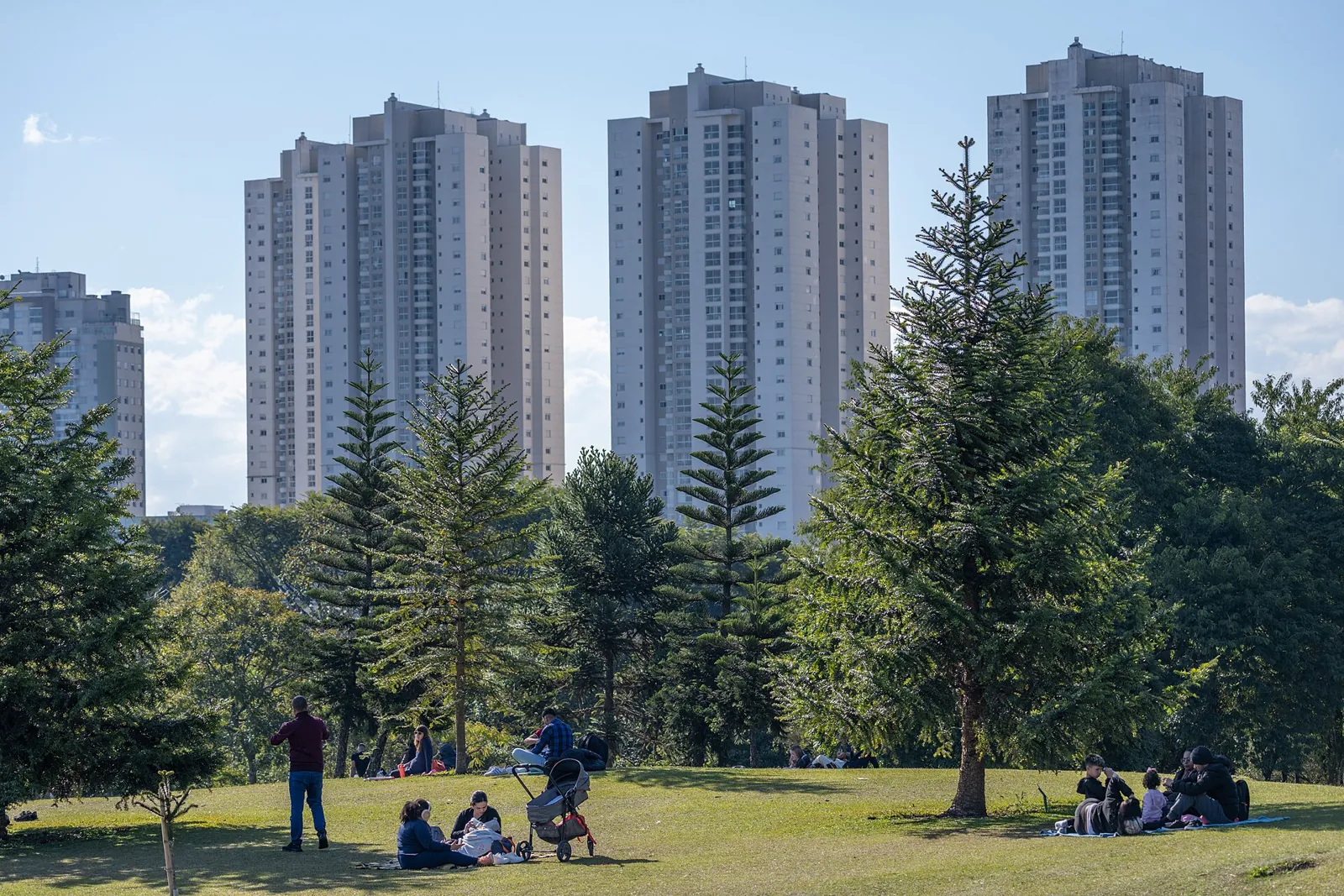
Apartment high-rises behind the Jardim Botânico, with araucária trees in the foreground.
Two published series cover Curitiba's neighborhoods, and they disagree by enough to matter. FipeZAP's September 2026 report, also republished by MySide, lists ten neighborhoods. A Corrida dos Bairros collects medians from public listings across many portals, and its citywide apartment median of R$ 10,078 sits below FipeZAP's R$ 11,766. Use them to rank areas, not to price a unit.
Monthly medians from small samples swing hard. A Corrida's Batel figure went from R$ 12,432 in September to R$ 15,759 in October and R$ 15,450 in November 2026, and the site has published an erratum about portal weighting. That looks like a change in the sample, not a 25% market move. MySide's text also swaps the Ahú and Bigorrilho figures, but FipeZAP's own report matches the table above.
Size changes the answer too. In Cabral, A Corrida shows R$ 10,308 per m² for apartments up to 50 m² and R$ 13,738 above 150 m², while Água Verde runs almost flat across sizes at R$ 10,492 to R$ 12,456. At the very top, Loft's average ticket for homes over 125 m² late in 2025 was R$ 3.95 million in Batel, R$ 3.51 million in Mossunguê, R$ 3.45 million in Campo Comprido, R$ 3.24 million in Bigorrilho and R$ 3.00 million in Cabral.
Against other capitals on FipeZAP, São Paulo (R$ 12,206) and Belo Horizonte (R$ 10,686) are the near neighbors, while Porto Alegre (R$ 7,545) is far cheaper. Buyers who want a southern city at a much lower entry price and a citywide yield of 7.36% can compare Porto Alegre's Moinhos de Vento, after reading that guide's risk chapter. Belo Horizonte is the closest parallel for the 2026 pause, at +1.97%, and its Savassi is the natural comparison for Batel.
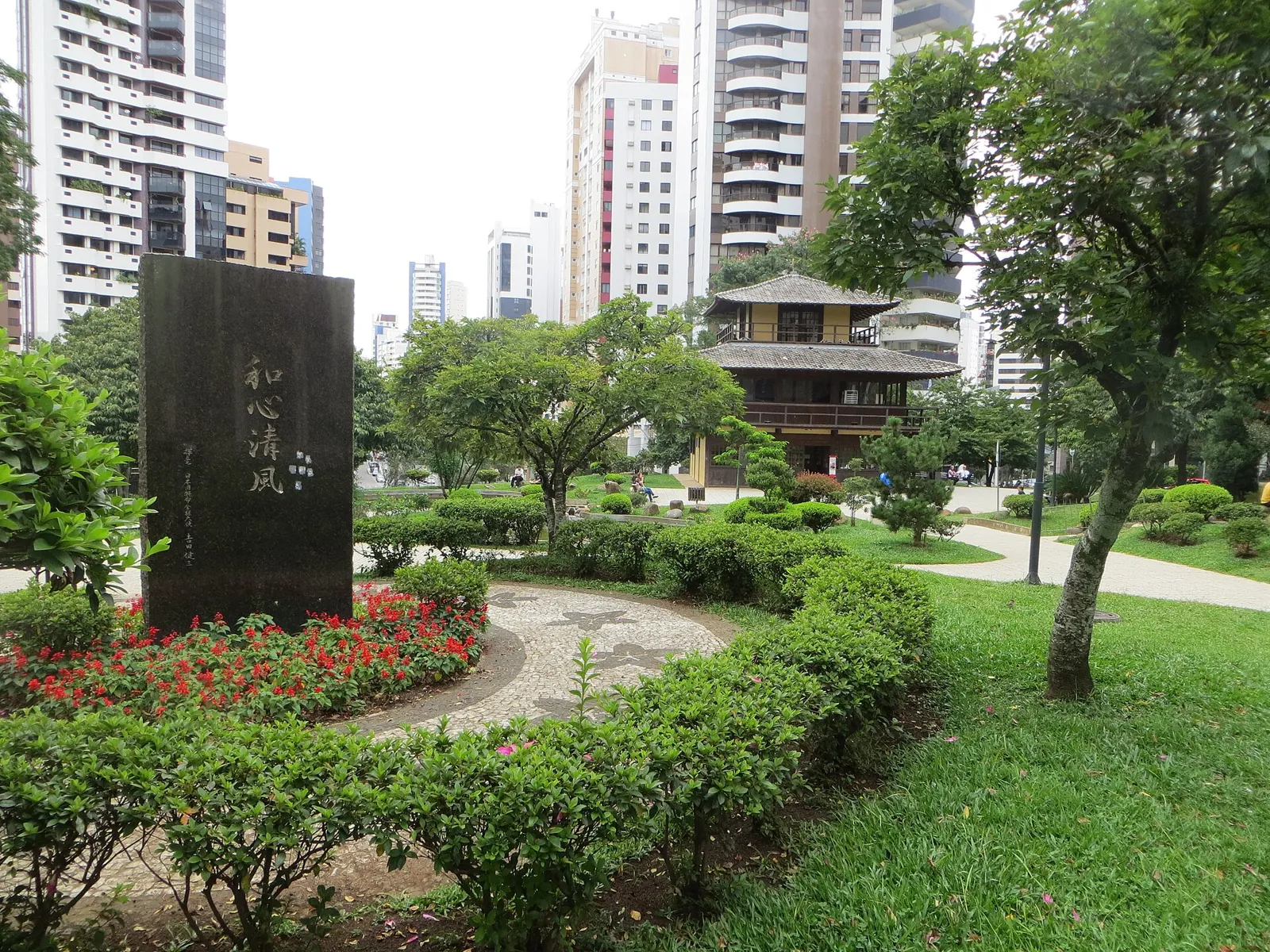
Praça do Japão, on the border of Batel and Água Verde.
Of the capitals covered here, only Fortaleza matches FipeZAP's 4.92% gross yield at the bottom of the table. Recife shows 8.3%, Natal 8.03% and São Paulo 6.43%. It is before condomínio, vacancy, management, insurance and tax. The low figure is not the result of rents lagging lately. FipeZAP's own series shows rents rising 24.47% in 2022, 20.70% in 2023, 14.58% in 2024, 10.98% in 2025 and 8.94% over the latest 12 months, faster than prices in most of those years. The yield is still under 5% after all that, which shows how low rents started against prices. A buyer should not assume another run of that size.
The yield is not spread evenly. A Corrida's November 2026 figures, based on asking rents and prices, run 4.32% in Cabral, 4.47% in Bigorrilho, 4.50% in Batel, 4.68% in Mossunguê, 4.95% in Água Verde, 5.13% in Centro and 5.28% in the Ecoville listings. Inside a single neighborhood the small unit wins: in Água Verde the site shows 7.03% for the smallest band and 4.27% for the largest. Before you buy for rent, take those small-unit yields with the warning that compact stock is what developers are adding most of.
Who rents, and where
Inpespar, the research institute linked to the Secovi-PR landlords' and managers' body, says 26% of Curitiba residents rent. It put residential rentals at 23.7% of the offer between January and March 2026, mostly one- and two-bedroom units. Its May 2026 figures, as reported by Bem Paraná, give Centro 11.9% of residential rental contracts, then Água Verde at 5.9% and Portão at 4.6%. Neighborhood averages can mislead: Prado Velho led Loft's table at R$ 58.83/m² late in 2025 even after falling 17% from earlier in the year, and the report does not say why.
Asking rent per m² per month, Loft, August to October 2025
Neighborhood
R$ per m²
Change, January-March to August-October 2025
Campina do Siqueira
54.73
+49%
Centro
49.67
+14%
Campo Comprido
49.16
+8%
Mossunguê
45.40
+3%
Batel
42.90
+8%
Água Verde
41.86
+10%
Bigorrilho
41.84
+2%
Cabral
40.65
-1%
Citywide
39.07
+11%
Loft's citywide figure is far below FipeZAP's R$ 49.44 because the samples differ. By May 2026 Loft's average rental ticket across 2,902 listings was R$ 4,460, with Bigorrilho at R$ 5,160 for 96 m² and Batel at R$ 8,259 for 150 m².
Guarantees and paperwork
The most recent breakdown found is old: Inpespar's 2016 figures for Paraná gave the traditional fiador, a guarantor with property, about 64.6% of contracts and seguro-fiança, rent-guarantee insurance, about 26%. No current split or official vacancy rate turned up. Ask two or three local administradoras, the licensed rental managers, what they see. If you live abroad, work out your net return with the guide to non-residents' rental tax. Whether a 3.5% IOF applies when rent or sale proceeds leave the country, and the CBS and IBS treatment of non-residents over the limits, are not settled. Get written advice.
Short lets
Curitiba appeared to have no short-let ordinance on its books in November 2026. A bill before the city council, number 005.00646.2025, would limit short stays in residential properties to 120 days a year and require municipal registration, with obligations for owners and platforms, according to a local political news site. The council's own pages could not be opened, and no vote or current status could be confirmed. On 25 May 2026 the city signed a data deal with Airbnb covering anonymous statistics on visitor flows and peak periods, and the local press says it opened a debate about housing, condominiums and municipal revenue. Watch this one before you buy for it.
The nearer risk is your building. In September 2026 the STJ, the top court on federal law in Brazil, took up the question under its binding-precedent procedure and stopped lawsuits on it nationwide: does a convention limiting a building to residential use already bar platform lets, or must the ban be express? Earlier rulings in each case stand until it decides. A Curitiba judge in 2017 blocked an assembly vote against lets under 12 months because the bylaws did not expressly forbid short stays, while SBT News reports an earlier STJ decision that offering a unit for short stays may require a change of use approved by two-thirds of owners, so there is no safe local assumption. Read the convention, then the assembly minutes. The national short-let guide covers the Tenancy Law, while the treatment of the R$ 600 deduction and of CBS and IBS for hosts is still unsettled.
What the published data says
BNBCalc's year to September 2026 shows 4,639 active listings on average, 23% more than a year earlier, charging R$ 293 a night at 39% occupancy, with R$ 44,000 of revenue per listing. The same page's headline cards show R$ 263 and 45%, so treat all of it as rough. A press release carried by Bem Paraná in May 2026 claimed over 5,000 Airbnb listings, about 4,000 of them in areas like Centro, Água Verde and Batel, and occupancy near 64% with no period stated. This guide gives no short-let yield, because no named source publishes one for Curitiba.
This is a business-and-events market, not a beach one. BNBCalc shows revenue per available night peaking in December and July and lowest in February and March, and weekend occupancy 36% above weekdays. The city's tourism institute logged 322 events by May 2026 and projected 406 for the year, and hotel occupancy hit 90% in October 2025 against a 63% figure for 2024. If you want a coastal holiday let, look at Florianópolis instead.
Short-let arithmetic
Starts from published figures (12 months to September 2026 (BNBCalc summary; the same page's headline cards show R$ 263 and 45%)). Set your own.
Curitiba charges ITBI, the municipal transfer tax, at 2.7% under Lei Complementar 108 of 2017. The law does give lower rates on a mortgaged home financed for at least 10 years, but only near the bottom of the market: exempt up to R$ 176,000, 0.5% up to R$ 205,000 and 1.6% up to R$ 220,000. A R$ 1,000,000 buyer pays the full rate with or without a loan. The tax applies to the deed or contract value unless that is below the city's valor venal, its assessed value, according to one calculator guide; the same guide cites the STJ ruling that the actual transaction value is the correct basis. If the city's figure looks high, ask a lawyer about that ruling. The argument is explained in the property tax guide.
Notary and registry costs are where Paraná differs. The state court's published table for deeds and registrations stops rising at a low band instead of climbing with value. The version usually linked carries amendments through a December 2021 decree. A newer version on the court's site, in a file created in December 2023, uses the same bands at higher reais, and that is what we use here. Later updates could not be confirmed. The state also charges a separate 0.2% to its judiciary fund, Funrejus, capped at 53 of the state's fiscal units.
Sample Curitiba purchase, R$ 1,000,000
Item
Basis
Amount
ITBI
2.7%
R$ 27,000
Escritura, the public deed
Highest listed band of the state table
R$ 1,377
Registro, entering the deed on the matrícula
Highest listed band of the state table
R$ 1,194
Funrejus
0.2%
R$ 2,000
Total before certificates and any lawyer
R$ 31,571, about 3.2%
A garage with a separate matrícula pays 50% of the deed band. Get a written quote from a tabelião, the public notary, because these fee figures are from the table as published and other charges can apply. The closing costs guide compares cities.
Annual IPTU
IPTU, the city's yearly tax, is charged on the assessor's valor venal and ignores what you paid. The 2024 decree's residential table runs from 0.20% to 0.65%, with the top rate above R$ 334,976 of assessed value, and the bands are raised with inflation each year. Mixed-use units reach 1%, non-residential units 1.35%. Vacant land is the trap: 1.5% on the top band along the structural axes and in the Zona Central, 1.25% in ZR4 and ZR3 and 1% elsewhere. So a home assessed at R$ 700,000 pays at most about R$ 4,550 a year.
The base has just been reset. Lei Complementar 149 of 2025 and Decreto 2668 of December 2025 rebuilt the value tables from market prices, street improvements and the construction cost index. The city says more than 80% of properties rose only by inflation, 4.46%, in 2026, and that between 2026 and 2029 an increase cannot pass 18% plus inflation, except where the adjusted amount is under R$ 290. For 2026 that means a ceiling of 22.46%. So your bill can keep climbing above inflation for years after you buy, and the seller's current bill may understate it. In 2026 the waste fee ran from R$ 237.92 to R$ 523.42, the due date was 20 March, and paying at once earned 10% off. The city says about 133,800 properties, 13.5% of the taxable base, are exempt in 2026, and it publishes the criteria separately, so find out whether your unit qualifies.
Building rights, heritage units and protected trees
There is no federal marine land here, because Curitiba has no coast. The title problems are municipal, and they come from a city that has regulated land use tightly for decades. Several of them are invisible on a clean-looking matrícula unless you know what to ask.
Paid building rights
Each zone has a basic coefficient, the multiple of the lot's area you may build for free. More can be bought. Under Lei 15.661 of 2020 and Decreto 1297 of 2022, half of the additional potential had to be bought from the city as OODC, the paid grant, and half from private holders as TDC, transferred rights. Lei 16.361 of June 2024 now deals with transfers too, and Decreto 1861 of 2024 regulates heritage transfers under it. We could not open the 2024 law, so whether the 50/50 split survives is unconfirmed. Ask an architect what applies on your lot. Under the 2022 decree the city's price uses the ITBI land value of the street frontage, with a factor of 0.75 when the coefficient rises and 0.15 when only floors are added, and transfers carry a 3% contribution. In one published case study of a ZR4 project with a coefficient rising from 2 to 2.5, the bought rights cost about 1.27% of total sales value and added 18% to it. That helps explain why developers pay for ZR4 lots, and why an old house on one can be priced above what it would fetch as a home.
UIPs, the heritage units
Curitiba has about 650 Unidades de Interesse de Preservação, buildings on the city's preservation register (the report's headline says 650 and its text 658), including a 1934 house in Batel that was long a restaurant and was registered in 1986. Lei 14.794 of 2016 governs them, and CAPC, the city's heritage panel, decides what can happen. An owner may receive building potential in exchange for a Restoration Permit and a commitment recorded on the matrícula. If it cannot be used on the same lot, it can be sold in stages under Decreto 81 of 2021, and Decreto 1861 of 2024 repeats the steps: up to 35% to start the work, up to 70% as work is inspected, and the final 30% only after the completion certificate. Potential can be renewed every 15 years if the building is well kept. Failing to conserve or destroying the property brings penalties.
A 2015 press report said UIP status did not oblige owners to conserve a building, and a 2013 report counted three court defeats for the city over UIP demolitions since 2011. Both predate the 2016 law. The city's own page on a 2016 state-court win over a Batel mansion failed to load for us, so ask a lawyer how the courts treat UIPs today. On the upside, tax relief exists: the 2026 budget lists total or partial IPTU relief for heritage property, and the Centro program adds more. Check with the city's urbanism office before you bid on any old house in Batel or Centro.
Protected trees and green sectors
Lei 9.806 of 2000, the city's Forest Code, bans cutting trees on private land without permission from the environment department. Removal, where allowed, carries replanting of two trees on the same property, and a 2017 Gazeta do Povo explainer says araucária and erva-mate cannot be cut at all. Lots with a registered Bosque Nativo Relevante, a protected native wood, fall into the Setor Especial de Áreas Verdes. Under Decreto 1783 of 2021 the usable area counts parking, pools and paths as well as the building, the minimum indivisible lot is 2,000 m², and the conditions go on the registry. So a wooded plot can be far less buildable than its size suggests. The 2026 budget lists total or partial tax relief for these lots.
Drainage strips and height limits
The city's faixa não edificável de drenagem is a no-build strip measured from an existing pipe or open watercourse. The city warns that the lot report cannot be the only source for a project, and that the strip's exact position on a lot comes from a land survey the owner must commission. Height has also just changed. Since 1 April 2026 the lot report has shown new limits from the airport protection plans revised by the federal airspace control department, Decea. Ippuc, the city planning institute, says the surface for Bacacheri airport dropped by the equivalent of about 15 floors and for Afonso Pena by about 6, and that no new building in the city can pass about 42 floors or 158 m.
Possession-only land at the edges
Cheap plots at the southern and western edges can be possession only, with no registered title. Curitiba regulated Reurb, federal land regularization, in October 2022. Decreto 1864 of 2024 looks at areas occupied by 22 December 2016, and Decreto 390 of March 2026 now governs low-income cases and excludes settlements consolidated after 12 July 2017. Cohab, the city housing company, opened low-income procedures in 15 areas with 2,823 lots in 2023, including areas in Caximba, Cidade Industrial, Santa Felicidade and Sítio Cercado. Start by reading the posse and escritura guide before you consider a bargain there.
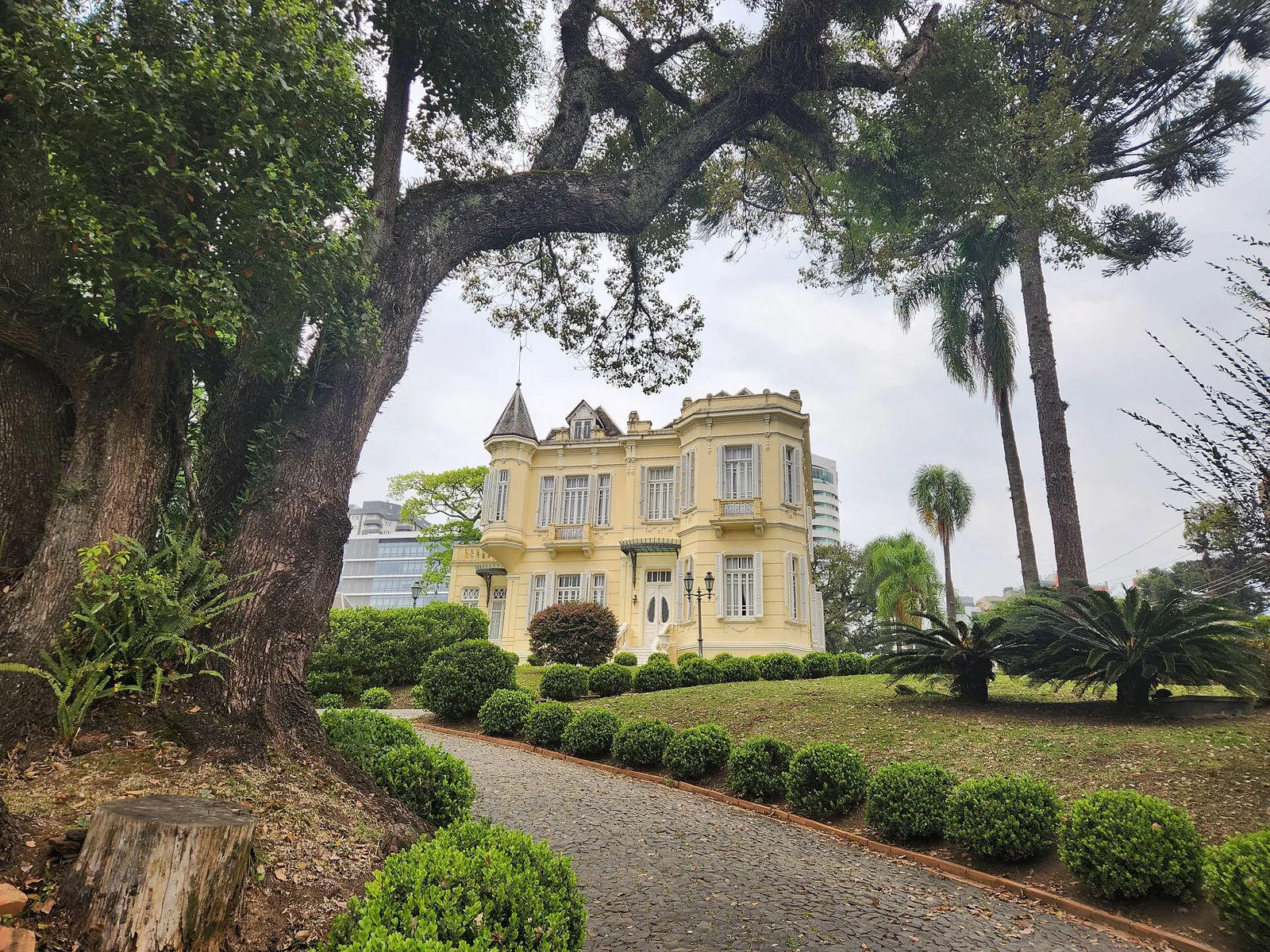
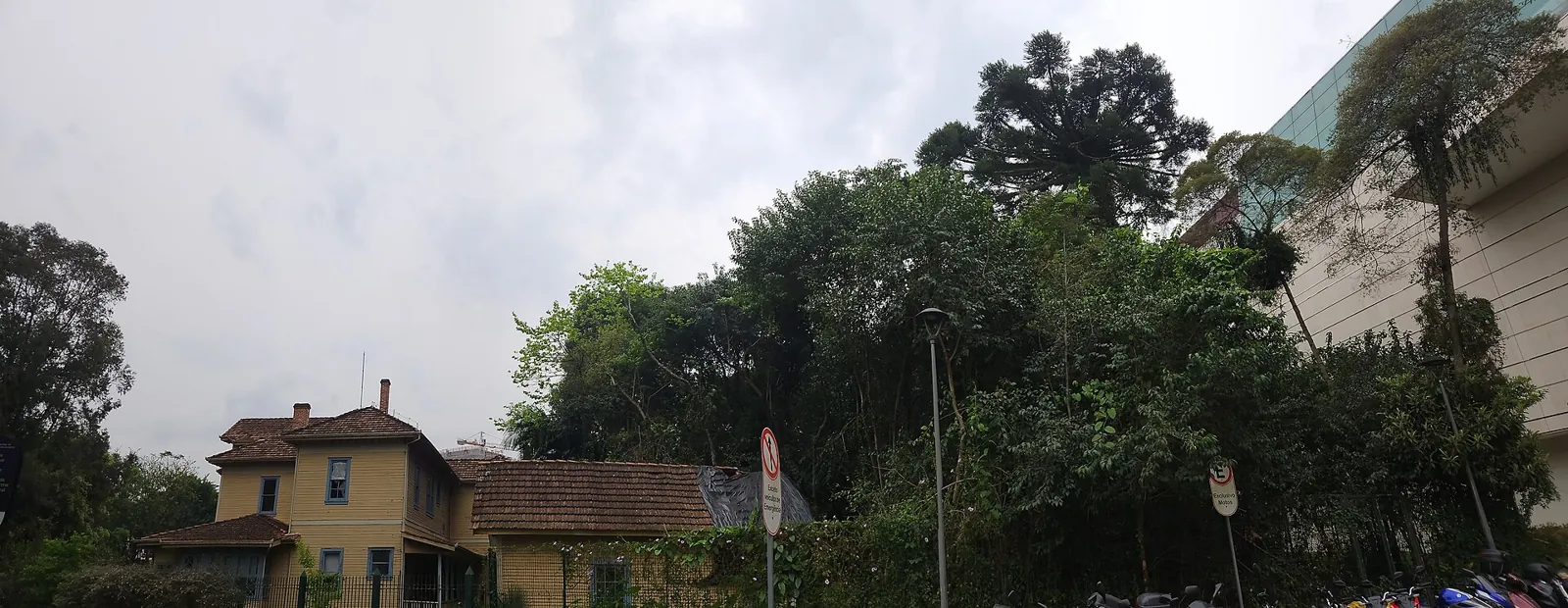
An old house and its trees on Avenida do Batel, beside a large modern building.
Curitiba's main physical risk is storm water. Researchers quoted in the press point to paved-over land and to homes on riverbanks. The rivers that matter most are the Belém and the Barigui. In the storm of 21 February 1999 water reached 70 cm at Boca Maldita downtown, and in the area around PUC the Belém spread to about 400 m across.
Prime addresses are not exempt. In early 2018 heavy rain flooded streets, shops, condominium garages and the cemetery in Água Verde, and a driver died when his car was swept off a bridge in Mossunguê, in Ecoville. The same report lists drainage works for Lindóia, Parolin, Fanny, Guaíra and Hauer on the Pinheirinho River and for Caximba, Cidade Industrial, Tatuquara and Fazendinha on the Barigui, and the Defesa Civil counted 127 people displaced in 2016 and 183 in 2017. More recent events: on 1 January 2026 a short storm flooded streets in Cidade Industrial and the Sabará underpass on the Linha Verde; overnight into 22 September 2026 at least 10 spots flooded, including parts of Centro, Rebouças and Parolin, and the Barigui gauge recorded 73 mm, per the Defesa Civil.
The maps
For its drainage plan and its flood maps covering the Barigui and the Iguaçu basin, ask the state water institute, IAT. We could not open that file because of its size, so we cannot describe its lines, and you should ask when any line you are shown was drawn. No national Serviço Geológico do Brasil risk sectoring for Curitiba turned up in this research. A city study from 2020 projects that the Barigui, Iguaçu and Belém could flood worse than today by 2099, and a researcher quoted in 2024 said the studies behind the city's flood measures are 20 years old.
Those parks do real work. São Lourenço, Tingui, Barigui and Atuba all have lakes that help hold floodwater, so low land beside a park may be part of the flood system and not only a nice view. Public works were listed in 2024 for the Belém, the Serraria sub-basin, Rua Samuel Cezar on the Água Verde River, and the Iguaçu near the zoo. Check the status of any that touch your street.
What to check
Ask the seller and the building manager in writing about water in the garage. Then walk the street while it rains hard in summer, get the assembly minutes on pumps, and pull the lot report for a drainage strip. The flood and landslide checklist shows where the official maps are.
Water rationing
Drought is the less obvious risk. Sanepar, the state water company, rotated supply across the metropolitan area from March 2020 to 21 January 2022 after what the state news agency called the most critical dry spell in Paraná in 90 years, with reservoirs bottoming at 26.77% on 11 November 2020. Check whether a building has its own reservoir capacity, and how the building coped in those two years.
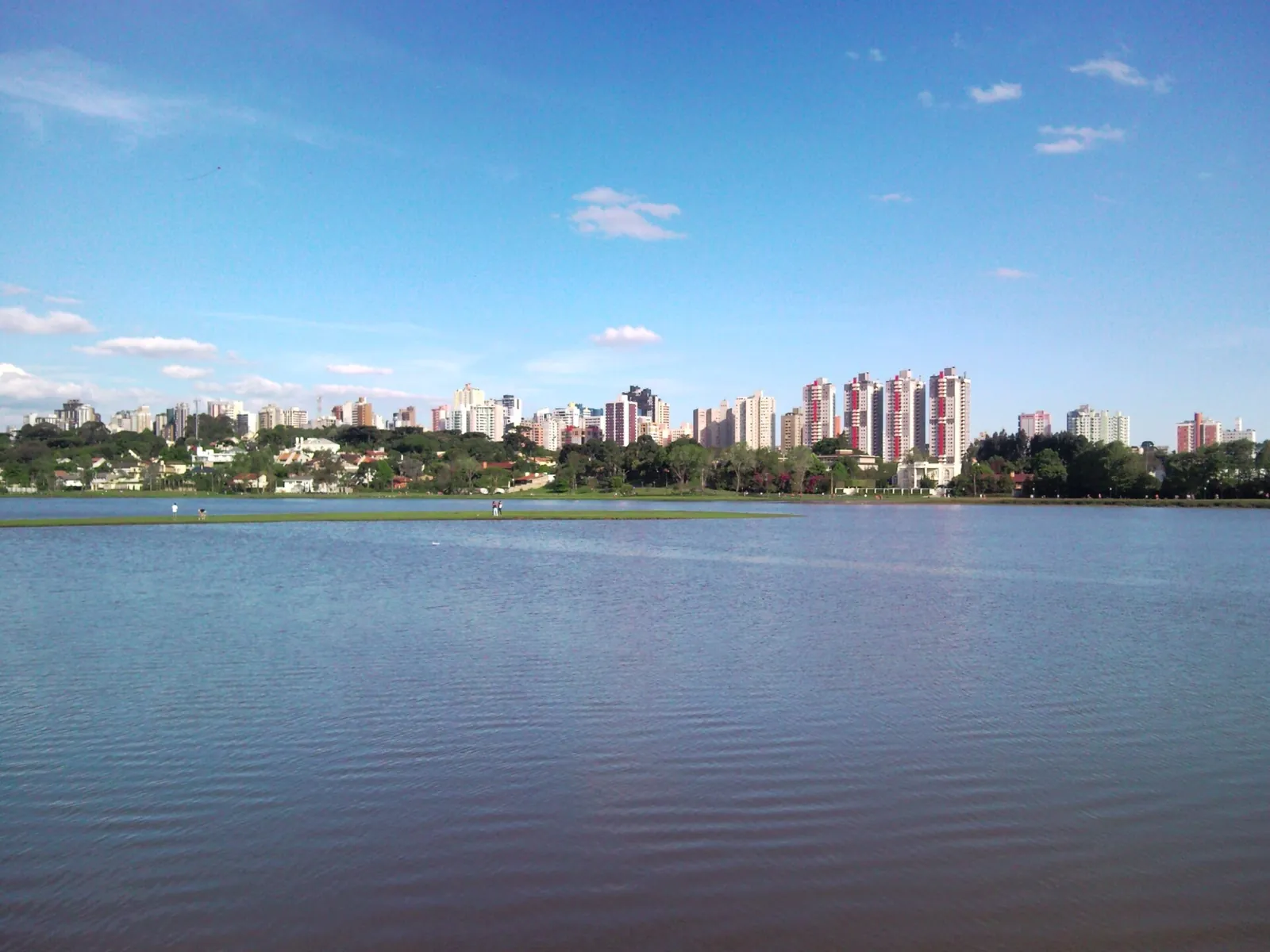
The lake at Parque Barigui, one of the parks that also help hold floodwater.
INMET's 1991 to 2020 normals give July an average high of 20.1°C and an average low of 9.3°C, and Climates to Travel records lows of -5°C in 1975 and -4°C in 2000, with snow in 1975, 2013 and 2020. Those are outdoor numbers. The surprise for a foreign buyer from a cold country is what happens indoors, because most homes have no heating.
A Gazeta do Povo columnist wrote in 2015 that heating is a luxury here and that a home with it is rare. No later count was found, so ask in each building. Aloísio Schmid, a UFPR architecture professor quoted in 2011, named the worst offenders: single-pane glass, concrete slabs and metal enclosures, then thin walls, openings facing south, too much ventilation and oversized rooms. In the southern hemisphere a south-facing room gets little direct winter sun, so orientation is a real cost here, and closed-up cold rooms are where damp and mold tend to start.
What to look at on a visit
Which way the bedrooms face, and how much sun they get in June.
Whether the windows are double-glazed, with sealed frames.
Black spots behind wardrobes and in the corners of top-floor ceilings.
Whether piped gas reaches the unit. Compagás, the state gas distributor, installs individual meters if the building chooses them, and it says 80% of the more than 2,500 units it connected in 2023 were in newly opened developments.
Heated floors. One local developer, promoting its own projects, says the market normally limits them to bathrooms.
Plan for running costs as well. Portable electric heat costs more than it did: Aneel, the federal regulator, approved a residential increase of about 20% in Copel's tariffs from 24 June 2026, with winter about to start. Some new units advertise heating as a feature. That justifies paying extra when the home is for your own use, and less clearly when it is for a tenant.
Crime in published numbers
Curitiba's crime figures depend on who counts. Sesp, the Paraná security secretariat, recorded 118 intentional homicides from January to September 2025, against 125 a year earlier. The Anuário 2026 that MySide cites, which uses health ministry mortality data, gives 20.11 killings per 100,000 in 2025 and ranks the city eighth on its safety list among those with over a million people. Paraná as a whole recorded 9.9 intentional homicides per 100,000 in 2025, by Sesp's count, against a national 14.62 on the federal Sinesp system. Police counts and mortality-based counts measure different things, so never compare one city's police number with another's health number.
Property crime is falling in the same data. Comparing the first nine months of 2024 and 2025, robberies went from 5,389 to 4,537 and vehicle thefts from 2,475 to 1,449, while common thefts barely moved, from 35,301 to 34,540.
Where it happens
Sesp's January to May 2025 data, as reported by Bem Paraná, names the ten neighborhoods with the most homicides: Cidade Industrial, Sítio Cercado, Tatuquara, Cajuru, Alto Boqueirão, Centro, Pinheirinho, Umbará, Parolin and Prado Velho. Batel, Água Verde, Bigorrilho, Cabral and Mossunguê are all absent. For crimes against the person, which include assault, threats and domestic violence, raw counts mislead because populations differ. So the table divides by the 2022 census population. This is our arithmetic, not Sesp's.
Crimes against the person, January to May 2025
Neighborhood
Reported
Residents, 2022
Per 1,000 residents
Batel
205
9,913
20.7
Centro
787
38,671
20.4
Bigorrilho
212
25,590
8.3
Cabral
96
13,723
7.0
Mossunguê
79
12,246
6.5
Água Verde
289
49,573
5.8
Batel's figure is likely inflated by its small resident base and by the many visitors drawn to its bars and malls, so it may say more about venues than about home life. Spend a late evening on the street before you decide. MySide also says Centro leads the city in thefts and robberies, without giving numbers.
Health care, schools, shopping and foreign residents
Hospitals. Newsweek's 2026 hospital ranking places three Curitiba general hospitals among its Brazilian entries: Pilar Hospital, Hospital Santa Cruz and Hospital São Marcelino Champagnat. According to MySide, Hospital Pequeno Príncipe is a national reference in pediatrics. Gazeta do Povo reported in January 2025 that Hospital Universitário Cajuru holds ONA Level 3, the top accreditation, while serving only public-system patients. Private care runs on health plans, with costs set out on the budget page.
Schools. The International School of Curitiba, in Santa Felicidade, teaches in English and offers the IB Diploma, per the OpenApply directory, which gives no tuition. The school's own site directs families to an admissions brochure for fees. Colégio Positivo near the Universidade Positivo in the west also holds IB certification, according to MySide. Local guides name Colégio Bom Jesus, Colégio Sion and Colégio Marista Paranaense among the private schools. In general, a long school run at rush hour can undo an otherwise good choice of neighborhood, so visit the school first.
Shopping. Trade press places Festval supermarkets in Batel, Água Verde, Bigorrilho and Cabral; a current store count by chain could not be opened. Main malls include Pátio Batel, Shopping Curitiba, Shopping Crystal, Shopping Água Verde and Park Shopping Barigui.
Foreign residents. Tribuna do Paraná counts about 19,700 residents from other countries, fifth among state capitals, with Venezuelans the largest group at over 7,000. Our research found no English-speaking expat quarter, so plan on Portuguese for daily life. The residency guide and the investor visa guide cover the route to staying, and the R$ 1,000,000 threshold applies here. To drive, see the license guide.
Work. The IBGE put third-quarter 2025 unemployment at 4.3%, and the city added 28,597 formal jobs from January to November that year, fifth among Brazilian cities. Ipardes, the state statistics institute, counts 57,019 formal jobs in technology-related work, as reported by Bem Paraná. That labor market is the tenant base for most of the apartments in this guide.
When to visit and what each season hides
The climate is subtropical with real seasons. INMET's normals give January and February highs around 27°C with lows near 18°C, and rain of 226 mm in January and 189 mm in February. August is the driest month at 81.5 mm. The year totals 1,631 mm, so no season is dry enough to ignore a leak.
A summer trip is the flood test. December to March brings afternoon storms, and that is when you learn whether a garage or street takes water. A winter trip, from June to August, is the comfort test: stand in the bedrooms at 7 a.m. and look at the walls. Spring and autumn are pleasant and tell you less, though September and October carry 143 mm and 161 mm of rain. Short-stay revenue peaks in December and July, per BNBCalc, and hotel occupancy reached 90% in October 2025, so book early for a trip built around viewings. If your family will not accept these winters, compare Florianópolis. If you like the cold and want a place with tourism income, compare Gramado.
Press a month
JFMAMJJASOND
Bars show rain. INMET 83842 Curitiba, 1991-2020. Source.
Flights, buses and roads
Airport. Afonso Pena International (CWB) is in São José dos Pinhais, 18 km out of town by the Melhores Destinos guide. It handled 6,082,391 passengers in 2025, up over 7%. International service is thin. As of November 2026, flight-schedule data shows nonstop service to Buenos Aires Aeroparque on Aerolíneas Argentinas, Santiago and Lima on LATAM, and Lisbon on TAP. The airport and airline pages we tried did not confirm these routes, so check each route before you plan around it.
Lisbon is the headline. TAP's first flight landed on 2 July 2026, the first direct link between Paraná and Europe, three times a week on an Airbus A330-200. The inbound flight is nonstop, but the flight back stops about 90 minutes at Galeão in Rio, with passengers staying on board, because the main runway at Afonso Pena is 2,218 m long and limits takeoff weight. Azul cut its Asunción and Montevideo routes from March 2026. Panama is only a possibility: the state tourism body says talks with Copa are advancing and a route could start in 2027, Copa declined to comment, and schedule data shows nothing now. JetSMART began seasonal Santiago flights in June 2024 and announced a Buenos Aires route that year. Schedule data now shows no Ezeiza service and names only LATAM on Santiago, so JetSMART's current status could not be confirmed.
A third runway of 3,000 m by 45 m, an R$ 800 million project, received its installation license on 31 July 2026, announced on 10 August. It is meant to let long-haul flights leave with more fuel from an airport 911 m above sea level. Tribuna do Paraná says delivery had been planned for December 2026 and that works had not begun when the license came, and an operating license is still required, so do not count on a date.
Getting to the airport. Line E32 runs every 20 minutes from 5:40 a.m. to 11:20 p.m., since March 2026, between the airport and Terminal Boqueirão via the central terminal, mostly in bus lanes. A VLT light-rail link from the airport to Centro Cívico is mentioned in the new bus tender, expected only from 2031 at the earliest.
Buses. Curitiba has no metro. Its bus rapid transit network, with exclusive lanes and raised tube stations, is why the zoning map looks the way it does. The fare is frozen at R$ 6.00 for 2026. Two large changes are under way. First, a 15-year tender for the whole network, split into two BRT lots and three regional lots, with R$ 3.9 billion estimated investment, proposals due 17 November 2026 and the B3 auction on 26 November. It promises time-based transfers across all lines and 245 electric buses in the first five years. A court challenge was filed on 31 August, with no ruling on suspension in the report we read, so the dates could move.
Second, the Leste-Oeste BRT works, funded with US$ 75 million from the New Development Bank, cover about 20 km of bus lanes, 34 stations and five terminals, with new facilities planned at Campina do Siqueira. Work began on Avenida Affonso Camargo in September 2025, and the rest of the Avenida Sete de Setembro stretch was scheduled for early 2026. We could not read the city's notices on Avenida Deputado Heitor Alencar Furtado and Rua Padre Anchieta, so the timing there is unconfirmed. If you are buying on those streets in Ecoville or Bigorrilho, ask the city for the schedule and how works would change access to the garage.
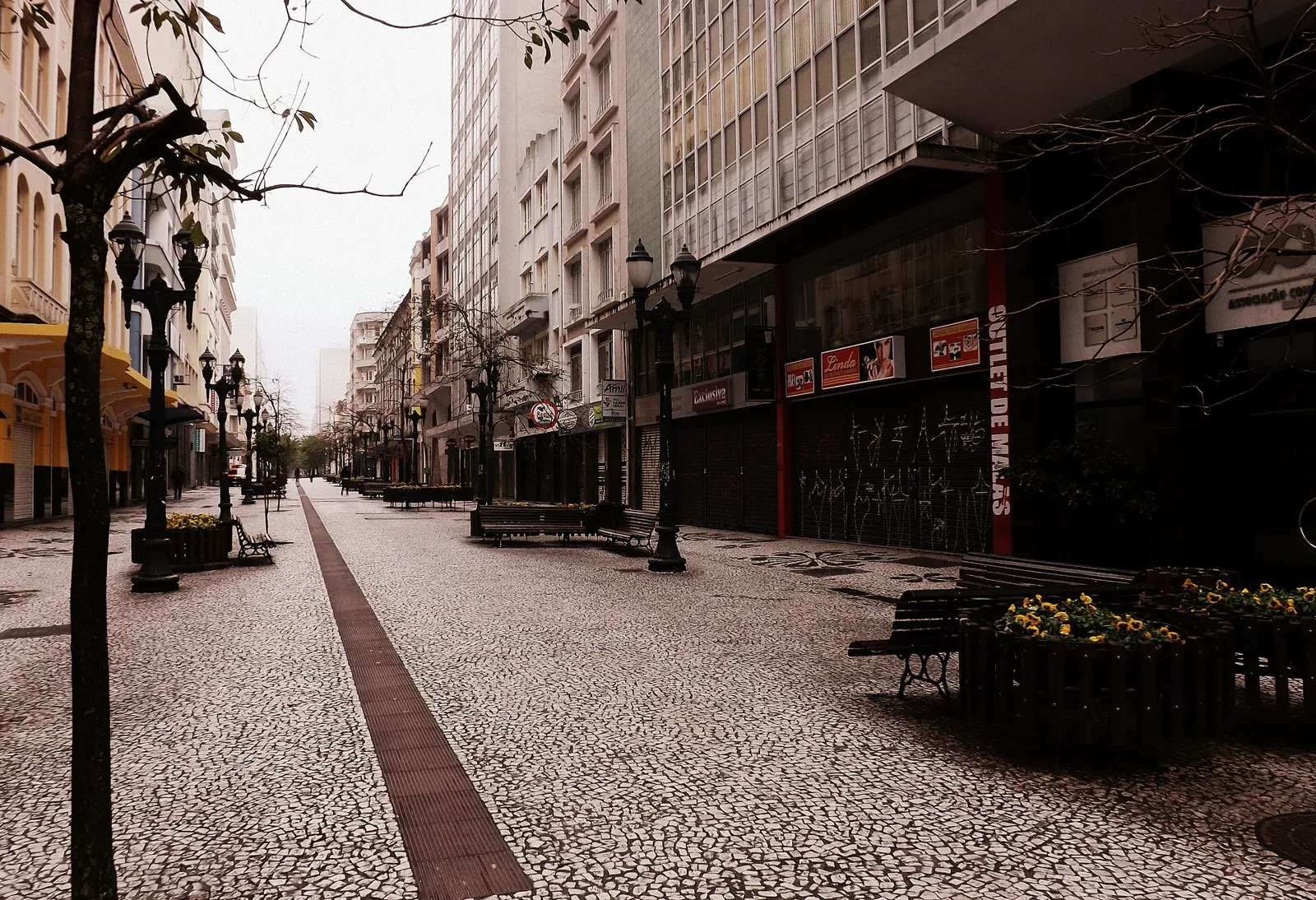
Rua XV. The Rua XV de Novembro was closed to cars on 20 May 1972, the first such street in Brazil, and Ippuc has estimated that about 140,000 people walk it daily. Research for this guide found no current proposal to bring cars back. The live question is the Centro revival program described in the next chapter.
The master plan. The city sent its Plano Diretor revision to the council on 2 July 2026 as bill 005.00285.2026, which would repeal Lei 14.771 of 2015. No vote date could be confirmed. The final text and any zoning follow-up could change what can be built on your street. If you are paying for development potential, ask an architect in Curitiba what the bill says and hold the purchase price to what today's law allows.
Curitiba de Volta ao Centro. This program, announced in November 2025 and regulated in March 2026, offers incentives of about R$ 163 million through 2032 for the central area: R$ 133 million in tax breaks and R$ 30 million in subsidies. It covers the central region, the historic center, part of São Francisco and the bus station area, with priority on the Rua XV mall and the Teatro Guaíra, São Francisco and Jaime Reis circuit. As announced, retrofit and restoration work under way gets full IPTU relief until 2028, restored UIPs and social housing get it to 2032, and residential, mixed-use and hotel properties get a 50% cut in the tax base to 2032. The city received 47 subsidy proposals worth R$ 268 million, but a report of 15 October 2026 says no project under the construction rules has been approved yet, and one early showcase, the expropriated Edifício Pires, has changed purpose several times and has no defined future. So the program is real and the results are still to come. Do not pay today for a transformation of Centro.
Heights. The lower airport ceilings described above, in force on lot reports since April 2026, can cut what a tall project can do. Property tax. The assessment reset and cap run through 2029. Rates. The Selic has fallen from 15% to 13.75%, so financing may change the market before prices do. Power. Copel's roughly 20% residential rise is already in bills. Tax reform. The national change to CBS and IBS begins phasing in; see what the rental tax guide says so far.
Rua das Flores, the pedestrian stretch of Rua XV de Novembro.
Your buyer probably needs a mortgage, since 69.2% of Curitiba deals involved financing in the figures reported for early 2026. That makes the bank's valuation a real limit on your resale price, and it rewards homes that are simple to finance: clean title, regular building and no unregistered additions. It also narrows the pool. A Loft simulation in October 2025, with the Selic at 15%, put the monthly income a bank would want for an average listing at about R$ 47,700 in Água Verde, R$ 60,600 in Bigorrilho and R$ 99,800 in Batel.
No published average time to sell was found. Two indirect signs help. Inpespar's sales-to-offer index for used residential property reached 4.3% early in 2026, led by two- and three-bedroom apartments, which suggests where the depth of demand is. And A Corrida dos Bairros reports that 75% of the Água Verde apartments listed in the prior month were still listed a month later, with stock up 13.8% in a month. Those are listings, not sales, but they do show that a home does not sell overnight.
The long history is worth reading. FipeZAP's Curitiba series ran at or below 5% a year from 2014 to 2019 and went negative at the end of that stretch, after a 37.3% rise in 2013. Prices then nearly doubled in the years after 2019. Plan on the possibility of another flat period and do not assume you will exit on a schedule. Larger family apartments and compact units serve different pools of buyers, as the listing-size table shows, and a very large unit that carries a R$ 1,800 fee has fewer takers when rates are high.
For a foreign owner, the steps are in the selling guide, including capital gains and the procurador, a representative in Brazil. Sending the proceeds home follows the same channels you used to bring money in, so keep the original Banco Central records. Whether a 3.5% IOF applies to sending proceeds abroad is unsettled, so put the question to your bank and lawyer at the time. If you can list without a broker, Brazil Keys takes owner listings for free, and the owner-sale guide explains what a buyer will ask of you.
What goes wrong in Curitiba
Paying land value for a lot you cannot build on
Sellers of old houses on ZR4 streets often price the development potential. A UIP listing, a protected wood, a drainage strip or the new airport ceiling can each remove it. Pull the Consulta Informativa de Lote and have an architect read it before you negotiate.
Buying a heritage unit as if it were an ordinary old house
Do not treat a UIP as a teardown. Destroying one brings penalties under the 2016 law, and how the courts now treat these cases could not be verified for this guide, so take that question to a lawyer. Restoration needs a permit and CAPC approval, and any building potential is released in stages. Ask the city's urbanism office directly whether the address is listed.
Forgetting winter when you read a floor plan
A bright-looking south-facing apartment in January can be dark and cold in July, and heating is rare. Visit in winter or ask the current owner for June and July power bills, and check for damp behind furniture.
Trusting a dry garage on a dry day
Garages in Água Verde flooded in 2018, and the Barigui gauge logged 73 mm in the September 2026 event. Ask for building minutes on pumps and water damage, and ask neighbors, not only the seller.
Budgeting yield from a neighborhood average
Small units show yields above 7% in some listing data and large ones about 3% to 4%, with fees of up to about R$ 1,800 a month in Batel. A gross yield says little until you take out the fee, IPTU, vacancy and tax on your own unit.
Assuming short lets are allowed because others do it
The STJ has stopped condominium short-let cases nationwide while it decides the question, and Curitiba has a bill whose status could not be confirmed. Get the convention and minutes, and put the question to the síndico, the building manager, in writing.
Reading a low IPTU bill as permanent
The city rebuilt its values from market data for 2026, and the city says an increase can reach 18% plus inflation a year through 2029. Ask for the current assessment and project it forward, particularly on a large unit in a district that rose quickly.
Buying on a BRT works street without seeing the plan
The Leste-Oeste rebuild is under way on some corridors, and timing for others, including Rua Padre Anchieta, could not be confirmed here. Ask the city how lanes, stops and garage access will change, and check whether the building has a commercial tenant that depends on the curb.
Questions about buying in Curitiba
What is the average price per square meter for an apartment in Curitiba?
R$ 11,766 on average, per FipeZAP for September 2026, with Batel at about R$ 17,575 and Água Verde at about R$ 12,500. These are asking prices. See the market index for current listings.
Why did Curitiba's prices stop rising in 2026?
No single cause is documented. Prices rose 18% in 2024 and 9.08% in 2025, rates were high, and most deals need a mortgage. Rents kept climbing, up 8.94% while prices rose 1.86% over the same 12 months.
What rental yield is realistic in Curitiba?
The index puts long-term gross yield at 4.92%, among the lowest of the big capitals. Costs come out of that. Small apartments show higher asking yields than large ones.
What ITBI rate applies in Curitiba?
2.7%. Reduced rates for financed homes stop at R$ 220,000, so a home at R$ 1 million pays R$ 27,000 whether or not there is a loan.
Are notary and registry fees high in Paraná?
They are low even at the high end of the market. The newest state table we could open, from December 2023, tops out at about R$ 2,600 for the two together, plus a 0.2% Funrejus charge, so get a current written quote.
Does Curitiba have flood risk?
Yes, along the Belém, the Barigui and their tributaries, and in low streets even in good neighborhoods. Water entered garages in Água Verde in 2018. Check the official maps and ask the building.
How cold does Curitiba get, and do apartments have heating?
July averages a low of 9.3°C, and frost and rare snow happen. Most homes have no central heating, so sun exposure and windows matter a lot.
Can I tear down an older Batel house and build on the lot?
Only if it is not a preservation unit and the zone, trees and drainage strip allow it. About 650 buildings hold UIP status, and destroying one brings penalties under the 2016 law.
Are short lets legal in Curitiba?
No municipal ban was found, and the status of a bill capping stays and requiring registration could not be confirmed. Your building's convention may still restrict them, and the STJ is now deciding what a residential clause means.
Can I fly directly to Curitiba from the US or Europe?
Schedule data shows no Miami route, so plan on connecting from the US. TAP flies from Lisbon three times a week, and the flight back stops in Rio for fuel. Other nonstops are to Buenos Aires, Santiago and Lima.
Does Curitiba have a metro?
No. It runs bus rapid transit in exclusive lanes with tube stations, and the fare is R$ 6.00 in 2026. A tender for the whole network is scheduled for November 2026, though it faces a court challenge.
How much must a Curitiba purchase cost to qualify for the investor visa?
R$ 1,000,000, since Paraná is outside the North and Northeast band. Paperwork is covered in the visa guide.
We use cookies, including Google Analytics, to understand how visitors use this site. You can accept or decline non-essential cookies. See our Privacy Policy.