Secovi-DF's median resale was R$ 13,630/m² in December 2025, while FipeZAP read only R$ 9,354/m² in September 2026, so expect wide variation by band and building.
SQS 108 to 116: Standard six-floor blocks of the 100 band, with shared green space and local strips.
SQS 208: Named in a 2012 court case on garage grilles; a useful reminder to ask any block about its ground floor.
SQS 408 to 413: JK and IAPI blocks of three floors without open ground floors.
CLS 105: A typical local shopping strip, with Oba Hortifruti at Bloco C.
W3 Sul: Bus corridor and commercial avenue on the west; flood complaints and noise, with row houses behind it.
FipeZAP (R$ 12,706/m² in September 2026) and Secovi-DF (R$ 12,644/m² in December 2025) agree closely here, unusual for this city, and rents run near R$ 67 to R$ 72/m².
W3 Norte: Long commercial and bus avenue; crossed by the new drainage tunnels near the wing's start.
L2 Norte: One of the wing's main avenues on QuintoAndar's page, crossed by the new drainage tunnels.
SQN 402: A double-superquadra block designed in 1972, among the later ones in the 400 band.
SQN 413/414: Designed in 1975, the last double superquadra, close to Parque Olhos D'Água.
SHCGN 706: Row-house band, with an Oba Hortifruti at Bloco B.
No index covers Lago Sul; Secovi-DF named it the district's highest house price at R$ 4.5 million in 2023 and in December 2024 put house rents near R$ 17,000 a month.
QL 6: First-row lots on the lake; named among those still to be cleared in 2017 and in the 2020 replanting.
SHIS QL 12, conjuntos 11 to 18: Special land-use line allowing 80% coverage, unusually high here.
QI 7: Inland block with Hospital Daher.
QI 11: Local strip with restaurants and Deck Brasil.
QI 21: Inland block holding the main campus of The School of the Nations.
A boot-shaped peninsula of family houses, with apartments in its activity center, a shopping mall, cleared shore and more unfinished title than Lago Sul.
FipeZAP read R$ 11,647/m² in September 2026 and Secovi-DF's apartment median was R$ 11,792/m² in December 2025; houses, most of the stock, rented near R$ 11,000 a month in December 2024.
SHIN QL 13: Lakeside block with the SARAH center.
SHIN QL 16: Among the first built, next to the Clube do Congresso.
SHIN QI 2, 4 and 6: The earliest inland blocks, from the 1960s.
CA 4 and CA 7: Centro de Atividades blocks left out of the 1993 revision because they had already been sold.
CA 5: Where a 2002 law allowed condominium buildings of small joined apartments.
A planned apartment district from the 1990s beside the Plano, with the highest index price in the district, many single-person homes and strict no-fence rules.
FipeZAP's R$ 14,672/m² for September 2026 is the top reading in its Brasília list, and Secovi-DF's R$ 14,805/m² median for December 2025 sits behind only Noroeste and Park Sul, far from the citywide average.
SQSW 100 and 300 series: The six-floor superquadras, on open ground floors with no fencing.
SQSW 302: Block with Oba Hortifruti close to hand.
SQSW 303 and 304: Residential quadras shown in the district's study.
QRSW: Three-floor blocks on open ground floors, with their own local strips.
CLSW: Local shopping strips of up to three floors.
Suits
Long-term landlords chasing government and diplomatic tenants
Families that rely on an international school and embassy access
Owner-occupiers who want a walkable superquadra with shops downstairs
Investor-visa buyers who want a registered apartment in a capital
Look elsewhere for
Anyone after a beach or a holiday home
Short-let income plans that assume high-season peaks
Buyers unwilling to check Terracap title in the outer condominiums
People who will not own a car
Brasília prices and rents as of late 2026
FipeZAP put the average asking price in Brasília at R$ 10,453/m² for September 2026, near US$ 1,930/m², after a rise of 0.81% in the month, 6.74% so far in the year and 9.80% over 12 months. Among the capitals in the index that is the seventh-highest level and the fifth-largest 12-month gain. The reading rests on 3,646 listings, so it measures what sellers ask, not what buyers paid.
The longer series matters more than the headline. Brasília rose 14% in 2011 and then fell in every calendar year from 2014 through 2019, with the worst year at 2.72% down in 2017. It gained just over 9% in both 2020 and 2021, slowed to 1.31% in 2022, and has picked up each year since: 2.24%, 3.71% and 4.05% in 2025. Someone who bought in 2013 sat through six straight years of small nominal declines before inflation is counted. This market has been called stable for a long time, and stable has included that.
Rents tell a different story. FipeZAP's rent index stood at R$ 53.84/m² a month in September 2026, up 8.34% over 12 months, which it turns into a gross yield of 6.20% on long leases, a shade above the 6.13% average of its 36 cities. Annual rent rises ran at 9.15% in 2022, 11.37% in 2023 and 14.56% in 2024. The local landlords' union, Secovi-DF, measured an even larger 26.19% rise in 2024 with its own index. The last two monthly readings point the other way: rents fell 0.79% in August and 0.53% in September 2026, and Brasília was one of only three capitals to drop in September. Two months do not make a trend, but a buyer should not assume the 2024 pace continues.
What drives it
A 2025 report on Secovi-DF's bulletin gave several reasons for the 2024 jump: scarce high-value homes in the listed central areas, demand above supply there, tenants such as embassies, international bodies and companies from other states renting for staff, post-pandemic leases coming up for renewal after the usual 30 months, and lower unemployment. In its review of 2025 the union added that some households who put off buying moved into renting, which pushed rents up most in the established districts. The same union counted R$ 20.70 billion of resale volume in 2024, up 14.5%, across a stock IBGE puts at 1,172,588 homes, of which the union says about 29% are rented.
New supply goes where the heritage rules leave room. Secovi-DF counted 46 launches by the end of September 2023, led by Setor Noroeste with 10, Águas Claras with 9 and Samambaia with 6. Launch prices in the Plano Piloto that year ran from R$ 17,028/m² in Noroeste up to R$ 24,526/m² in Asa Sul. No newer count of launches by district was found.
How it sits against other capitals
At these levels Brasília costs less per square meter than Curitiba at R$ 11,766 while yielding more, since Curitiba's gross yield is 4.92%. São Paulo, where sellers ask R$ 12,206, yields 6.43%, so the yield gap there is small and the price gap is the point. A buyer whose goal is a beach has no reason to be here: Natal asks R$ 6,465 with an 8.03% yield. People look at Brasília for tenants and for government work, not for a holiday home.
FipeZAP sale index, September 2026 report. 2026 is the 12 months to September. Inflation is not removed.
Two wings, two lake shores and a long way out
The Federal District covers 5,761 km² and held 2,817,381 people in the 2022 census, but the Brasília a foreign buyer pictures is a small part of it. It is divided into administrative regions and not municipalities, and one district government collects both state-level and city-level taxes. The Plano Piloto region counted 221,326 residents in the 2018 district household survey (PDAD), well under a tenth of the total: 115,703 in Asa Norte, 78,640 in Asa Sul, 10,871 in Noroeste and the rest in scattered sectors.
The federally listed area is a defined perimeter of 112.25 km²: the west shore of Lake Paranoá on the east, the EPIA highway on the west, the Vicente Pires stream to the south and the Bananal stream to the north. Inside it are Asa Sul, Asa Norte, Sudoeste, Noroeste, Cruzeiro and the Octogonal. Lago Sul and Lago Norte, on the far shores, sit outside the perimeter but inside what the district's planners call its zone of influence. That difference decides which rulebook applies to your home.
Reading an address
Few homes here have a street name. "SQS 308, Bloco B, apartamento 204" means South superquadra (a residential super-block) number 308, building B, unit 204. SQN is the north equivalent. CLS and CLN are the local shopping strips, SHS and SHN the hotel sectors, SGAS and SGAN the sectors for institutions and large facilities, and SHIS and SHIN the individual-housing sectors of the two lakes. The superquadras are numbered 102 to 116, 202 to 216, 302 to 316 and 402 to 416, and the number tells you where you are. Learn this before you read a listing, because the first digit often tells you the building type, as the next chapter explains.
Beyond the plan
Outside the listed area, prices fall quickly. FipeZAP's September 2026 readings put Águas Claras at R$ 9,289/m², Taguatinga Sul at R$ 6,635, Ceilândia Sul at R$ 5,036 and Sobradinho at R$ 4,434. Lago Sul sits some 8 km from the Plano, reached by three bridges: Garças (1974), Honestino Guimarães (1976) and JK (2002). Most people on the lake shores work across the water: in 2018, 65.3% of Lago Sul's workers and 69.4% of Lago Norte's worked mainly in the Plano.
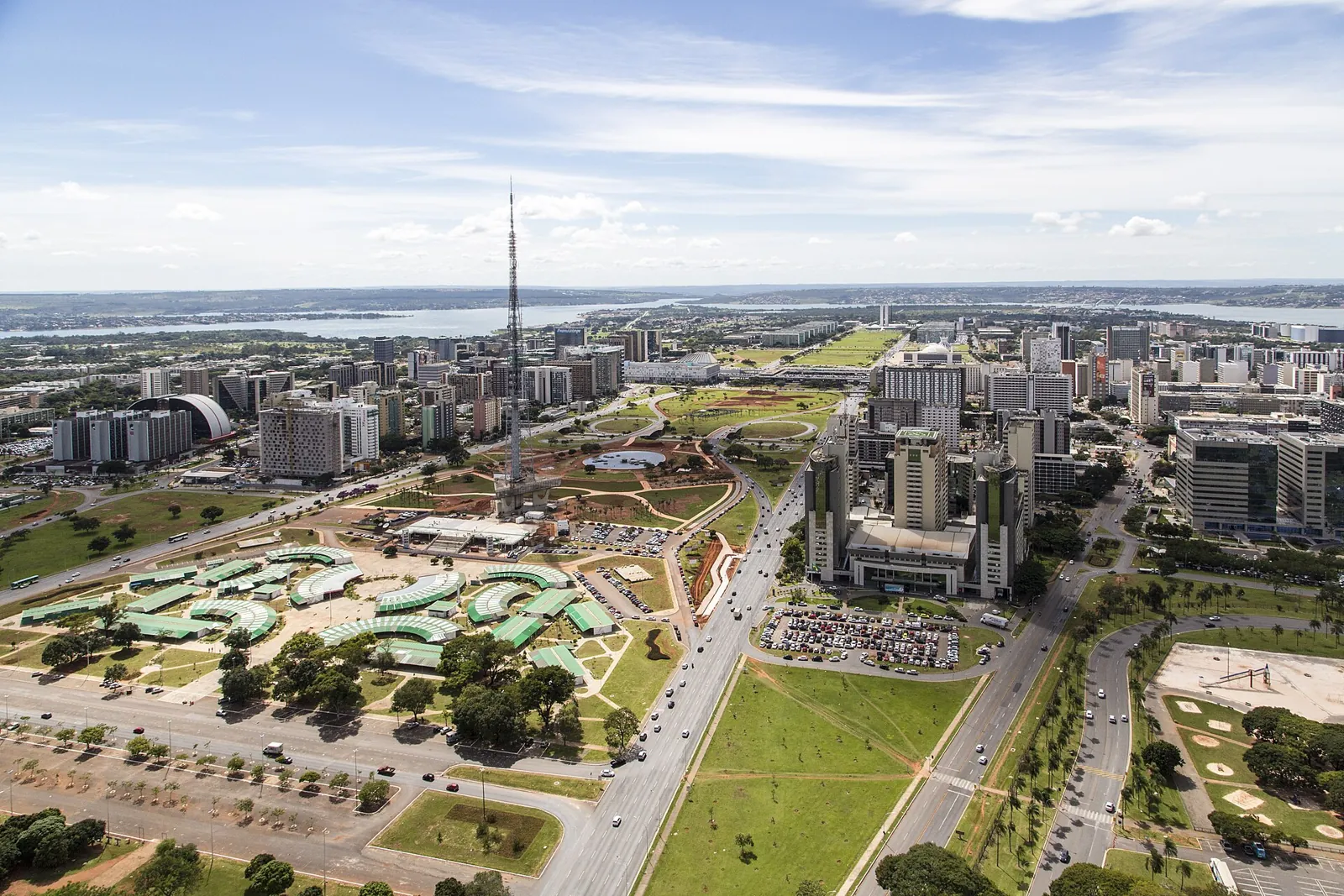
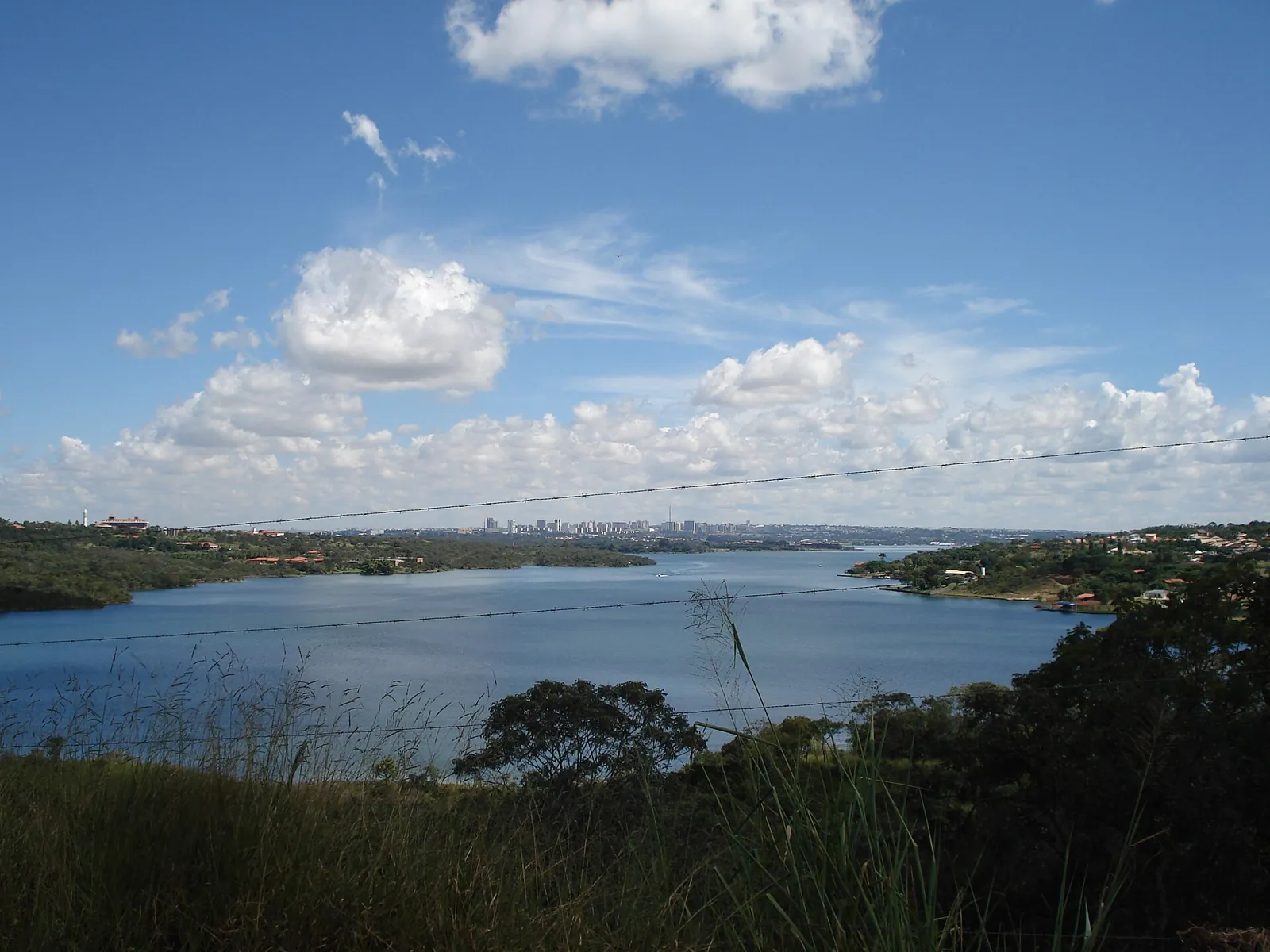
The Eixo Monumental with the TV mast at the center and the lake on the horizon.
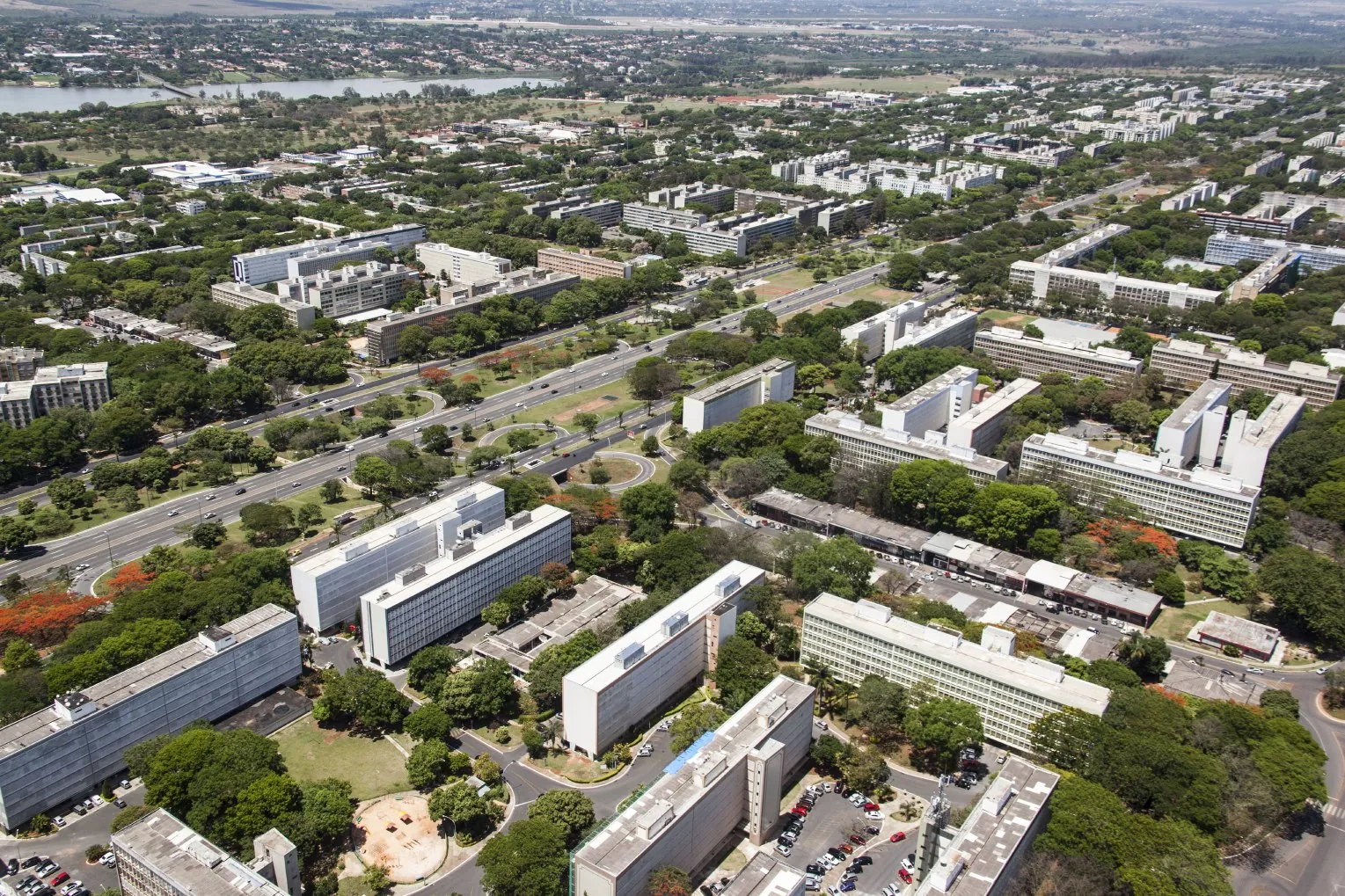
Most of the central stock rests on an idea foreign buyers rarely meet. Brasília's 1960 building code created the projeção, a perimeter that holds a building's facades, while the ground floor stays in the public domain. So you are buying a unit in a block on stilts, with no private land around it. The grass, the trees and the space under the building are public, and nobody in the block can fence them.
What the first digit tells you
Building types in the central area, from federal heritage rules and a 2025 architectural study
Sector
Floors
Typical features
Superquadras 100, 200, 300
Up to 6 on pilotis (ground-floor columns), 23 m
The standard block; the 1960 code required basement garages
Superquadras 400
Up to 3, 12 m
Smaller units, no elevators, garages or service entrances in the original design
JK and IAPI blocks, SQS 408 to 413
3
No open public ground floor
700 series houses
2, 8.5 m
Row houses, some now reaching 400 m²
Sudoeste SQSW / QRSW
6 / 3
Occupation of the ground floor up to 40%
Noroeste SQNW
6
Occupation of the ground floor up to 40%
The 400 series is the trap and the bargain. A 2025 study in Revista Docomomo Brasil explains that the 1960 rule on basement garages and the 1967 rules on minimum size (40 m²) and separate service elevators were not applied to these blocks, which is why they became the Plano's more popular housing. They were built over a long stretch: SQN 402 was not designed until 1972 and SQN 413/414 until 1975. Individual blocks differ, so check the unit. A third-floor walk-up without parking serves a student tenant well and an older owner badly.
Outside the plan
The lakes are houses: 98.9% of Lago Sul homes in 2018 and 76.5% in Lago Norte, where 20.2% were apartments and the law allows apartment buildings in parts of the Centro de Atividades (CA). In Sudoeste and the Octogonal the same survey found 93.5% apartments and 5.7% studios, known as kitnets. Across the whole district, FipeZAP's profile counts 338,000 apartments among 988,000 households. The contrast is Águas Claras, planned for 8 to 12 floors, where some buildings now reach 30, according to a 2024 Correio Braziliense report.
Monthly fees
The only published ranking found comes from Loft, using 256 listings in July 2025, so read it as a rough guide. It gave an average condomínio (the monthly building fee) of R$ 494 across the district, R$ 890 in Asa Norte, R$ 670 and R$ 650 in the two halves of Águas Claras, and R$ 556 in Asa Sul. As a general observation, blocks from the 1960s and 1970s face pipe and facade bills that newer buildings do not, so get three years of meeting records; the guide on condomínio charges shows how to read them.
UNESCO listed the urban ensemble in 1987, and the working federal rulebook is IPHAN Portaria 166 of 2016 (IPHAN is the federal heritage institute). It protects the plan and its scale, not the look of your kitchen. The rules that reach an owner in a superquadra are specific, and they are in article 32.
No extra floors: six in the 100, 200 and 300 series and three in the 400 series, with 23 m and 12 m as ceilings, plus a small allowance for tanks and machinery.
The ground floor stays open and public. No barriers of any kind, and the text names hedges.
Up to 30% of the ground floor may be closed, in separate pieces, only for lobbies, caretaker rooms, technical rooms and shared uses. The same 30% limit applies to the roof.
Railings or planters on the ground floor only where there is a risk of falling, at most 1.20 m high and at least 75% see-through.
Underground garages may go beyond the block's footprint only if they do not reduce the superquadra's green area, apart from access ramps.
No advertising in the superquadras, except signs at building sites.
Sudoeste has its own article and a looser 40% limit on the ground floor and roof, but article 73 bans fencing there as well. Article 85 sets who decides: projects go to the district government, and IPHAN must review only those that change use, height, occupation, floor-area ratio or setbacks, along with changes to main roads, lot lines, kiosk and advertising plans and signage, though it may call in anything else it chooses.
How it plays out
The cases are about ground floors. In 2012 a district court upheld the enforcement agency against Bloco E of SQS 208, ordering grilles around the garage removed and demanding a permit for a party room built under the block. The judge wrote that urban violence does not justify taking over public space. In 2022 Jornal de Brasília found cars parked under blocks in 104 Sul and in 110, 111 and 113 Sul; the enforcement body DF Legal said cases without permission had gone to court. Each of these becomes a cost shared by every owner in the block. When you visit, look for gates, closed party rooms and parking under the pilotis, then get the permit and the meeting records from the síndico, who manages the building.
The 2024 plan and the unfinished fight
Complementary Law 1.041 of 12 August 2024, known as the PPCUB, gathered the urban rules for the Plano Piloto, Cruzeiro, Candangolândia, Sudoeste/Octogonal and the graphics sector into one 782-page text. It took 174 amendments in the legislature and 63 vetoes from the governor. It regularized residential use in the upper floors in SHCN and in parts of SEPS 700/900, SEPN 500 and SGAS/SGAN 900, and widened permitted uses in the local shopping strips. IPHAN said it had never guaranteed that the plan would not endanger the UNESCO title, and that its technical staff would check the text against Portaria 166. The district prosecutors said in July 2024 they would challenge the law in court. Whether that suit was filed, and any ruling on it, could not be confirmed; the court's list of laws halted by injunction, updated 31 August 2026, does not include this one, though that list would not show a pending case.
A further amendment is now stuck. A court injunction of 28 September 2026, sought by the prosecutors, stopped the public hearing set for two days later on a draft touching 53 of the plan's lot-by-lot parameter tables. The government must call a new hearing after the election with at least 60 days' notice. So a lot's permitted use can sit under two rulebooks that may not fully agree, and an owner relying on a new use should have a lawyer read both. As a general observation, a sale of an ordinary apartment is not part of this: article 85 deals with projects, and nothing in it calls for IPHAN to sign a deed.
Two published series cover Brasília by district, and they disagree sharply in places. FipeZAP's September 2026 report lists ten regions. Secovi-DF publishes a median resale price from its own data. QuintoAndar's rent index adds a third view of rents.
The big one is Asa Sul. FipeZAP's R$ 9,354/m² sits 31% under Secovi-DF's R$ 13,630 for much the same streets, and FipeZAP's rent of R$ 41.4/m² is far below QuintoAndar's R$ 67. It would make Asa Sul cheaper than Asa Norte, the reverse of Secovi-DF's order. FipeZAP states that it does not release detailed price tables by zone or neighborhood, so the cause cannot be proved from the report. As a general observation, a sample heavy in old 400-series walk-ups would pull an average down this way. The same caution runs the other direction for Sudoeste's FipeZAP rent of R$ 89.8, well above the other reading. Use district figures to rank areas roughly, and price a specific unit from recent sales in that block.
Secovi-DF's ranking also corrects a common claim. Asa Sul is often described as the top of the apartment market. On these numbers Noroeste, Park Sul and Sudoeste all stand above it, and Sudoeste is far above the city average.
Lago Sul has no index figure at all: FipeZAP lists no reading for it, and nearly every home there is a house. The nearest published data point is Secovi-DF's report of Lago Sul as the highest house price in the district, a 2023 figure of R$ 4.5 million from an article that does not say exactly what the figure measures. Loft's July 2025 average asking prices, from 1,800 listings, give another angle by ticket size: Noroeste R$ 2,179,159, Jardim Botânico R$ 1,544,682, Vicente Pires R$ 1,345,875, Asa Sul R$ 1,335,216, Asa Norte R$ 1,300,998 and Águas Claras about R$ 800,000. The second and third of those are areas where title is often unfinished, which is the subject of a later chapter.
Secovi-DF's list of 2025 resale gains shows how uneven a year can be: Sobradinho 26%, Asa Sul 15%, Sudoeste and Guará 10%, Asa Norte 9%, Noroeste 7%. Current homes for sale and the asking-price index let you test those numbers against real asks.
Civil servants, embassies and who pays the rent
This is the part of the market that made Brasília's reputation, so it is worth seeing what the numbers show. The district's 2018 household survey asked every household how it holds its home, and it asked workers whether they are statutory civil servants, the tenured public employees who are hardest to dismiss.
Tenure and civil servants by area, PDAD 2018
Area
Homes rented
Homes provided by employer
Workers who are statutory civil servants
Asa Norte
37.6%
7.8%
30.3%
Asa Sul
31.4%
9.0%
24.0%
Noroeste
34.0%
not reported
41.2%
Sudoeste and Octogonal
33.0%
not reported
37.9%
Lago Norte
25.2%
not reported
28.5%
Lago Sul
10.0%
not reported
22.2%
Those shares are older than the rent boom, but they make the point: civil servants are a large minority of workers, not the whole market, and the heaviest concentration is in Noroeste and Sudoeste, not in Asa Sul. Employer-provided homes, close to one in ten in the wings, are a distinct feature. They take units out of the rental pool, and the federal property office also auctions surplus units from time to time.
Secovi-DF points to more than 100 embassies, international bodies and company offices in the central area, and to firms from other states renting staff housing. Its December 2024 figures put a Lago Sul house at about R$ 17,000 a month, Lago Norte at about R$ 11,000, and an Asa Sul house at about R$ 7,000. At the rent levels in the previous chapter, a 70 m² apartment in Asa Norte means R$ 4,700-5,000 monthly, before fees.
What was not found
Sales material often claims that Brasília has Brazil's lowest vacancy. No published residential vacancy figure for the district was found, so treat that as a sales line and ask two property managers how long a unit like yours sits empty this year. Secovi-DF's president said in 2025 that residential leases typically run 30 months, which sets how often you can reset to market. Rules on deposits and guarantors are national, and the tax on your rent depends on your residency: see the guide to rent tax for non-residents. A 2023 Secovi-DF bulletin gave a monthly rent-to-price reading of 0.56% for one-bedroom apartments in Noroeste; that is one old data point, gross of every cost.
Short lets in a weekday city
AirROI counted 2,200 active Airbnb listings in Brasília for October 2025 through September 2026, with an average nightly rate of R$ 317, 41.8% occupancy and R$ 29,125 of revenue per listing. Apartments made up 82% of listings, and 86% were whole homes. The best month in its data was June at 55.4% occupancy and about R$ 5,680, and the weakest was February at 37.5% and about R$ 2,900. That is the reverse of a beach town, and the February slump falls in what would elsewhere be high season. These are Airbnb-only figures from one vendor, so treat them as a starting point.
No district-wide short-let law was found. A committee of the district legislature cleared a bill, PL 1994/2021, in February 2024; it would require licensing, ISS service tax and quarterly reports on guests and nightly prices, with fines up to R$ 5,000. Whether it has moved since could not be confirmed. Building conventions are the working limit here, as they are nationally, and the short-let guide sets them out. Tax on a non-resident's short lets is partly unsettled, including the R$ 600 deduction and how far CBS and IBS will apply above the limits, so get written advice before you count on a net figure.
To estimate for a specific unit, take listings of the same size in the same sector, read their calendars for a working week and a weekend, and add the fee, cleaning and platform costs. No published short-let yield for Brasília turned up, so this guide gives none. The 2024 vetoes of lodging uses in SGAS and SGAN show how contested paid accommodation is inside the listed area.
Short-let arithmetic
Starts from published figures (October 2025 to September 2026 (AirROI, Airbnb listings only)). Set your own.
ITBI, IPTU and the total cost of a R$ 1 million purchase
The Federal District charges 2% ITBI on most transfers, and 1% when a newly built property is transferred for the first time. Those rates come from Lei 7.635 of 2024 and have applied since 1 January 2025, so older pages that quote 3% are out of date. The original law, Lei 3.830 of 2006, set 2%; a tax-office ruling records the move to 3% from 1 January 2016; a one-off cut to 1% ran from January to March 2022. The reports on the 2024 law do not define "newly built", so get the notary's answer in writing before you count on 1%.
The base is where the disputes started. As first published, article 5 taxed the valor venal (assessed value), article 6 let the tax office set it by its own valuation, and a declared price won only if it was higher. Courts pushed back. In November 2019 a district small-claims judge ruled for a buyer in Noroeste who paid R$ 1,057,118.74 for an apartment and was taxed on R$ 1,347,068.15. The court ordered R$ 8,698.48 refunded, holding that the district could override the declared price only if the buyer's documents were omitted or not credible, and that it had not shown its criteria.
Lei 7.794 of 10 December 2025, promulgated by the legislature after it overrode a veto, rewrote article 6. Valor venal now means the cash price the property would bring in normal market conditions. The law presumes the declared value equals market value, and it can be overridden only through a separate administrative process under the national tax code; any valuation must look at the particular case, with no generic reference value set in advance. A June 2026 local guide still described the base as a reference value or the price, whichever was higher, so how the tax office applies the new text today is unconfirmed. Ask the notary. The guide to ITBI and IPTU gives the national position. Buyers pay under article 7, but article 8 makes the seller and the notary jointly liable, so notaries will not move without the receipt. The 2006 text exempts foreign governments acquiring embassy premises or a diplomat's home, and popular housing. Neither it nor the reports on later changes list a general first-home or financed-share discount.
Why registry costs are low here
Notary and registry fees come from a table set under federal Law 14.756 of 2023 and updated each year by inflation through the district court. They top out low: above R$ 1,729,316.79 a deed costs R$ 2,775.56, and above R$ 1,886,527.40 registration costs R$ 2,102.70. The table in force from January 2025 charges R$ 2,439.13 for a deed between R$ 822,211.54 and R$ 1,257,684.94, and R$ 1,598.06 to register a title between R$ 833,216.28 and R$ 1,100,474.32. The 2026 version was not found, so expect slightly higher figures.
Worked example, R$ 1,000,000 apartment bought for cash, 2025 fee table
Item
Amount
ITBI at 2%, charged on a declared R$ 1,000,000
R$ 20,000.00
Escritura (public deed)
R$ 2,439.13
Registration
R$ 1,598.06
Total before certificates and lawyer
R$ 24,037.19, or 2.4%
Compare the fee lines with your home country and with the closing cost guide: the district's deed and registry charges together come to about 0.4% of this price, so the tax is most of the bill. If the unit were new-built and this were its first transfer, the 1% rate would cut the tax to R$ 10,000.
IPTU and the rubbish charge
IPTU, the annual property tax, was unchanged for 2026 at 0.3% of assessed value for homes, 1% for non-residential property and 3% for vacant land or buildings under construction or demolition. The vacant rate is the local sting: a R$ 500,000 lot assessed at that value pays R$ 15,000 a year until a house is finished. A R$ 1,000,000 assessment means R$ 3,000 a year, and the bill also carries the TLP, a separate rubbish collection charge with a reference value of R$ 481.38 for homes in 2026. Single payment earns 10% off if the property has no debts; otherwise up to six installments. The tax office estimates assessed value from location, built area and construction standard, so get the latest bill from the seller and check for arrears.
Terracap, condominiums and land without a deed
This is the chapter that can cost the most money. Across the Federal District, whole neighborhoods of houses, shops and paved streets stand on land the occupants do not own. Many grew out of informal subdivisions, often sold under the name condomínio, and they are now being regularized one sector at a time by Terracap, the district's public land company. A home in one of these areas may look identical to one with a registered deed and cost nearly as much.
How the land got this way
Vicente Pires is the clearest case. Four farms were transferred from the federal government to Terracap in 1972, but the registry never recognized the transfer because the record lacked descriptions of the areas. A term signed in March 2022 finally fixed that. It covers about 22,000 lots, 16,000 of them in Vicente Pires, plus parts of Lago Oeste and Vila São José. More than 100,000 residents were told they would have to pay for their lots again, with families above five minimum wages on different terms from those below.
How the direct sale works
Under federal Law 13.465 of 2017, Terracap sells directly to the occupant. Its published notices spell out the terms, and they are worth reading before you pay anyone. A 2023 registration notice for Vicente Pires Trecho 2 shows the kind of conditions involved.
Applicants must occupy the lot and show proof, including a current utility bill at that address, plus a purchase contract or assignment of rights showing how they acquired it from the previous holder.
For vacant lots, the document must be dated before 22 December 2016 or be traceable back to that date.
No use concession is issued where private parties are in court over the occupation, or where two people registered for the same lot.
Single-family residential lots go to individuals only, and an applicant is limited to one residential and one non-residential property under the use-concession option.
That concession costs 0.3% of market value a month for five years, renewable once, and what you pay does not count toward the eventual purchase.
The Vicente Pires notice current in June 2026 set a starting price of R$ 313/m². Terracap appraises each lot at market value and subtracts the infrastructure and the appreciation it created. A 25% discount applies to cash or to payment within 60 months, and longer terms run to 360 months at 0.2% monthly interest. Terracap says combined discounts can reach 73%. A district deputy asked the local audit court to halt the notice, calling the prices abusive, and Terracap rejected that. On 15 June 2026 a judge dismissed a residents' association suit against the process in Trechos 2 and 4. The first definitive deeds in Trecho 2 were handed over on 6 April 2026.
What it means for an outside buyer
If you buy from an occupant in a sector still in process, you are buying a place in line, and the final bill to Terracap may be yours. Occupancy is part of the test, which matters for anyone who plans to live abroad. Ask for these before signing:
The matrícula (the registry record) if one exists, and in whose name. In a sector still in process, expect the answer to be Terracap, or no individual record at all.
The current Terracap notice for that exact sector and URB project, and whether the seller registered in time.
The whole chain of assignments back past 22 December 2016 for an unbuilt lot, with originals.
Whether the seller has a Terracap contract, how much remains, and whether it can transfer.
Any court case over the lot, and the building's permit status.
Why possession is weaker than title is covered by the posse guide, and the certificates to pull are listed in the guide to checking title. A local real estate lawyer who works with Terracap is worth the fee. Residents themselves report the status unevenly: in the 2018 survey 84.5% of Lago Norte households said their lot was regular, and 52.7% in the Plano Piloto's outlying sectors, against 99.3% in Asa Sul and Sudoeste.
Where it is still being sold illegally
This is not only a historic problem. A 2024 Correio Braziliense report described a network based in São Sebastião and reaching Arniqueira, Vicente Pires and 26 de Setembro, and a practice called venda cruzada, selling one lot to several buyers. It put irregular lots in parts of São Sebastião at R$ 30,000 to R$ 60,000 against R$ 100,000 to R$ 180,000 for regularized ones nearby, and said buyers struggle to prove fraud because they took part in an irregular process. DF Legal, the enforcement agency, says it cleared 17,184,757 m² of illegally occupied land in 2,004 operations from 2024 to April 2026, including 9,390,485 m² in 2025. In July 2026 a joint operation removed 146 structures from the Planalto Central protected area near Estrutural, seized six trucks and arrested two men; police said their inquiries this year were also looking at Núcleo Rural Bonsucesso in São Sebastião. Federal Law 6.766 of 1979 punishes illegal subdivision with up to five years in prison. A lot on rural land raises a further question for foreigners, in the rural land guide.
The new master plan
The revised PDOT, the district's master plan and its first full revision in 16 years, passed in November 2025, with one deputy voting against and opposition groups objecting to speculation and thin public participation, and was signed into law in February 2026. As passed, it adds about 5% to the urban area and provides for housing condominiums in rural areas. A Correio Braziliense columnist reported that it opens regularization for 28 housing areas but regularizes nothing automatically: it authorizes Terracap and Codhab, the housing agency, to start the process through urban plans. The final text and any vetoes were not reviewed for this guide. Being named in the PDOT is not a deed.
Safer sources of land and apartments
Terracap also sells its own land at open auction. A September 2026 notice offered 106 properties from R$ 80,600 in Samambaia to R$ 26.2 million, with a 5% deposit to bid and direct financing, usually at 0.25% a month or 0.2% for single-family lots, up to 240 months in Jardim Botânico. The federal property office sells surplus units too. One notice opening on 5 November 2026 offered a 74.61 m² apartment with a garage at a minimum of R$ 633,435. There is no coast here, so terreno de marinha does not apply.
Homes in commercial sectors
Residential use in parts of SEPN 500 and SGAS/SGAN 900, among others, gained regular status under the 2024 PPCUB, which tells you it had not been regular before. In these sectors, check that the matrícula and the building's occupancy certificate say what the seller says, since the wider plan is still under dispute.
Setbacks and the fight over the shore
The lake is artificial: work on the dam for a hydroelectric plant began in 1956. Its edge has been in court for two decades. The shoreline runs 102.31 km, with 50.31 km on the Lago Sul side and 52 km on the Lago Norte side. The 30 meters nearest the water form a permanent preservation area (APP), and for years first-row owners fenced it into their gardens.
From lawsuit to demolition
District prosecutors sued in 2005. A 2011 ruling ordered the strip cleared, but it was not carried out at the time. Removal began on 24 August 2015 at Península dos Ministros, with a list of 439 properties, mostly private homes, and with embassies and seven official residences left for a second stage. By October 2017 the governor said the Lago Norte side was clear; 446 lots were in the program and 67 remained in Lago Sul, among them Villages Alvorada and lots on QL 6, and four embassies had not cleared theirs. Status after that is hard to pin down: no complete public list of what remains was found. In 2020 the government was replanting 65 hectares, funded in part by court payments and settlements from occupants, on sites from QL 6 to QL 28.
The alleys law
The newer fight is over strips of public land beside lots. Becos are public passages left between end lots, reportedly for future utilities; pontas de picolé are a second kind of public strip beside lots, which the reports opened for this guide do not define closely. A Seduh planning survey counted 220 pontas and 266 becos in Lago Sul and 238 and 167 in Lago Norte, and an association, Amigos do Lago Paranoá, said only about 100 of the 891 remained open. A 2023 law lets adjoining owners take a 30-year renewable concession, paying a public price set from the IPTU land value. The government may revoke it at will, and it must not overlap the APP or block pedestrian access. In 2024 the TJDFT, the district court, on a suit by the PSB party, upheld the challenge on occupation of the shore, after the rapporteur noted that some lots could gain up to 30,000 m². The report does not say what stands for inland becos. If a listing mentions a ponta de picolé or beco, what you get at best is a revocable right, not land. Have a lawyer read the current position for the specific strip.
What you may build
Lago Sul lots are governed by the LUOS, the district land-use law of 2019, through a table by lot type. The published annex gives these parameters; a bill passed in 2025 altered some commercial heights, so verify what applies today.
Residential parameters, Lago Sul, LUOS Annex III Table 8A
Type
Lot size
Max floor-area ratio
Max coverage
Min permeable
Height
Front / side setback
RE 1
500 to 4,000 m²
1.40
70%
10%
9.5 m
3 m / 3 m on one side
RE 1, SHIS QL 12 Cj 11 to 18
1,300 to 2,900 m²
1.60
80%
10%
9.5 m
none listed
RE 2
5,000-16,000 m²
0.80
40%
20%
9.5 m
5 m / 5 m on both sides
RE 2, SMDB
11,000-25,000 m²
0.40
40%
45%
9.5 m
5 m / 5 m on both sides
In practice 9.5 m means about two stories, and a 500 m² lot with 70% coverage is more built-up than many foreigners expect from a district of large houses. Old houses that exceed these numbers or were built without a permit may carry an irregularity into the sale. Get the habite-se (occupancy certificate) and set it against what stands on the lot. Portaria 166 also promises public access to the shore in the listed area, except for lots registered with private access to the water, so a lakeside address on the west shore needs its own reading. Lago Sul's detail is on its own page, and Lago Norte's on its page.
The water itself
The utility, Caesb, monitors ten fixed points for bathing. In January 2026 three were rated unfit, and stretches near sewage plants are permanently off limits for bathing. University specialists warn of eutrophication, the Marinha counts more than 52,800 registered boats, and the planning secretariat concedes there is no dedicated plan for the lake.
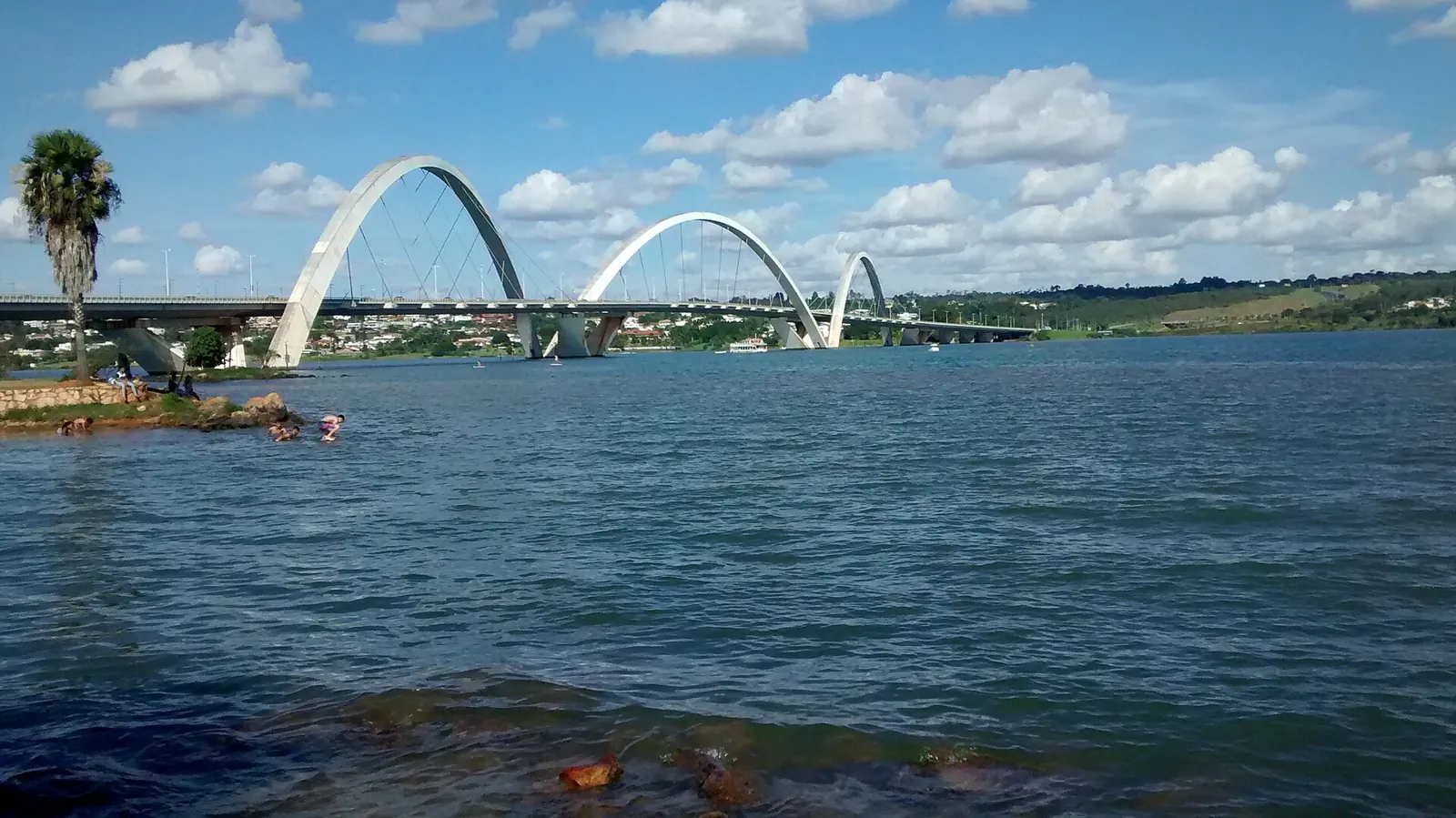
The JK Bridge, opened in 2002, crosses Lake Paranoá toward Lago Sul.
With no coast, Brasília escapes the salt problems of the coastal capitals. Its main risks come from a climate with two seasons: almost no rain from May to September, then heavy rain until March. INMET's 1991-2020 normals give 1,479 mm a year, of which only 86 mm falls in those five dry months.
Water supply
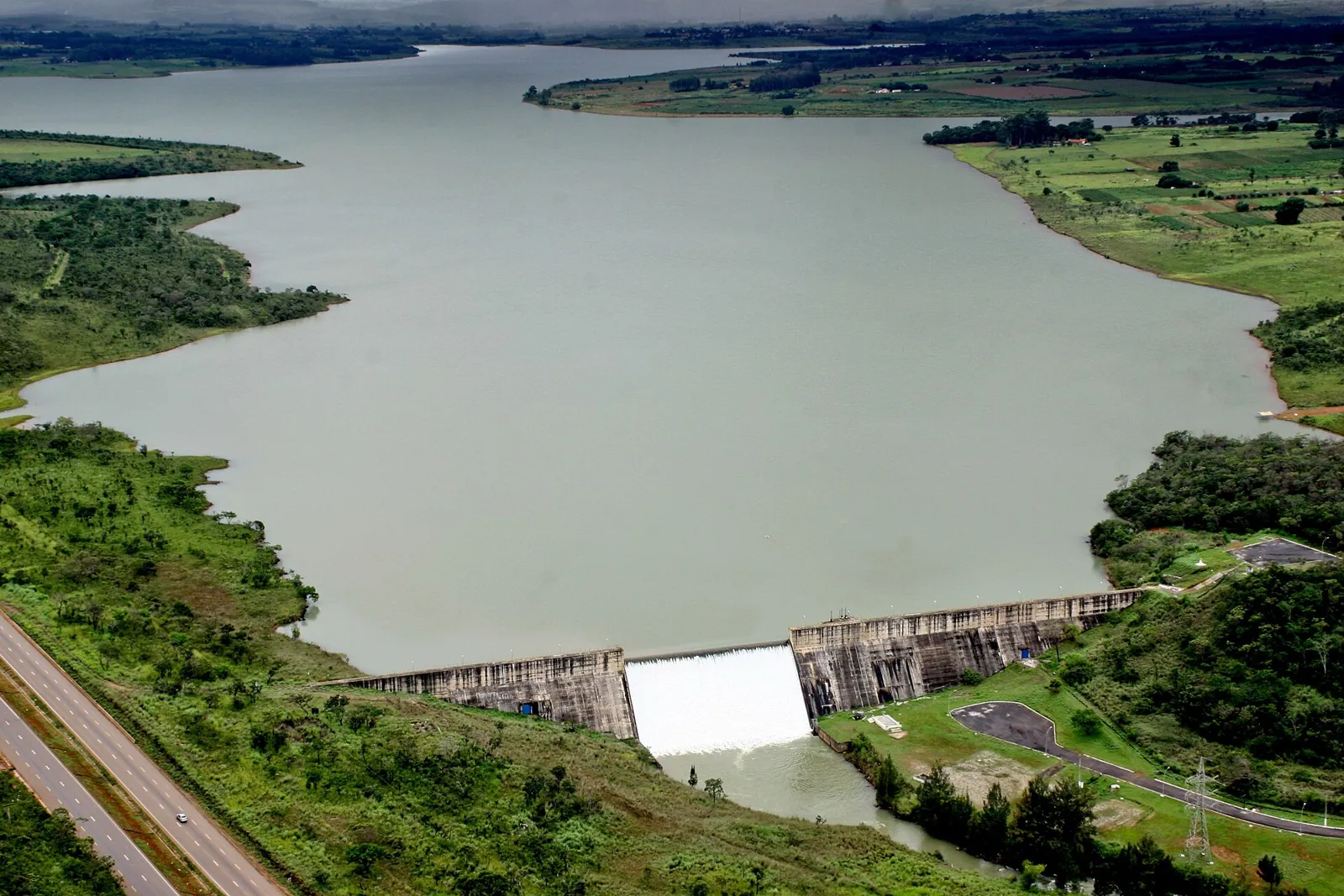
Rationing is the event that every long-term resident remembers. Rotating weekly cuts began in January 2017 in areas served by the Descoberto reservoir, and on 27 February 2017 they reached the Santa Maria/Torto system, which covers the Plano Piloto and the lakes. They ended on 15 June 2018, after a year and five months. Daily use per person fell from 189 liters in 2014 to 129 liters in 2017. The government spent R$ 519 million and added sources: 700 liters a second from the Bananal subsystem, 700 from a Lago Norte plant drawing on the lake, and 1,400 in the first phase of the Corumbá system, with 2,800 planned.
The picture in 2026 is far better. Santa Maria overflowed in April for the first time since 2022, and on 20 August, at the height of the dry season, Descoberto stood at 89.2% and Santa Maria at 94%, up from 81% and 73% a year earlier. Descoberto serves about 64% of the population. That is comfort for now, not a guarantee. Ask a building how large its tanks are and whether it ran short in 2017. In 2018, 27.3% of Lago Norte homes and 21.2% in Lago Sul said they collected rainwater.
Storms and flooded streets
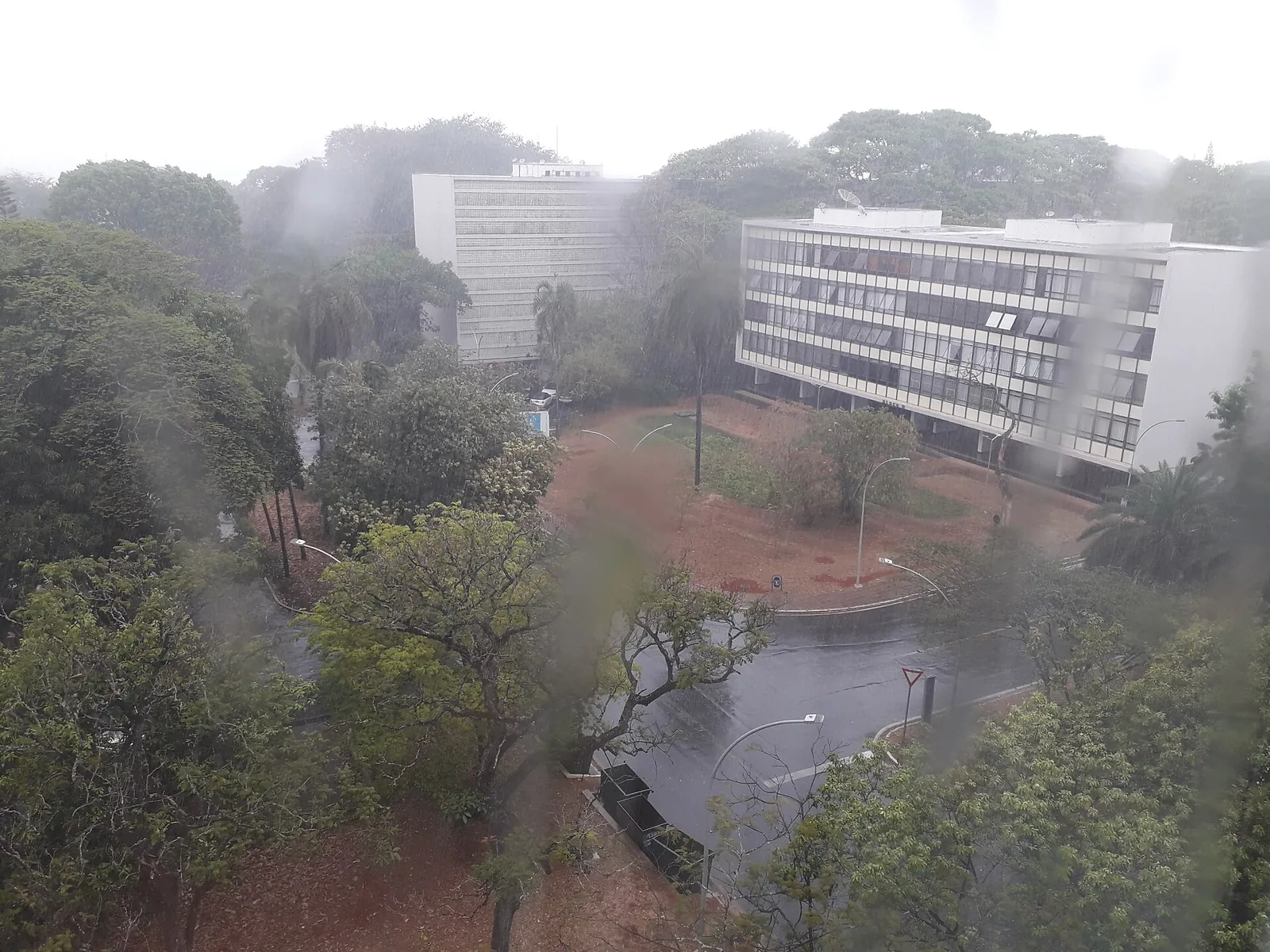
A study of 851 flooding reports covering 1999 to 2020, published in 2025, gave the Plano Piloto 382 and Vicente Pires 103, together 57% of the total. Its authors say it is not official. Asa Norte alone had 263, and 80% of those came from ordinary rain and not extreme storms. A 2026 report on it flags the 210 Sul underpass and W3, and seven regions rate as very dense in reports, including Águas Claras and Vicente Pires. The Drenar DF project opened 7.7 km of tunnels under the start of Asa Norte in March 2025, with a 96,000 m³ basin; further phases were still on the drawing board. For a garage or ground-floor shop, visit in January and ask neighbors, then read the flood check guide.
Dry air, fire and smoke
In 2024 the city reached 164 days without rain on 4 October, one day past the 1963 record. On 28 September 2026 INMET's station read 14% humidity and 35.5 °C at 4 pm; the Civil Defense treats 20% to 12% as an alert and lower as an emergency. Fire follows. On 15 September 2024 a blaze in Brasília National Park burned about 700 hectares by ICMBio's count, and smoke covered the north of the Plano the next morning. Federal police investigated, with arson the main hypothesis. If you are buying at the north end, ask about 2024 and look at the park boundary on a map.
When to inspect
What each season shows a buyer
Months
Rain, normal
What you will and will not see
Nov to Mar
about 180 to 253 mm a month
Roof and pipe leaks, flooded underpasses, drainage. Green gardens hide dry-season wear.
Apr
145 mm
Late storms, then the air clears. Lake levels are high.
May to Aug
1.5 to 27 mm
Cool mornings (lows near 14 °C) and easy viewing, but a dry roof tells you nothing.
Sept and Oct
38 to 142 mm
The hardest test: highs near 29 °C on average, low humidity, dust and possible smoke. Note whether the unit needs a humidifier or air conditioning.
The Descoberto reservoir and dam with water going over the spillway.
The Federal District recorded 287 intentional violent deaths in 2025, which is 9.6 per 100,000 people; Brazil as a whole stood at 19.1. Only Santa Catarina and São Paulo were lower, according to the 2026 Brazilian Public Security Yearbook. It was up from 270 and 9.1 in 2024, the low point of the series. The district's own security secretariat counts homicides alone and reported 203 victims and a rate of 6.8 in 2024, its lowest since 1977, so check which measure a claim uses. Feminicides rose to 29 in 2025 from 22.
Property crime has been falling. For 2024 the secretariat reported 10,659 street robberies, down 16.6%; 156 home robberies, down 28.8%; and 1,018 vehicle robberies, which fell again to 860 in 2025. Vehicle theft, a different count, stood at 6,706 in 2024. Figures by area were not found for the crimes a resident cares about, so no ranking of neighborhoods can be offered here.
What makes Brasília different is the rule that blocks cannot be fenced. Anyone may walk under your building, day or night, and courts have refused security as a reason for grilles. Locals tend to choose, as a general observation, by lighting, by which shopping strip is busy at night, and by whether the block has a doorman. Lago Sul has a police battalion (5º BPM) and a station (10ª DP) within its boundaries. Visit at night, and ask the building manager for its incident log.
Hospitals, schools and shops
Several large private hospitals line the south wing. Hospital Sírio-Libanês is at SGAS 613, DF Star at SGAS 914, and Santa Lúcia Sul was the only hospital in the Center-West among Brazil's top 30 in Newsweek's 2026 ranking. It has a north-wing sister, Santa Lúcia Norte. Hospital Daher is at SHIS QI 7 in Lago Sul, and Lago Norte has the SARAH center for neurosciences and rehabilitation in SHIN QL 13. On the public side there are the Hospital Regional da Asa Norte and the university hospital. Brasília's cost of living page carries the prices.
International schools
Brasília's diplomatic community supports a real choice, and school location often decides the neighborhood. The American School of Brasília (EAB) is at SGAS 605 in Asa Sul and teaches the IB. The School of the Nations has its principal campus at SHIS QI 21 in Lago Sul, with an early-years campus in SMDB, teaches the IB's primary and diploma programs and is NEASC-accredited. A September 2026 cost guide also lists the British School of Brasília, SIS Swiss International School and Brasília International School. Its indicative monthly tuition spans R$ 4,500-11,000, and it puts the all-in yearly cost per child at R$ 65,000-150,000. Confirm fees and any capital levy directly.
Shops and services
Each superquadra group has its local shopping strip, which is why the wings are walkable for errands even though people drive to work. Oba Hortifruti has stores at CLS 105, SCLN 306, SHCGN 706 and SQSW 302. Big Box has one at the 211 Norte strip, one in SMDB in Lago Sul and one on SHIN EPPN in Lago Norte. In Lago Sul shops gather at set points, among them Gilberto Salomão and the strips at QI 3, 9, 11 and 17. Residents from QI 27 on long lacked a real center, and a complex at QI 28 was announced in 2023 to fill the gap.
Embassies shape the foreign community, and the sectors set aside for them flank the Plano. Families who want a cluster of international schools and missions sometimes set this against Jardins in São Paulo. Those who care more about beaches and nightlife will find far more in Rio de Janeiro.
Flights, metro and a city built for cars
Flights
Brasília International Airport (BSB), run by Inframerica, lies in Lago Sul, about 15 km from the center. Its nonstop international map has just shrunk. On 26 October 2026 Inframerica confirmed that Gol was dropping Miami, Orlando and Buenos Aires, leaving five nonstop international destinations: Lisbon, Panama City, Santiago, Lima and Bogotá. The airport's own site counted eight on 1 September 2026, flown by Copa, Gol, LATAM and TAP, but its text does not name them, so the five rest on the press report of Inframerica's statement. Copa described its Panama service from Brasília as daily in June 2026. On that list there is no nonstop from Brasília to the United States as of that date. Anyone flying from North America should plan on a connection, usually through Panama or a Brazilian hub, and should check the airline's own timetable before booking, because this list changed days ago.
A renegotiated version of the airport's concession goes to auction on 17 December 2026, with a R$ 1.2 billion investment package that includes a new international terminal, a parking building and a new access road. The concession still ends in 2037.
Metro and buses
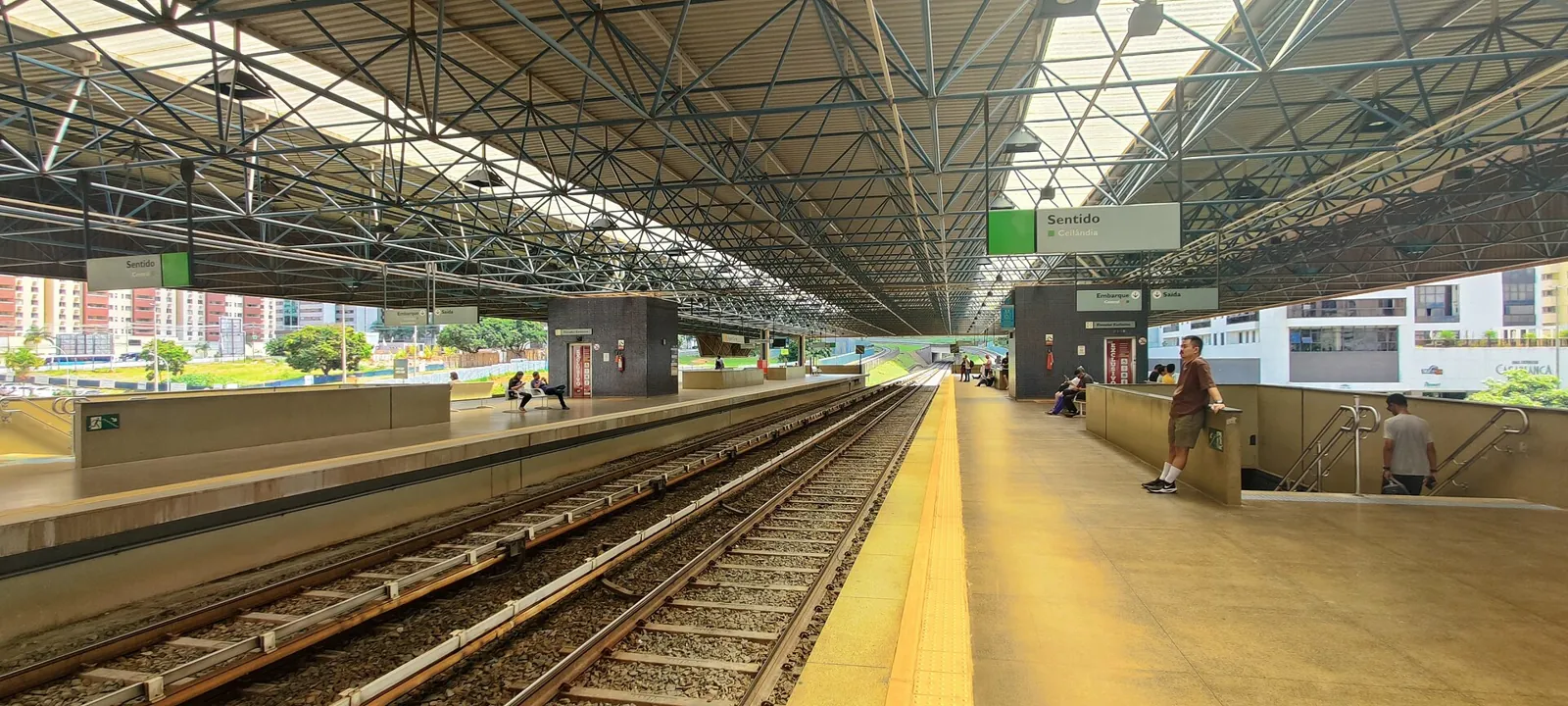
The metro runs about 42 km from the central bus station through Asa Sul to Águas Claras, Ceilândia and Samambaia, carrying about 160,000 people a day, with a flat R$ 5.50 fare, from 5:30 am to 11:30 pm Monday to Saturday and 7 am to 9:30 pm on Sundays. It does not serve Asa Norte, either lake or the airport. A single maintenance failure closed all stations between 114 Sul and Central for about 11 hours on 6 January 2026, a reminder that the wing depends on one tunnel. Bus fares stay frozen through 2026 at three levels, up to R$ 5.50.
Cars
Plan to own one. In 2018, 88.4% of Sudoeste and Octogonal workers, 86.9% in Lago Sul and 84.3% in Lago Norte drove to work. Even in Asa Norte, the most walkable area, it was 69.9%, with 14.3% on foot. Parking is therefore a value question: an Asa Sul walk-up without a space sells to a narrower group of tenants. Águas Claras shows the other risk, with about 56,000 vehicles a day, three ways in and out, and reports of hour-long peaks. Driving rules for foreigners are in the license guide.
Transfer tax. ITBI fell from 3% to 2% from January 2025, and to 1% for a new-built unit on its first transfer; a December 2025 law moved its base to market value with the declared price presumed true.
Planning law. The PDOT was signed in February 2026. The PPCUB amendment is on hold after the 28 September 2026 injunction, with a new hearing to follow the election.
Rail. Samambaia's metro extension reached 23% in mid-2026, and a Ceilândia tender reopened in March 2026. A plan presented in September 2026 proposes 119.7 km of new lines for R$ 29.2 billion, including a 22.4 km light rail linking the airport, W3 and Noroeste at R$ 4.8 billion. It is a proposal with no funding announced, and it should not be priced into any apartment on W3 yet.
Airport. The December 2026 auction could change the terminal and, over time, the route map. For now the map is smaller than a year ago.
Land. Terracap is working through direct sales in Vicente Pires. Land in the Serrinha do Paranoá, whose springs feed the lake, was in dispute in March 2026 when the governor kept its Gleba A among the assets pledged as collateral to capitalize the BRB, the district's bank, over protests from residents and environmental groups.
Tax reform.The landlord guide for non-residents follows the national changes. It remains unsettled how a 3.5% IOF would hit rent or sale money sent abroad, and how non-residents above the limits are treated under CBS and IBS, so ask before putting a figure into your plans.
Utilities. Neoenergia Brasília's power rates rose by a provisional 1.11% for homes starting 22 October 2026.
Selling later
How long homes take to sell here is not published anywhere this guide could find. What can be said is that the market is active: Secovi-DF counted R$ 20.70 billion of resale in 2024, up 14.5%, and R$ 17.34 billion in the year to September 2023. The FipeZAP record is a warning against assuming you can exit at a gain on a short horizon. Six down years in a row, 2014 to 2019, are in the data.
Three things decide how easily a unit sells here. The first is title. A registered matrícula sells to anyone and can be financed; an unfinished lot in a process sells to a smaller group, at terms that depend on Terracap. The second is the building type. A 400-series walk-up without a garage has a thinner pool of buyers than a 200-series unit with one, and a kitnet in a commercial sector depends on the use rules staying as they are. The third is the tenant: a unit with a stable lease to an institution may attract an investor at a price that owner-occupiers would not pay, and the reverse is true for a family home.
No breakdown of who buys was found. Foreign sellers should read the foreign seller's guide early, since capital gains, the attorney and sending money out take time. Owners selling on their own can use a free listing on this site, and the broker directory covers those who want a local agent. Those who bought for the investor visa should read the visa guide before selling, since this market's threshold is R$ 1,000,000.
What goes wrong in Brasília
Paying for a lot that has no title
In sectors still in Terracap's process, what is on offer is an assignment of rights and a place in line. The final bill to Terracap can fall on you, and unbuilt lots need paper traceable back past 22 December 2016. Get the current notice for that sector and have a lawyer trace the chain: see the possession and title guide.
The same lot sold twice
Police described a practice called venda cruzada in 2024, in which one lot goes to several buyers. Prices far below the area's regularized lots are the warning. Buyers later struggle to prove fraud because they took part in an irregular process. Do not pay a deposit on a receipt.
A garden that is public land
A lake house may include a beco or a ponta de picolé, meaning a public strip that was fenced years ago. The 2023 law offers only a revocable concession at a public price, and the district court backed a challenge to the law's use on the shore in 2024. Ask for the lot's registered dimensions and compare them with the wall.
Grilles and rooms under the block
Fences, gates and closed party rooms on the ground floor of a superquadra block have been ordered removed, as at SQS 208 in 2012. A building that has them may face fines and demolition costs shared by all owners. Ask the síndico for permits and three years of meeting records.
No elevator and no garage in the 400 series
The 400-series blocks were built without elevators or garages, and the rules that later required them did not apply. They price lower for a reason. Rent them to students and young staff, and be cautious if you will grow old in one or need to resell to a family.
Trusting a single district average
FipeZAP's September 2026 reading for Asa Sul is 31% below Secovi-DF's December 2025 median. Neither is a price for your unit. Before making an offer, get recent deed values for that block and floor plan from the registry or a broker.
An ITBI bill above your price
For years the tax office taxed its own valuation. A Noroeste buyer who paid R$ 1,057,118.74 was taxed on R$ 1,347,068.15 and won a refund of R$ 8,698.48 in court in 2019. A December 2025 law now presumes the declared value true, but how that works in practice is unconfirmed. Have the notary check the value first, before any promise of sale is signed, and write into the contract who bears any excess.
Vacant land taxed at ten times the home rate
IPTU on vacant land is 3%, against 0.3% for a home. Holding a lot in Lago Sul or Jardim Botânico while you plan a house can cost more than the plan. Add it to your budget, along with the 9.5 m height limit in Lago Sul.
Septic tanks and old drains
In 2018, 21.2% of Lago Sul homes and 14.7% in Lago Norte reported having septic tanks. Find out which system you are buying, and when any tank was last emptied. In Asa Norte, check if the garage has taken water: the wing drew 263 street-flood reports over two decades, most after ordinary rain.
Questions about buying in Brasília
How high are apartment prices in Brasília?
The FipeZAP average for September 2026 stands at R$ 10,453/m², so 70 m² averages about R$ 730,000. District readings run from R$ 14,672 in Sudoeste down to R$ 4,434 in Sobradinho, and Noroeste's median resale figure was R$ 16,407 in December 2025.
What return can long-term rentals give in Brasília?
FipeZAP's gross long-term yield was 6.20% for September 2026, gross of fees, tax and empty months. Rents fell slightly in August and September after rising 14.56% in 2024.
Can a foreigner buy an apartment in the Plano Piloto?
Yes. Heritage listing limits what can be built, not who can own. You need a CPF first, and the process is in the buying guide.
Does the UNESCO listing stop me renovating my apartment?
IPHAN's 2016 ordinance deals mainly with height, use, ground floors and roofs, and sends most projects to the district government. Work inside a unit follows building rules and the condominium's rules, but anything that closes the pilotis or changes the block's outline runs into the listing.
What does SQS or SQN mean in an address?
SQS is a South superquadra and SQN a North one, followed by the block number and building letter. The first digit of the number says which band it sits in, and the 400 band usually means three floors with no elevator.
Is a house in a condominium in Vicente Pires or Jardim Botânico a safe purchase?
Only with a lawyer's check of that lot. Many are still being regularized by Terracap, the buyer may owe a further payment, and Terracap asks for occupancy proof. The first definitive deeds in Vicente Pires Trecho 2 were handed over in April 2026.
Can I swim in Lake Paranoá or own the shore?
The 30-meter preservation strip is officially public, and the government began clearing it of fences in 2015. Caesb rated three of ten monitored points unfit in January 2026, and stretches near sewage plants are permanently closed to bathing.
Could water rationing come back?
It ran from January 2017 to June 2018. New sources have since been added, and reservoirs stood at 89.2% and 94% in August 2026, so nothing points to it now, though no official guarantees it. Ask each building about its tanks.
Does any airline fly nonstop from the United States to Brasília?
Not as of late October 2026. Inframerica lists Lisbon, Panama City, Santiago, Lima and Bogotá as the remaining nonstops after Gol dropped Miami, Orlando and Buenos Aires.
How much will I pay in closing costs when a home sells for R$ 1 million?
About R$ 24,000, or 2.4%: R$ 20,000 of ITBI at the 2% rate plus roughly R$ 4,000 for deed and registration on the January 2025 table, before certificates and a lawyer. A new-built unit pays 1% at its first transfer. See the closing cost guide.
What is the investor visa amount in Brasília?
R$ 1,000,000 invested in urban property, the figure outside the North and Northeast. See the visa guide for the rules.
Which part of Brasília is cheapest with metro access?
Of the districts FipeZAP lists along the line out to Ceilândia, Ceilândia Sul reads R$ 5,036/m², Taguatinga Sul R$ 6,635 and Águas Claras R$ 9,289. Traffic in and out of Águas Claras is a known problem, so try the commute at peak hours.
We use cookies, including Google Analytics, to understand how visitors use this site. You can accept or decline non-essential cookies. See our Privacy Policy.