Brazil's largest apartment market: for long-let investors, relocating professionals and owner-occupiers who want rail, hospitals and depth, with little for a holiday buyer.
Four garden districts below Avenida Paulista: apartment buildings near the avenue, listed single-family houses farther down, and a price gap of about two to one between its parts.
In September 2026 FipeZAP's Jardins average stood near R$ 18,028/m², a rise of 6.7% over a year, while declared values range from R$ 11,721 in Jardim América to R$ 25,110 in Jardim Europa.
Rua Oscar Freire: Luxury shops and galleries; expect visitors and deliveries more than quiet.
Alameda Lorena: A luxury launch here was quoted at roughly R$ 10 million to R$ 30 million.
Alameda Campinas: Only 7 phone robberies in the crime map MySide cites.
Avenida Brasil: Heavy traffic along Jardim América; good for access, hard on front-facing rooms.
Avenida Brigadeiro Luís Antônio: Residents complain of noise; 23 phone robberies on the local stretch, mostly near Paulista.
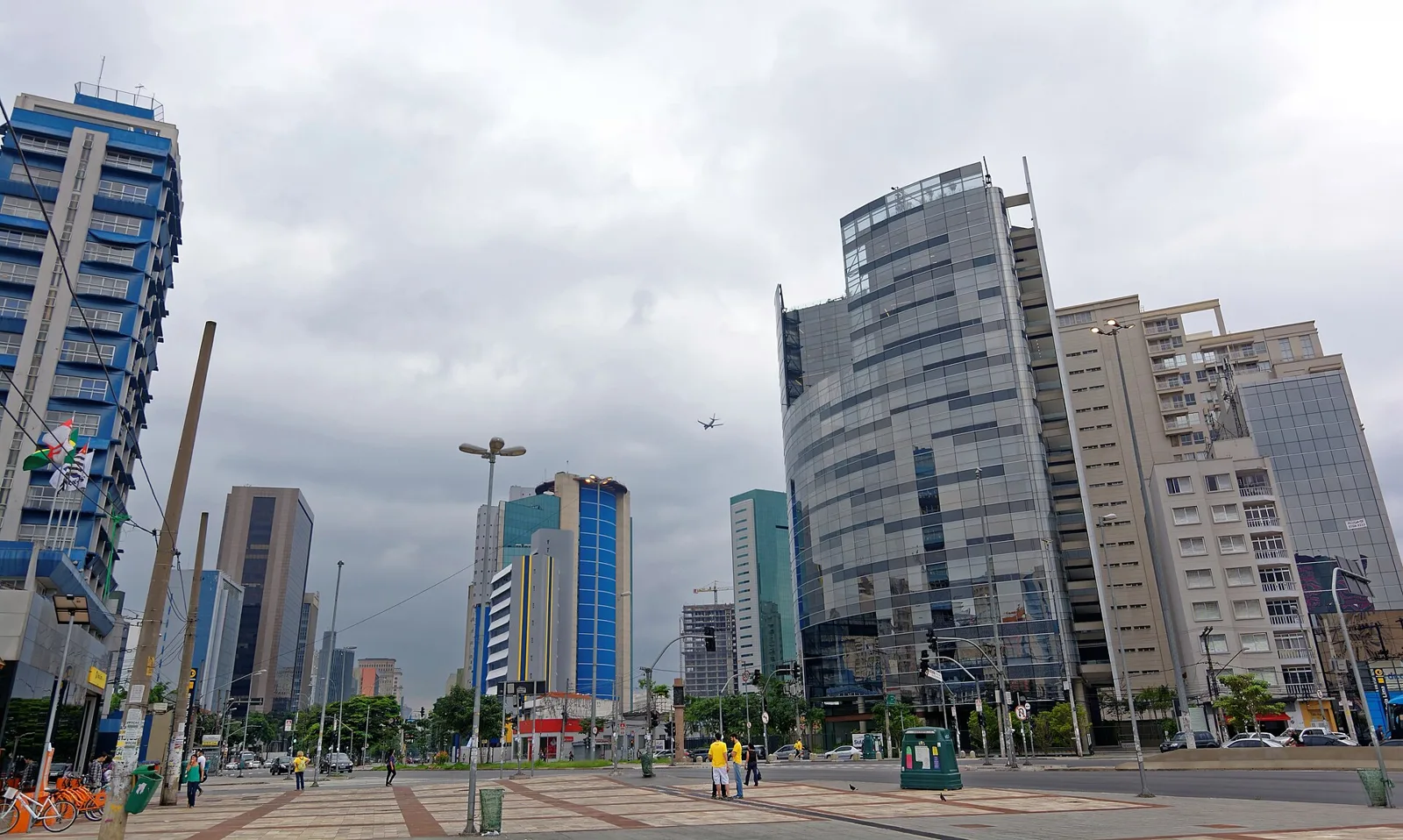
The address beside Faria Lima, with some of the city's highest office rents next door, no metro station, expensive fees and tenants who would rather go to the office on foot.
FipeZAP put asking prices near R$ 19,989/m² on average in September 2026, the top entry in MySide's table of its neighborhood figures, while declared ITBI values averaged R$ 15,561.
Rua Joaquim Floriano: Restaurants and shops, 11 restaurants in one directory; a cluster at number 466.
Rua Pedroso Alvarenga: The densest restaurant street, with 27 in one directory.
Rua Tabapuã: Frequent apartment address in listings.
Rua Leopoldo Couto de Magalhães Júnior: Apartment listings, with restaurants at street level.
Rua Bandeira Paulista: Often the address given in apartment listings.
No FipeZAP sale figure appears for Vila Madalena in the tables we found; Loft shows about R$ 13,000/m², while FipeZAP's rent stood near R$ 86 at the end of 2025.
Rua Aspicuelta: The bar street; the most crowded nights and the site of street parties.
Rua Fidalga: Dozens of bars at the Aspicuelta crossing; a large new building completed in 2026.
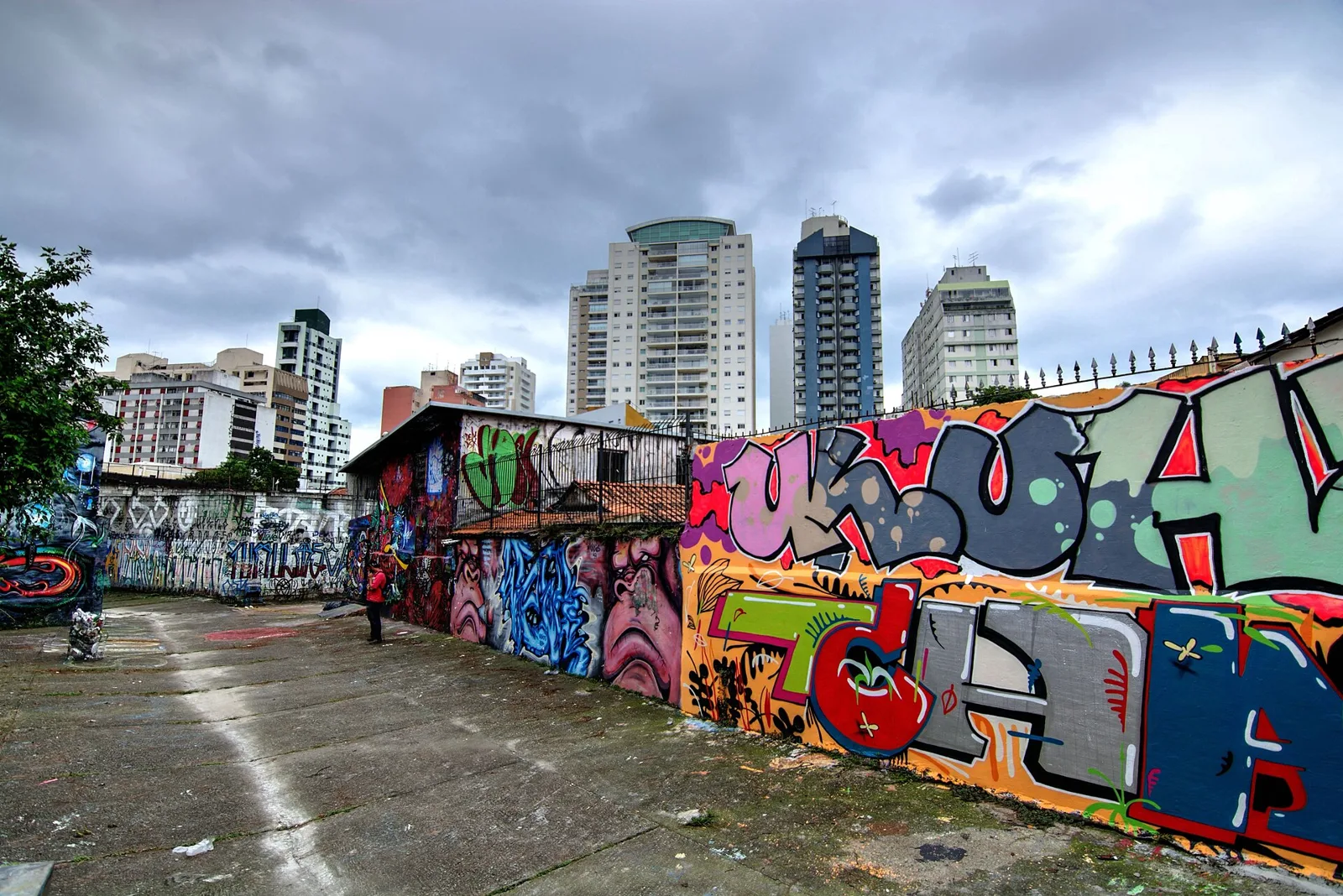
Rua Harmonia: Houses and small buildings; an entrance to Beco do Batman, which flooded in 2022, and bar noise at the Wisard corner.
Rua Wisard: Residential with bars nearby; visit late to judge it.
Rua Mourato Coelho: Shops and services; bars on some blocks.
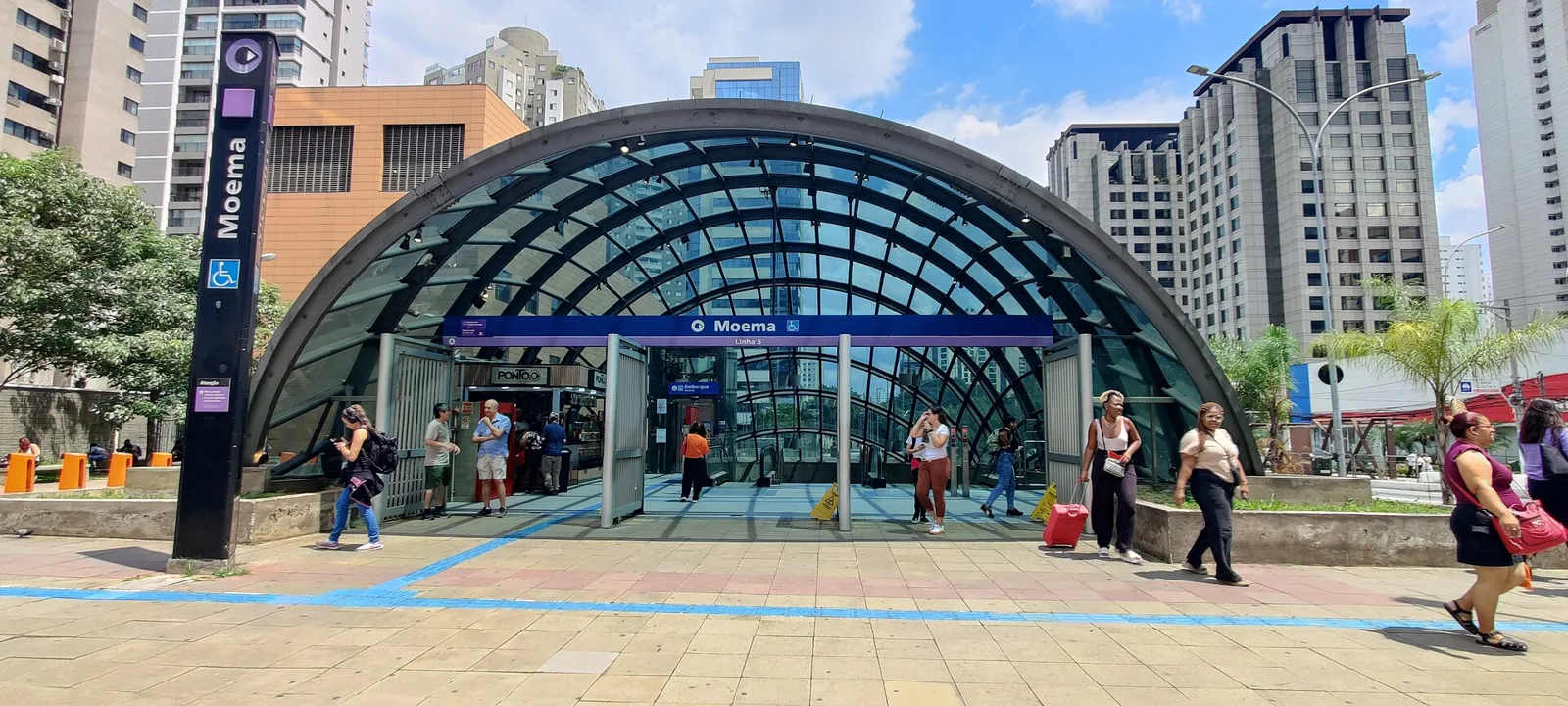
Tree-lined streets beside Ibirapuera Park, divided into the two sections of Moema Pássaros and Moema Índios, with Line 5, planes from Congonhas overhead and a flood reservoir under construction.
FipeZAP's asking average was about R$ 16,520/m² in September 2026, up 5% in a year; declared values in Moema Pássaros averaged R$ 10,374, and new launches run above R$ 22,000.
Avenida Ibirapuera: The dividing line between Pássaros and Índios, with many bars and restaurants.
Alameda dos Nhambiquaras: Tree-lined street in Moema Índios, named in guides.
Rua Gaivota: Flood point in the low ground; a R$ 117.3 million reservoir is going in below it.
Avenida Santo Amaro: Outer limit of Pássaros.
Avenida Moreira Guimarães: Outer limit of Índios, on the airport side.
long-let investors, against FipeZAP's 6.43% gross yield
professionals who work around Faria Lima, Paulista or Berrini
families who want hospitals and international schools in reach
buyers who want a large market of used apartments and public price data
Look elsewhere for
anyone expecting a holiday home or a season to rent into
studio buyers counting on Airbnb income before reading the convention and the HIS and HMP rules
buyers unwilling to pay a local lawyer for a reading of the matrícula and the zoning
Prices, launches and who is buying
FipeZAP's September 2026 report puts the average asking price of a São Paulo apartment at R$ 12,206 for each square meter, about US$ 2,250. That is up 3.64% in twelve months and 2.6% since January. The same report shows twelve-month inflation at 4.45% on its IPCA preview, so the average seller lost ground in real terms. Price growth has been slowing: 6.56% in 2024, 4.56% in 2025. Rents ran ahead of prices at R$ 65.78 a square meter a month, up 6.22%, which FipeZAP converts into a 6.43% gross long-term yield. Gross means before condominium, vacancy, IPTU and income tax.
The larger story is supply. Secovi-SP, the housing trade body, counted 139,700 new apartments launched in the city in 2025, up 34%, against 113,000 sold, up 9%. Its count of new units on offer rose 40.3% to 85,200 over 2025 and reached 98,018 by August 2026. About 61% of the 2025 launches were Minha Casa Minha Vida units, the federal affordable program, at an average R$ 265,500. Mid and high-end launches rose 41% while their sales fell 11%, at an average R$ 1.1 million. Portas adds up three years of launches and estimates about 317,000 apartments under construction.
The top of the market has turned faster. In 2025 developers launched a record 1,879 apartments above R$ 5 million, more than double the 698 of 2024, and Moema, Jardim Paulista and Itaim Bibi took 61% of what was delivered in that bracket over five years. Then the consultancy Brain reported that sales in the top segments fell 39% and launches 53% between January and June 2026. A Citi report cited in July 2026 put the time to sell new three and four-bedroom units at 26 months, up from 18.5. If you are buying a large new unit in Itaim Bibi or Jardins, that is your negotiating background.
The used market is a different crowd. CRECISP, the brokers' council, surveys agencies every month, and its February 2026 sample shows 86% of sales were apartments and 59.6% were outside the central and prime areas. Banks financed 63.9% of those sales, Caixa alone 39.6%. Cash paid for 22.9%, and 12.5% paid the owner directly on agreed terms, so seller financing is ordinary here. The survey covers agency sales, and our page on dealing with a private seller covers sales with no broker. The Selic rate was 14.75% in June 2026, and one analysis that month argued that high rates feed rents more than they restrain them.
Against other Brazilian cities, São Paulo sits above Rio de Janeiro on price (R$ 11,302 a square meter) with a similar yield (6.3%), though rents there climbed 14.8% over the same period. Yield hunters also compare Recife at R$ 9,045 and 8.3%, or Porto Alegre, which costs R$ 7,545 and yields 7.36%. Florianópolis costs more at R$ 13,607 and yields less at 5.42%, so a buyer who chooses it is paying for the coast.
FipeZAP sale index, September 2026 report. 2026 is the 12 months to September. Inflation is not removed.
Zones, rail lines and the southwest corridor
The 2022 census counted 11,451,999 people on 1,521 square kilometers. Guides split the city into five zones and more than 400 named bairros, while the administration runs it through 32 subprefectures. Broker names and official districts do not line up, and that matters when you read a statistic. Vila Nova Conceição sits inside the Moema district. Rua Funchal and Rua Quatá, which any broker would call Vila Olímpia, are filed under the Itaim Bibi district in the city's own environmental register. Guides do not even agree whether Itaim Bibi belongs to the south or the west zone. Ask which map a number uses before you compare it.
Most foreign buyers look along one band that runs from Avenida Paulista down to the Pinheiros River. Jardins lies between Paulista and Ibirapuera Park and rides Line 2-Green at Trianon-Masp and Consolação and has its own Oscar Freire station. Pinheiros sits on the river with three Line 4-Yellow stations and the Line 9 train. Vila Madalena climbs the hills next door and ends Line 2. Itaim Bibi wraps the Faria Lima and Juscelino Kubitschek office avenues and has no metro of its own, only the Cidade Jardim and Vila Olímpia train stations. Vila Olímpia is the office and nightlife quarter beside it. Moema lies past the park toward Congonhas airport, on Line 5-Lilac at Moema and Eucaliptos.
Rail access has a price. A June 2026 market analysis in Monitor Mercantil put homes within 500 meters of a metro station 18% to 25% above comparable homes a kilometer away. Treat that as one writer's estimate, then test it on the blocks you are looking at. The city's zoning points the same way, because the tallest buildings are steered toward stations, as the chapter on changes explains.
Outside the band, prices and fees step down. FipeZAP's neighborhood readings around September 2026 show Vila Mariana at R$ 14,879 a square meter, Perdizes at R$ 13,455, Bela Vista at R$ 12,703, Santana in the north at R$ 9,288 and Vila Andrade at R$ 8,372. Data Lello's average condominium fee runs from R$ 792 a month in the east zone and R$ 840 in the north to R$ 1,364 in the south. Those averages hide risk as well as savings: the east zone holds Jardim Pantanal on the Tietê floodplain, and M'Boi Mirim in the far south had the most mapped landslide areas in the Defesa Civil count.
A city apartment often comes with a question about weekends. Three second-home markets are covered here: Guarujá on the coast, Ilhabela by ferry and Campos do Jordão in the mountains.
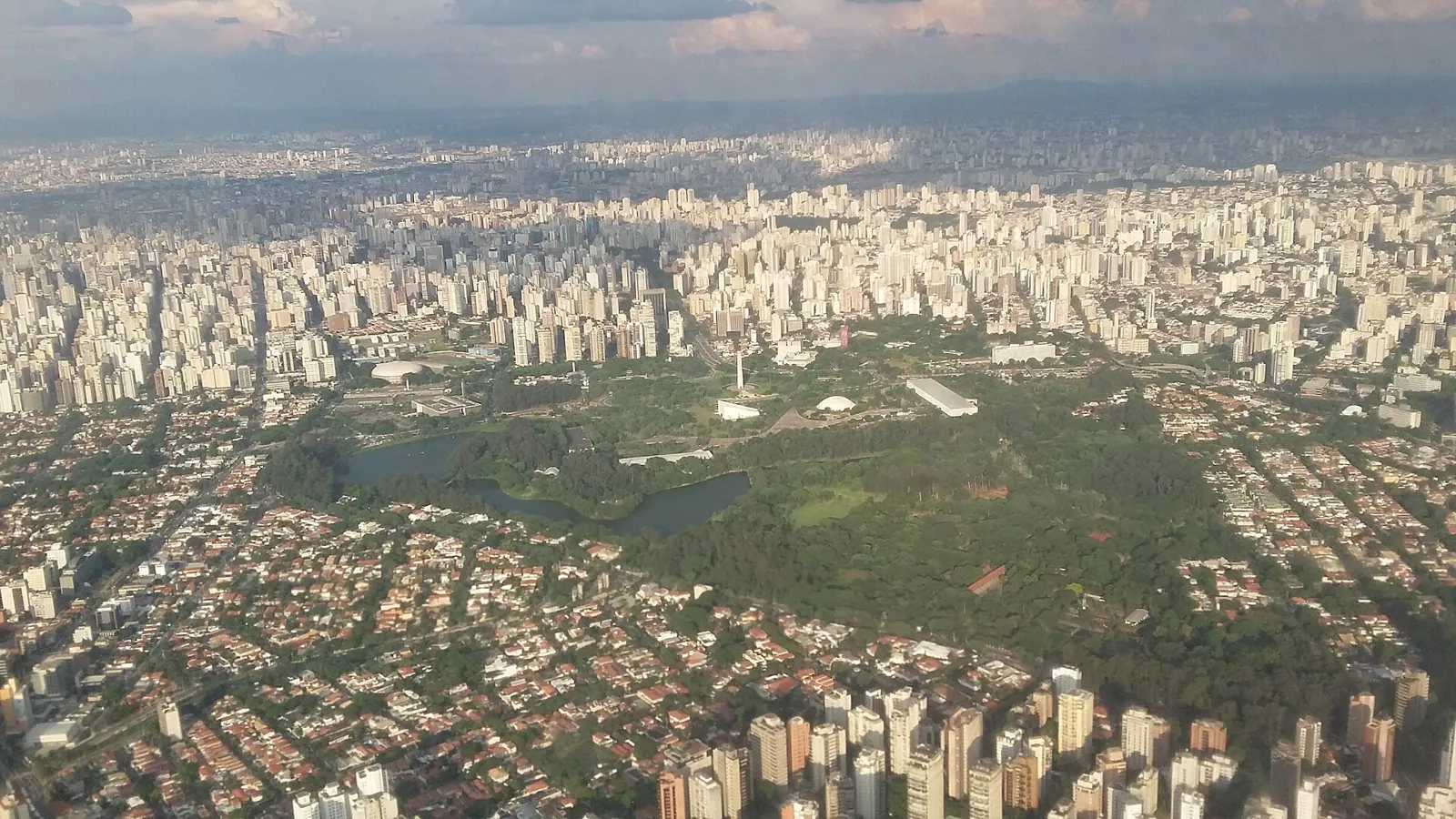
Ibirapuera Park from the air: garden-district houses on the near side, apartment blocks stretching toward Paulista behind.
Three generations of apartment sit side by side in the same neighborhoods. Jardim Paulista's postwar blocks, many dating from the 1960s and 1970s, are valued for unit size and now attract retrofit money, and Pinheiros has its share of roomy older apartments. As a general observation, these buildings give you space per real but ask you to check wiring, gas lines and fire paperwork, which the title chapter covers.
The second generation came after the 2014 master plan steered density toward stations. Developers answered with units of just 20 to 30 m², and by 2023 Metrópoles was reporting them along the Rebouças corridor and asking whether they were occupied at all. The third generation is what sells today. In May 2026 two-bedroom units were 54% of launches and 65% of sales in Secovi-SP's survey, and units of 30 to 45 square meters made up more than half of launches and nearly two-thirds of sales.
Moema shows how far the shift has gone. A Binswanger survey counted 13,722 units launched there between 2019 and 2025, with one-bedroom units making up 64% of the new stock in Moema Pássaros and 78% in Moema Índios. Yet listing data still shows about five ads for homes of 100 m² or more for every one under 40 m². Large apartments remain the bulk of what you can buy used, and small ones dominate what is being built.
Small new units carry a question that older ones do not: many were built under social-housing incentives and cannot be used the way an investor assumes. That has its own chapter below, and you should read it before you look at any studio.
Parking changed too. The 2023 master plan revision allowed one parking space per 60 square meters of computable area on the transit corridors, which encourages larger units with more spaces. A garage spot in an older building may have its own registry record and its own IPTU, so confirm what you are buying.
Condominium fees vary more than prices do. Data Lello's 2026 study of 3,100 vertical buildings puts the city average at R$ 1,085 a month. Loft, working from listings, gets R$ 843, up 14.4% in a year, and ranks Jardim Europa highest at R$ 3,117, with Itaim Bibi (R$ 2,151) and Jardim Paulista (R$ 2,040) well above the average. Portas lists Pinheiros at about R$ 1,200. Staff cost is 49% of spending in the Lello-based breakdown, utilities 22% and upkeep and maintenance 16%. As a general observation, that means a small building shares one payroll among few owners, and a 24-hour front desk is the first line to read in the accounts. Our guide to the monthly fee shows how to read them.
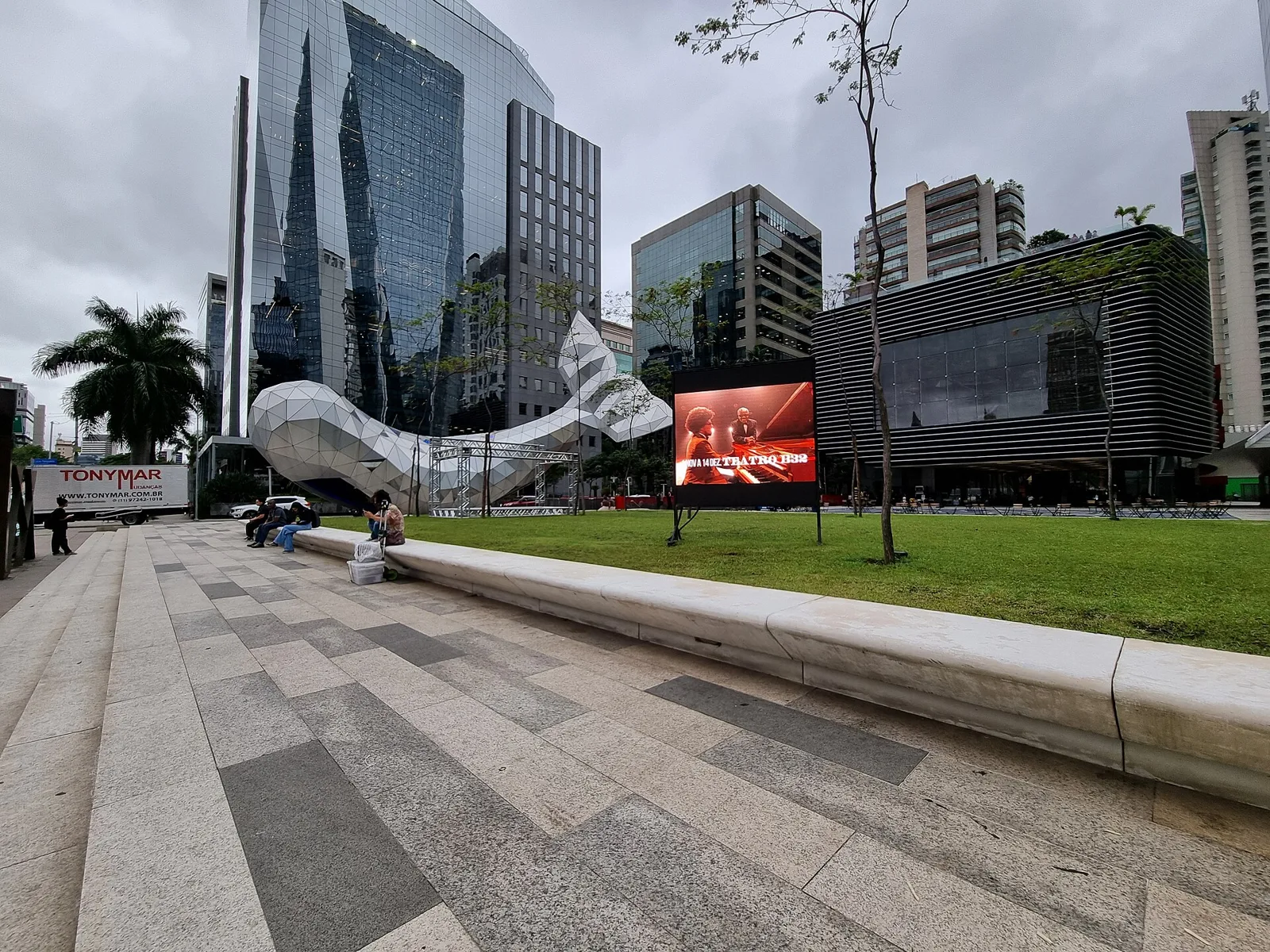
Itaim Bibi at dusk: apartment buildings of several decades stand next to glass offices.
São Paulo has unusually good public price data, and the sources disagree in a way that tells you something. FipeZAP measures asking prices. Loft and Portas analyze the values declared to the city for ITBI, the transfer tax. Binswanger and Brain track new launches. These are three different markets.
Reais per square meter, published readings from late 2025 and 2026
Area
FipeZAP asking, about Sept 2026
12-month change
Declared in ITBI records
Asking rent, July 2026
City average
12,206
3.64%
5,557
75.20
Itaim Bibi
19,989
3.4%
15,561
88.90
Pinheiros
18,260
-0.3%
11,191
105.40
Jardins
18,028
6.7%
Jardim América 11,721; Jardim Paulistano 14,465; Jardim Europa 25,110
Jardim América 98.50; Jardim Europa 113.20
Moema
16,520
5.0%
Moema Pássaros 10,374
90.30
Vila Olímpia
19,378 (Dec 2025)
2.5%
not found
116.50
Vila Nova Conceição
27,293 (Dec 2025)
5.4%
not found
99.20
The asking column comes from MySide's table of FipeZAP figures, plus ISTOÉ Dinheiro's January 2026 ranking for the two rows marked December 2025. The declared column comes from Portas, using ITBI records from 2025 and early 2026. The rent column is the QuintoAndar Imovelweb index, whose city average of R$ 75.20 runs above FipeZAP's R$ 65.78 because it measures a different sample.
The gap between the second and fourth columns is the useful part. In Pinheiros, asking prices run at R$ 18,260 and declared values at R$ 11,191, and the declared figure likely includes more older apartments. Portas warns that a declared value can differ from what was negotiated. New construction sits above both: Binswanger's launch prices in Moema reach R$ 29,205 a square meter on the bird-named side and R$ 22,983 on the other, against R$ 16,520 for FipeZAP's Moema asking average.
Commercial figures can muddle the picture. A Forbes Brasil table from 25 August 2026, also credited to FipeZAP, shows Itaim Bibi at R$ 13,744 and Pinheiros at R$ 13,032, but its heading says those are sales of commercial property. A Forbes piece three weeks earlier shows R$ 19,990 and R$ 18,302, in line with the apartment series used here, so check which market any quoted figure describes.
You can test any quote yourself. The city's finance department publishes a spreadsheet of ITBI transactions, one row per declaration, updated monthly. Ask your lawyer or broker to pull recent rows for the building or block. The asking-price index here gives a comparison, and it is thin: only 19 São Paulo listings had an area figure at the last count, with a median of R$ 13,242 a square meter.
Long-let tenants, guarantees and office demand
The everyday rental market is smaller units at modest rents. FipeZAP's April 2026 reading put a 30 m² one-bedroom at R$ 1,926 a month and a 45 m² two-bedroom at R$ 2,889, and it says the second model is 45% of rental demand in the city. In CRECISP's February 2026 survey 54.9% of apartments rented had two bedrooms, rents clustered between R$ 2,000 and R$ 3,000, and two-thirds of leases were outside the central and prime areas.
Guarantees are where São Paulo differs from what a foreign owner expects. No single instrument dominates. In that same survey the cash deposit led at 29.2%, followed by a personal guarantor (fiador) at 25.8%, guarantee insurance at 17.4% and a capitalization bond at 11.8%. National law allows only one guarantee per contract and caps a cash deposit at three months' rent, held in a savings account. Tenants did not bargain hard: 66.2% of leases closed at the advertised rent and another 20.3% within 5% of it.
Office demand also shapes the prime districts. JLL put vacancy in high-standard offices at 13.1% in mid-2026, the lowest in 17 years, with Paulista at 2.8% and Rebouças at zero. Newmark reports asking office rents of about R$ 312 a square meter on Faria Lima and R$ 276 in Itaim. Apartment rents in and around those districts are high too: Vila Olímpia tops the QuintoAndar Imovelweb rent ranking at R$ 116.50 a square meter and Pinheiros reaches R$ 105.40. FipeZAP's own ranking in April 2026 had Pinheiros first at R$ 98, then Itaim Bibi at R$ 92.
Corporate tenants are not a guaranteed floor, and the office numbers show why. BTG Pactual expected vacancy to rise in Vila Olímpia, and an April 2026 trade report said one bank's exit could push it from just above 15% toward 20%. Portas reports young professionals in finance and technology renting compact units there, so an office contraction reaches the apartment market next door. Rental figures for tenants paid by an employer were not published in anything we found, so ask an agency that handles relocations for its current vacancy and fee before you price a furnished corporate let.
For scale, Expatistan data cited by MySide in April 2026 puts a furnished 85 square meter apartment in upscale areas at R$ 7,063 a month and a 45 square meter studio at R$ 4,224. One June 2026 analysis puts overall vacancy near 6%, which we could not trace to a primary source. A non-resident owner has its own tax treatment, set out in our page for non-resident landlords.
Avenida Faria Lima, the office address that sets the tone for rents in the surrounding blocks.
Published data shows a crowded market and does not agree on how full it is. These three trackers cover about the same twelve months:
Airbnb-type listings in the city, 2026 readings
Source
Average nightly rate
Occupancy
Active listings
AirROI, 12 months to Sept 2026
R$ 309
40.1%
34,925, up 66%
Airbtics, 12 months to Aug 2026
R$ 270
58%
35,986, up 77.7%
GuestFavorites, Nov 2026
R$ 268
61%
37,788
A rise of two-thirds in listings within a year is the number to think about. AirROI's average listing earned R$ 32,797 in that period, down 2.6%, and GuestFavorites puts yearly takings at R$ 79,721 in Itaim Bibi, R$ 74,105 in Jardim Paulista, R$ 70,177 in Pinheiros and R$ 60,687 in Moema, on its own method. We publish no short-let yield because none of these sources gives one for this market. This is a business-travel city more than a beach season: AirROI's two-year calendar average shows November as the strongest month and February the weakest for revenue, with occupancy lowest in May, though July 2026 led its latest twelve months.
The legal ground moved in 2026. On 7 May the Second Section of the STJ, the federal appeals court, ruled 5 to 4 in REsp 2.121.055 that repeated short stays through platforms are incompatible with a building whose convention sets residential use, unless two-thirds of all owners approve a change. In a 30-unit building that is 20 votes. The case began in Minas Gerais and does not formally bind lower courts. The court then took up the same question as a binding repetitive issue, Tema 1.443, with a São Paulo case among the leading ones (REsp 2.272.536). On 17 September 2026 it announced that courts across Brazil must park lawsuits on the point until it rules. That pause does not ban anything. It does mean nobody can tell you today how a silent convention will be read.
The city has no general short-let law that we could find as of November 2026. Two bills sit in the city council. PL 1476/2025 would require host registration, a digital permit and a R$ 5,000 fine per unregistered unit, and would treat the unit as commercial for IPTU. PL 194/2026 would create a register called eVisitanteSP and allow the activity in residential condominiums only where the convention or an assembly permits it. Both were with the council's constitution and justice committee, awaiting the rapporteur's opinion with no vote recorded, at the last entries we could open (May 2026 for the first, August 2026 for the second). What already applies is Decreto 64.244/2025, which bars short lets in social-housing units classed HIS or HMP, whenever they were bought.
Before you buy with short stays in mind, ask the building manager for the registered convention, the last assembly minutes on the subject and any fines issued, and check the unit's classification on the matrícula, the registry record. Federal law treats a lease of up to 90 days as a seasonal rental, and how that sits with platform stays is the very thing the courts are deciding. The national position is in the guide to short lets. Two national tax points are unsettled: the R$ 600 deduction for short stays, and CBS and IBS on non-residents beyond the limits.
Short-let arithmetic
Starts from published figures (12 months to September 2026 (AirROI, Airbnb listings; other trackers report higher occupancy and lower rates)). Set your own.
ITBI, IPTU and the cost of a one-million-real home
São Paulo charges 3% in ITBI, the transfer tax, normally to the buyer. The argument is about what the 3% applies to. The city's finance department still taxes whichever is greater, the price or its own reference value, the valor venal de referência or VVR, under Decreto 55.196/2014. The STJ said otherwise in Tema 1113 in February 2022, in a case that came from São Paulo: the price the buyer declares is presumed to be market value, the city can displace it only through an individual administrative process, and it cannot set the base in advance from a reference table it writes itself.
The city now points to Complementary Law 227/2026 as support for its practice. In May 2026 the 14th public-law chamber of the state court, the TJ-SP, ruled against the municipality in two cases, holding that the new law does not allow automatic use of the VVR and does not apply retroactively. One buyer recovered tax already paid on the VVR. These are early decisions, and the question can still go higher.
In practice the online declaration asks for the transaction value and the VVR lookup uses the IPTU number and the transfer date, so check the VVR before you sign. If it exceeds your price, the routes are the city's Avaliação Especial, requested through Portal SP156, or a court action, and a lawyer should choose. Late payment costs Selic interest plus 0.33% a day, capped at 20%.
Reductions rarely reach a foreign buyer. The exemption covers only an individual's first purchase of a home and purchases through Minha Casa Minha Vida, with a 2026 ceiling of R$ 245,527.77. The reduced rate of 0.5% applies only to the part financed through the SFH housing system, up to R$ 120,968, and only on homes up to R$ 725,808. Above that, everything pays 3%. Our national tax page has the detail.
IPTU, the annual property tax, starts at 1% of the city's assessed value for residences, with a discount or surcharge on each slice of value: minus 0.3 points up to R$ 150,000, minus 0.1 to R$ 300,000, plus 0.1 to R$ 600,000, plus 0.3 to R$ 1.2 million and plus 0.5 above that. So the rate on a slice runs from 0.7% to 1.5%. For a home assessed at R$ 1 million the annual bill is R$ 10,900 by our arithmetic. Paying in one installment in February earns 3% off, or you can split it into ten.
The 2025 reform is Lei 18.330/2025. It raised exemptions from 2026 to R$ 150,000 for any building and R$ 260,000 for qualifying modest homes, for one property per taxpayer, and it reset the city's value tables. The city said values had risen about 15% on average since the last update, more in Jardins, Itaim Bibi and the Faria Lima area. Annual increases are capped at 10% of the previous bill, so by our reading of the law a recently underassessed apartment may rise 10% a year for several years until it reaches the calculated tax. Ask for the current bill and look at the assessed value on it, because the seller's number tells you little about next year.
Cash closing on a one-million-real home, 2026 tables
Item
Amount
ITBI at 3%, assuming the VVR is not higher
R$ 30,000.00
Public deed (escritura), CNB-SP capital table
R$ 6,026.36
Registration, ARISP table, before any municipal service tax
R$ 3,846.10
Total before certificates and a lawyer
R$ 39,872.46, about 3.99% or US$ 7,360
See how this compares nationally on the closing cost page; the fee tables change each January.
The social-housing label on small apartments
This is the local trap most likely to cost a foreign buyer money. Since the master plan, developers have received building incentives for two social categories, HIS (Habitação de Interesse Social) and HMP (Habitação de Mercado Popular). The units look like any new studio or compact apartment, often in expensive neighborhoods. Press accounts of a council inquiry listed developments in Pinheiros, Vila Mariana, Perdizes, Vila Nova Conceição, Vila Clementino and Itaim Bibi. The city's figures, reported in June 2026, are that at least 321,000 such homes have been built and that they make up about 75% of the city's housing production.
Municipal limits, updated January 2026
Category
Family income
Maximum sale price
HIS-1
up to 3 minimum wages, R$ 4,863
R$ 276,102
HIS-2
3 to 6 minimum wages, up to R$ 9,726
R$ 383,637
HMP
6 to 10 minimum wages, up to R$ 16,210
R$ 537,673
Under Decreto 63.130/2024 and Decreto 64.244/2025, the unit must stay within its category for 10 years from first sale or the occupancy permit. The housing department says sales and rentals in that period are limited to families in the income band, that buyers must not own another residential property, and that short lets are prohibited, platforms included. Testimony to the inquiry reported in October 2025 said an investor need not meet the income test but must declare the unit will be rented out, so the tenant must qualify instead. Have a lawyer read the decree as it stands on the day you sign.
Enforcement is real but uneven. The city reports at least 926 irregularity proceedings covering about 171,000 units. It has fined 45 builders and managers R$ 44.1 million over 1,054 units, and sent platforms lists covering 62,812 units, after which Airbnb and Booking.com began removing ads. By June 2026 it had also halted a tender for automated monitoring, so violations still surface mainly through prosecutors' complaints and registry offices. The council inquiry's report, approved on 19 May 2026, proposed a voluntary regularization program and tougher penalties, and sent its findings to state and federal prosecutors and the police.
The registry will not warn you the way it did. In 2025 alert notes began appearing on matrículas of suspect units. In April and May 2026 a court ordered them removed after a challenge by the developers' associations, so the record now shows only that a unit is HIS or HMP. Prosecutors said registry offices had flagged more than 8,200 social units with signs of irregularity. A clean-looking record therefore tells you the category and nothing about any inquiry.
Courts have gone both ways on the use of these units. One São Paulo appeal panel barred an owner in a Vila Madalena building from short lets, and a judge annulled a convention change permitting them in a Pompeia building, yet another suit in that same building was dismissed. Buyers who say they were never told of the restrictions have sued to cancel their purchases, and those who won generally proved the builder had not been open about it.
Check four things: the matrícula for the classification, the official sign the city requires at these developments, the building permit, and the sales contract. As a general observation, a compact unit priced near one of the caps above deserves the question at once. If you do not fit the income band and you still want a small unit in Pinheiros or Vila Madalena, ask for a unit outside these categories in writing. Off-plan buyers should read the off-plan guide as well.
Title checks on older buildings and old land
The general method is in the title check guide. What follows is what São Paulo adds to it.
Old records and the right office
Each property belongs to the registry office of its area, and the capital has several. The ONR's public map has an address search and a registry-office filter, though we could not confirm that a search names the office, so ask the notary as well. Under the Public Records Law a matrícula is opened at the first registration after that law took effect in the 1970s, so an apartment that has not changed hands in a long time may still rest on an older transcription with a thinner description. That alone is a reason to ask for the full chain of records and not only the latest certificate. If an older apartment is being sold through a power of attorney or an estate, the power of attorney guide and the inheritance guide set out the extra papers.
Built area that is not on paper
Houses and penthouses grow over the years, and a registry will generally not record new area without the city's sign-off. Lei 17.202/2019 let owners of buildings finished by July 2014 apply for a Certificado de Regularização, and the city says more than 222,000 properties were regularized that way. The last extension we could find closed on 30 August 2026, so ask the city's licensing department whether the window has reopened. Filing has its own cost. A lawyer writing in June 2026 described one owner billed more than R$ 22,000 in back IPTU on the enlarged area while the request was pending, later annulled in court.
Garage spots
Since Law 12.607/2012 a garage space cannot be sold or rented to someone outside the building unless the convention expressly allows it. Lei 18.330/2025 also speaks of garages taxed as separate units, so some spots have their own IPTU. Ask whether yours has its own matrícula, because a spot left out of the deed is not yours.
Fire paperwork
Condominiums need an AVCB, the fire department's inspection certificate, valid for five years for residential buildings in São Paulo. A lapsed one can bring warnings and fines and can complicate an insurance claim, and a building that let it slide for years may face large works such as replacing gas pipes. Ask for the certificate and the assembly minutes about it.
Contaminated land
This is a São Paulo issue that most guides miss. The city's July 2026 register lists 797 areas: 203 contaminated, 213 contaminated and under investigation, 75 being monitored and 306 rehabilitated. By our count of its entries, Santo Amaro has 39, Mooca 37, Vila Leopoldina 33, Lapa 27, Barra Funda 26, Itaim Bibi 24, Pinheiros 11, Moema 8 and Jardim Paulista 6. Many involve fuels, solvents or metals left by past activity. Any permit, certificate or occupancy approval on a registered property goes through an environmental assessment, and a site cleared for commercial use needs a new evaluation for housing. Check the IPTU number on the city's GeoSampa map, using the contaminated and potential-contamination layers, and ask for the assessment if a new building stands on one of these lots.
Heritage rules in the garden districts
Jardim América, Jardim Europa, Jardim Paulista and Jardim Paulistano have been listed since 1986 by Condephaat, the state heritage council. The listing protects the urban design, such as height and lot size, and it allows only single-family houses inside the protected area. Condephaat loosened that in December 2024 to allow horizontal condominiums. A judge halted the change days later, and on 17 August 2026 the state court unanimously upheld its annulment, on procedure, with appeals still possible. The 1910s Companhia City deed restrictions on Jardim América add setbacks, and those remain in force. A buyer who plans to subdivide a house or run a business from it should get this read first.
Expropriation for new lines
Metro lines bring declarations of public utility that fix on specific blocks. In Pinheiros, Line 20-Pink alone would need about 20,000 square meters, displacing 61 families. Ask the seller and check the published decrees before you buy near a planned station. The capital has no marine land, but the coast towns are another matter, as the pages on Guarujá and Ilhabela explain. Rural limits for foreigners do not touch apartments in the city itself. As a general observation, possession-only homes exist in the outer zones, and the guide on posse and escritura explains why they are a different purchase.
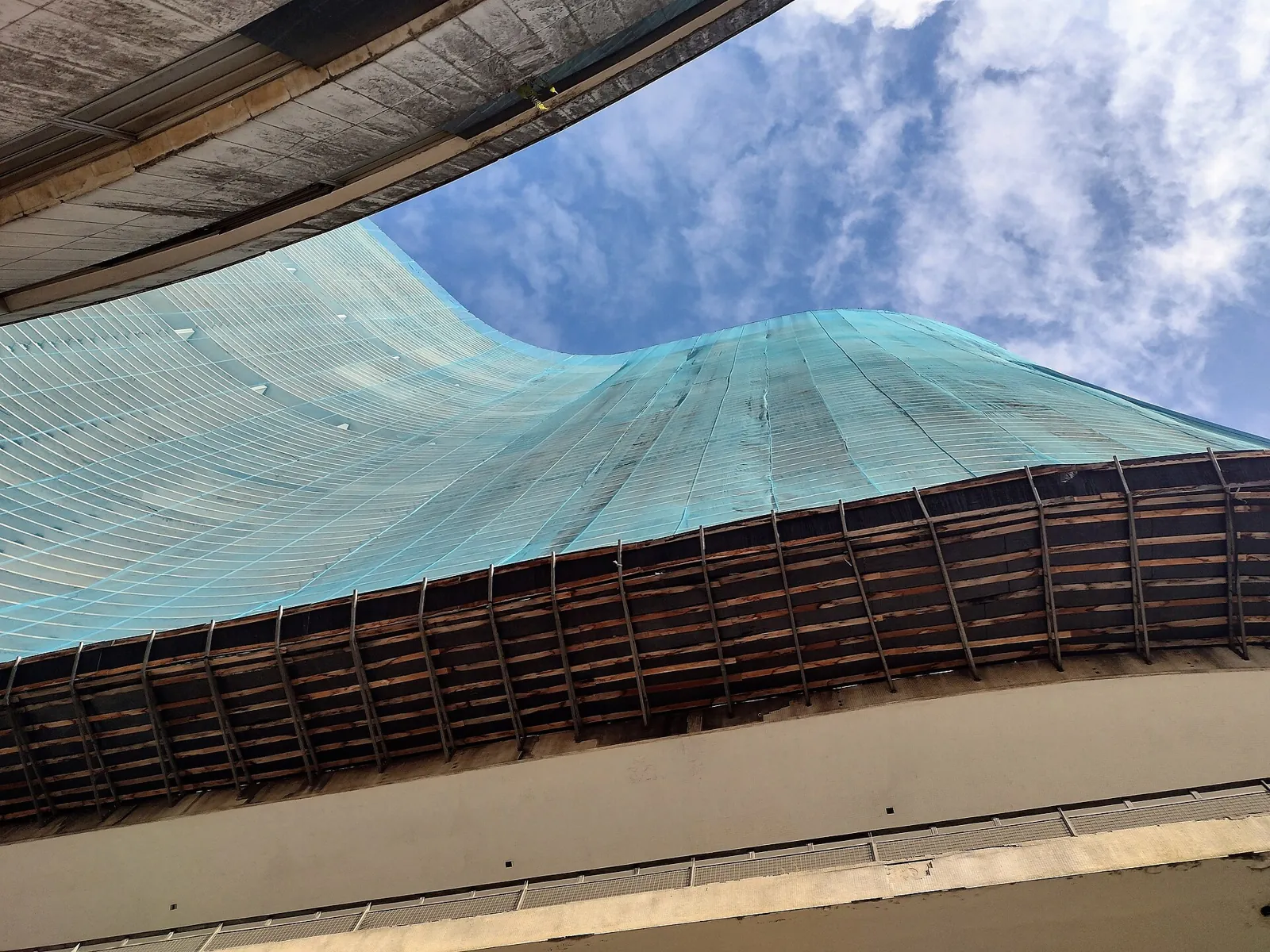
Edifício Copan in the center, seen from below with netting on its curved facade.
Flooding here has two faces. The extreme one is the floodplain. In early February 2025 the Tietê overflowed into Jardim Pantanal in the east zone and residents were cut off for about a week, in what reporting called the area's worst flood in 15 years. By December 2025 the city's recovery plan aimed to remove 1,338 families and about 1,000 properties to clear the riverbank. The everyday one is the storm drain. On 24 January 2025, 125 mm of rain fell in one day, according to the Defesa Civil, the third-largest such total in 64 years of INMET records at Mirante de Santana, and the city logged 37 flood points. Residents near Fradique Coutinho station told Metrópoles in 2023 of clogged storm drains and new flooding.
Prime neighborhoods are not exempt. In QuintoAndar's resident surveys, only 59% in Vila Olímpia ruled out flooding, against 73% in Itaim Bibi and 75% in Moema. These are opinions from small samples, so use them as a prompt. Moema's low ground is getting a large underground reservoir, due in May 2027. Visit the block during a January storm if you can, and use our flood and slope checklist with the city's GeoSampa map.
Landslides concentrate at the edges. A January 2024 report using Defesa Civil data counted 185,634 homes in 489 mapped risk areas across 29 of the 32 subprefectures, led by M'Boi Mirim with 60 areas. Sé, Vila Mariana and Pinheiros had none. Parque Brasilândia, Jardim Ângela and Campo Limpo were among the named locations. Hills inside prime areas are a question of steep streets more than of mapped risk, as in Vila Madalena.
Power failure is the risk foreign buyers underestimate. Enel São Paulo's outages left about 2.1 million properties dark in November 2023, 3.1 million in late 2024 and about 4.2 million in December 2025, and restoring everyone that last time took six days. The regulator Aneel began proceedings that could end the concession, and on 6 October 2026 the rapporteur voted to end it before another director asked for up to 60 days' review. The contract runs to June 2028 in any case. As a general observation, a blackout in a high-rise stops lifts and often the water pumps. Ask whether the building has a generator, what it powers and who pays for the fuel.
Water is the newer worry. Reports in February 2026 put the largest reservoir network near 32%, its lowest since the 2014-15 crisis, and the Cantareira system stood at 32.99% at the end of August. Sabesp has reduced night-time pressure since August 2025, cut to eight hours from 10 p.m. to 6 a.m. from August 2026. The governor ruled out rationing for now in September. Ask how large the building's water tanks are, and test the top floor's pressure on a late visit.
Crime figures and how they fall
The state security department recorded 530 homicide victims in the city in 2025, up 6.4% from 498, which is about 4.6 per 100,000 on the census population by our arithmetic. Through May 2026 the count was 188, down 9.6% on the same months of 2025. Robbery is falling: 98,300 cases in 2025, the lowest in the 25-year series, and 41,418 in the first five months of 2026 against 45,496. Theft rose 3.6% to about 250,100 in 2025.
Prime areas have a different crime from the outskirts. Homicide is rare there: the Mapa da Desigualdade 2025, as reported by Portas, ranks Itaim Bibi second-lowest in the city at 0.98, Jardim Paulista fourth and Moema fifth. Phone theft is the local plague. A TVT News analysis of state data ranks Pinheiros first among bairros for stolen phones, with 3,091 cases, and the guide to Pinheiros from MySide names Largo da Batata, Faria Lima and parts of Rebouças as hot spots. Phone robberies across the city fell to 21,881 in January to May 2026 from 26,392 a year before.
Street-level data exists. O Globo's crime map, cited by MySide, shows 21 phone robberies on Avenida Brasil in 2025 and 7 on Alameda Campinas in the Jardins area, while the worst street in the city had 314. A figure for residents' sense of safety comes from QuintoAndar's surveys: 78% in Itaim Bibi and Moema and 85% in Vila Olímpia called their area safe, with complaints about robberies in the comments. As a general observation, residents choose by foot traffic after dark and by how a building controls access. Ask the front desk about incidents, and walk from the nearest station at night before you decide.
Hospitals, international schools and shops
Medical care is one reason people choose this band of the city. Around Jardim Paulista and Bela Vista you have Hospital Sírio-Libanês, Hospital Alemão Oswaldo Cruz and units of Albert Einstein, plus the public Hospital das Clínicas and InCor heart institute next to Pinheiros. Itaim Bibi has Hospital São Luiz, and Moema residents name Santa Paula and Alvorada. The cost of living page sets out what health plans and school fees add to a monthly budget.
International schools charge in the range of a good apartment's rent. An independent 2026 guide gives indicative annual tuition of R$ 110,000 to R$ 180,000 at St. Paul's, R$ 100,000 to R$ 160,000 at Graded, R$ 90,000 to R$ 145,000 at GIS-SP, R$ 85,000 to R$ 130,000 at Chapel and R$ 75,000 to R$ 120,000 at Pan American Christian Academy, usually with a one-time enrollment fee of R$ 5,000 to R$ 25,000. Confirm with each school, and drive the school run at 7:30 a.m. before you commit to an address.
Everyday shopping is easy in most of the band. Guides name Pão de Açúcar and St. Marche in Pinheiros, and Moema adds Carrefour. Shopping JK Iguatemi and Shopping Vila Olímpia anchor the office district, and the Saturday antiques fair at Praça Benedito Calixto is a Pinheiros institution.
São Paulo state held about 350,000 foreigners and naturalized Brazilians in the 2022 census, the most of any state, though we found no city-only figure. Consulates, corporate offices and luxury hotels cluster around Jardim Paulista. Liberdade is the best-known center of the Japanese-Brazilian community, with its immigration museum. For a smaller city at a similar price, see Curitiba, at FipeZAP's R$ 11,766 a square meter and a 4.92% yield.
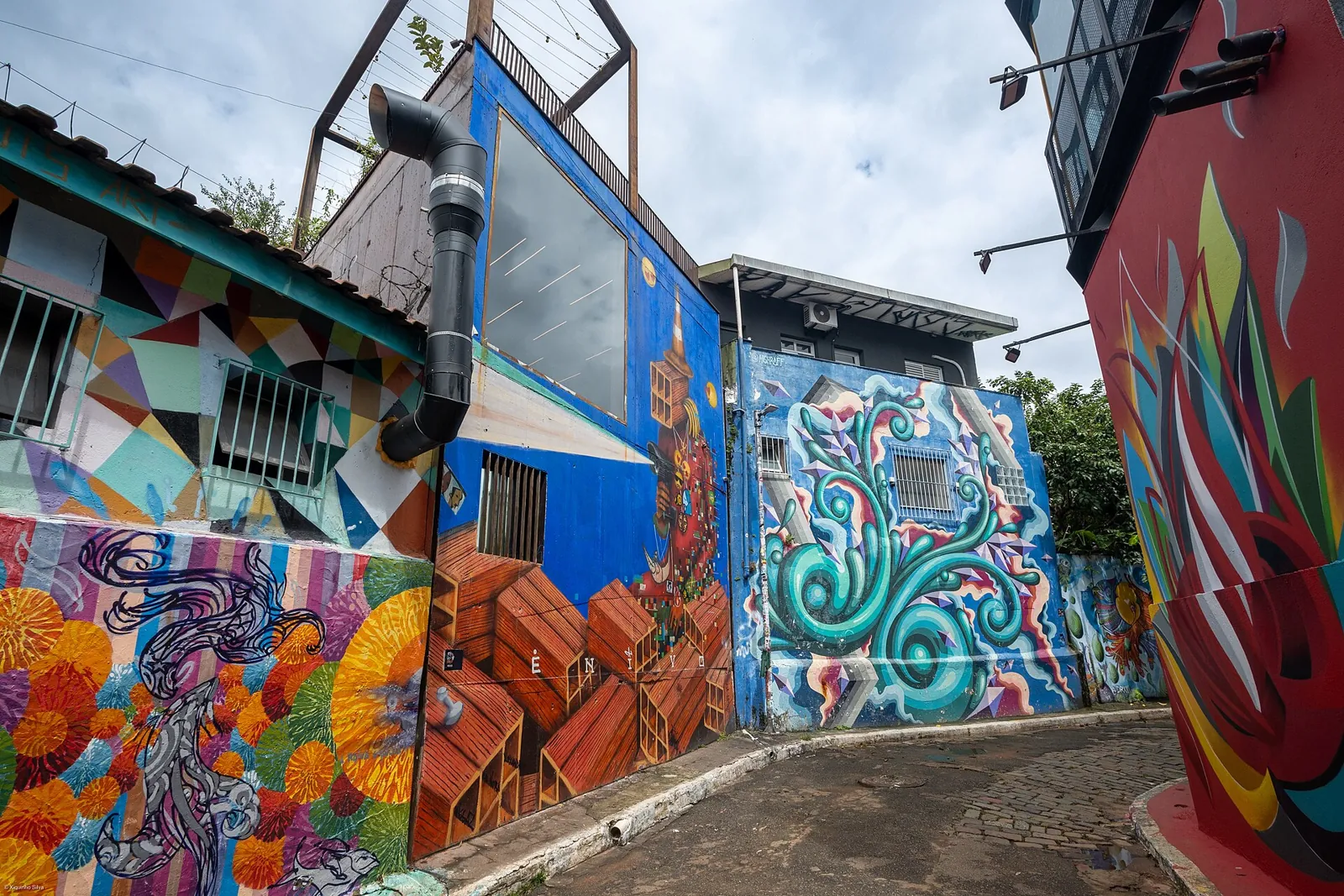
Beco do Batman in Vila Madalena, where house walls serve as an open-air mural gallery.
Rain, cold and what a summer or winter visit tests
The Mirante de Santana station's 30-year averages (INMET, 1991 to 2020) give highs of 29 °C in February and 22.9 °C in June and July, with lows of 12.8 °C in July. Annual rainfall is 1,658 mm. December to March brings 1,010 mm, or 61% of it, and January alone 292 mm. August gets only 32 mm.
A trip from December to March shows you the things that cost money: storm drains, leaks, roof membranes, the Enel network under stress. The December 2025 blackout and the January 2025 downpour both came in this stretch. It will not show you the mid-year cold. From June to August a visit shows what the mild averages hide, since the normals drop to about 13 °C at night. As a general observation, older apartments often have no heating, so a south-facing unit in July tells you more than one in January. These months also show dry-season water pressure at its most delicate.
AirROI's two-year average has November as the peak for occupancy at about 53%, so asking rates on furnished units may look their best around then. Traffic is a year-round test: go at the hour you would commute.
Press a month
JFMAMJJASOND
Bars show rain. São Paulo (Mirante de Santana), INMET code 83781, 1991-2020. Source.
GRU, Congonhas and the rail map
GRU, Guarulhos International, handled more than 47 million passengers in 2025. An Uber trip to the city averages about 32 km and 47 minutes, and traffic can far exceed that. A train alternative exists: the CPTM Airport Express runs about hourly to Luz and Palmeiras-Barra Funda in 35 to 36 minutes at the ordinary fare, and Line 13-Jade runs every 15 minutes on weekdays to Engenheiro Goulart. A free airport transfer links the station to the three terminals in about 10 minutes.
Nonstop service is broad: the operator counted 55 international destinations for July 2026, but GRU's own route list would not open for us. Reports of the operator's December 2025 schedule name Santiago, Buenos Aires, Montevideo, Bogotá, New York, Miami, Lisbon, Madrid, London, Paris, Rome and a returning Munich. Air Canada says Toronto runs all year and Montreal is seasonal from December. LATAM announced Orlando, Boston, Los Angeles and Barcelona for 2026, plus new Amsterdam, Brussels and Cape Town routes at three flights a week, and KLM's Amsterdam flights rise to nine a week in parts of the northern winter. A Roame schedule feed checked in November 2026 also lists Atlanta, Dallas, Houston, Chicago, Newark, Washington, Porto, Frankfurt, Milan, Zurich, Istanbul, Dubai, Doha, Addis Ababa and Johannesburg. We did not confirm those on an airline or airport page, so treat them as unconfirmed and check with the airline. The same feed shows Calgary, Aruba, El Calafate and Ushuaia as seasonal and Geneva starting on 28 March 2027. A terminal list from Passageiro de Primeira, updated in August 2026, names American, Delta, United, British Airways, Air France, TAP, Iberia and Lufthansa among carriers at Terminal 3.
Congonhas, in the south zone, is the domestic and shuttle airport, handling over 590 flights a day amid apartment buildings. Current hours run 6 a.m. to 11 p.m. An airline request to allow exceptional flights outside those hours was under review in July 2026, opposed by about 20 residents' associations. Aena is building a new terminal for delivery in June 2028 and expects passengers to grow from 22 million to 29.5 million a year.
Rail is improving in pieces. Line 17-Gold, a monorail promised for the 2014 World Cup, opened to Congonhas on 31 March 2026 in assisted operation. Since 30 September it has run Monday to Saturday from 6 a.m. until 10 p.m., free of charge, with waits of about nine minutes, still as a transitional service. The full schedule, from 4:40 a.m. until midnight, was expected from October, and we found no report that it has begun. Line 6-Orange opened six stations between João Paulo I and Perdizes on 3 July 2026, running 10 a.m. to 3 p.m. on weekdays, the latest hours we could find. Brasilândia and Itaberaba are promised by the end of 2026 and the run to São Joaquim for the second half of 2027, which would connect Line 4 at Higienópolis-Mackenzie and Line 1 at São Joaquim. Plan on what is open today.
Foreign drivers should read the guide to driving in Brazil. A metro or train ride costs R$ 5.40, and a monthly integrated pass about R$ 411.
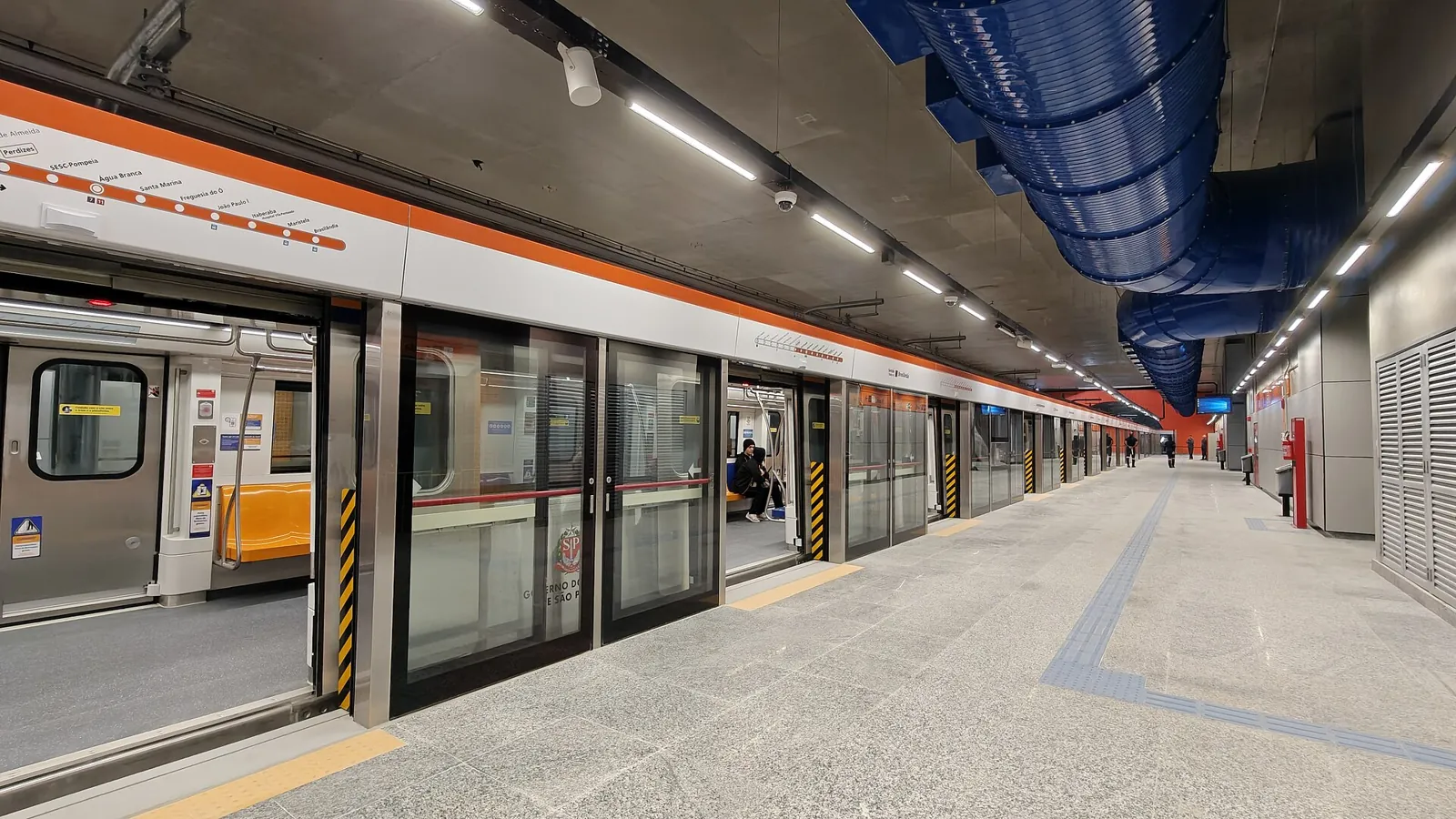
Perdizes station on Line 6-Orange in July 2026, weeks after the first stretch opened.
The rules on what can be built near you are in dispute. The 2023 revision of the master plan, Lei 17.975/2023, widened the corridors where tall buildings are encouraged, from 600 to 700 meters around metro and train stations and from 300 to 400 meters along bus corridors. Building potential there can reach several times the lot; Metrópoles reported up to 14 times. Because blocks are large, urbanists said the effect can reach about a kilometer from the line. Outside the corridors, in the neighborhood interiors, the mayor's veto on the January 2024 zoning law (Lei 18.081/2024) kept the limits at 28 meters in mixed zones and 48 meters in centrality zones.
Then came the fight over the map. The council's July 2024 adjustment, Lei 18.177/2024, redrew blocks and corridors. In February 2026 the state court's special body halted new permits in an interim order, and in April the president of the STF, the supreme court, put that order on hold. On 26 August 2026 the TJ-SP's special body upheld the January 2024 law but struck down article 8 of the July law and its map, so the January 2024 map is back. Permits and filed requests are preserved. Prosecutors and the council have filed further motions, and Portas reported in October that the dispute may run into 2027. Morumbi, Cidade Jardim, Vila Mariana, Perdizes and west-zone blocks were named as affected. If you are buying a house or low building for its land, have a lawyer check which map any valuation assumes. If you are buying an apartment, check what the empty lot next door can become.
Largo da Batata in Pinheiros may change most. In December 2025 the city signed with Instituto IDEA, a nonprofit that will pay for the studies and a basic design of the square. The Faria Lima urban operation sells CEPAC certificates that let developers build up to 4.8 times the lot, and one investor has been buying land around the square. Lines 16-Violet, 20-Pink and 22-Brown could turn Pinheiros into the city's biggest rail junction beyond downtown, with concessions starting from 2026, but these are long-term projects. An environmental study expects much of the surrounding area to become a corridor zone.
In the old center, Requalifica Centro offers tax incentives for retrofits, and Lei 18.330/2025 gives renovated buildings in its perimeter a 60% IPTU reduction for 48 months while phasing out older exemptions. National tax reform is covered in the rental tax guide. Buyers comparing capitals can look at Brasília, where FipeZAP's price rose 9.8% in twelve months.
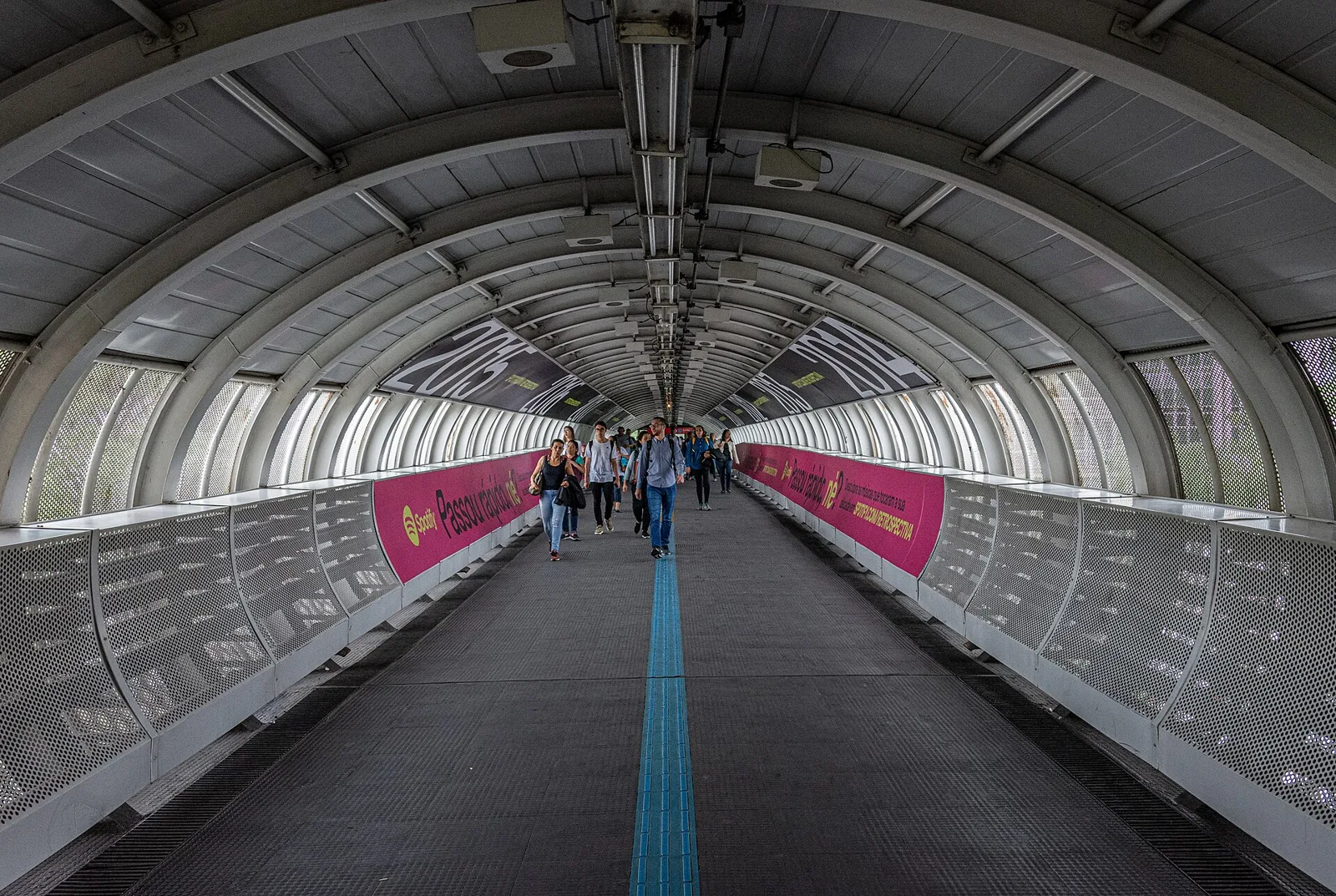
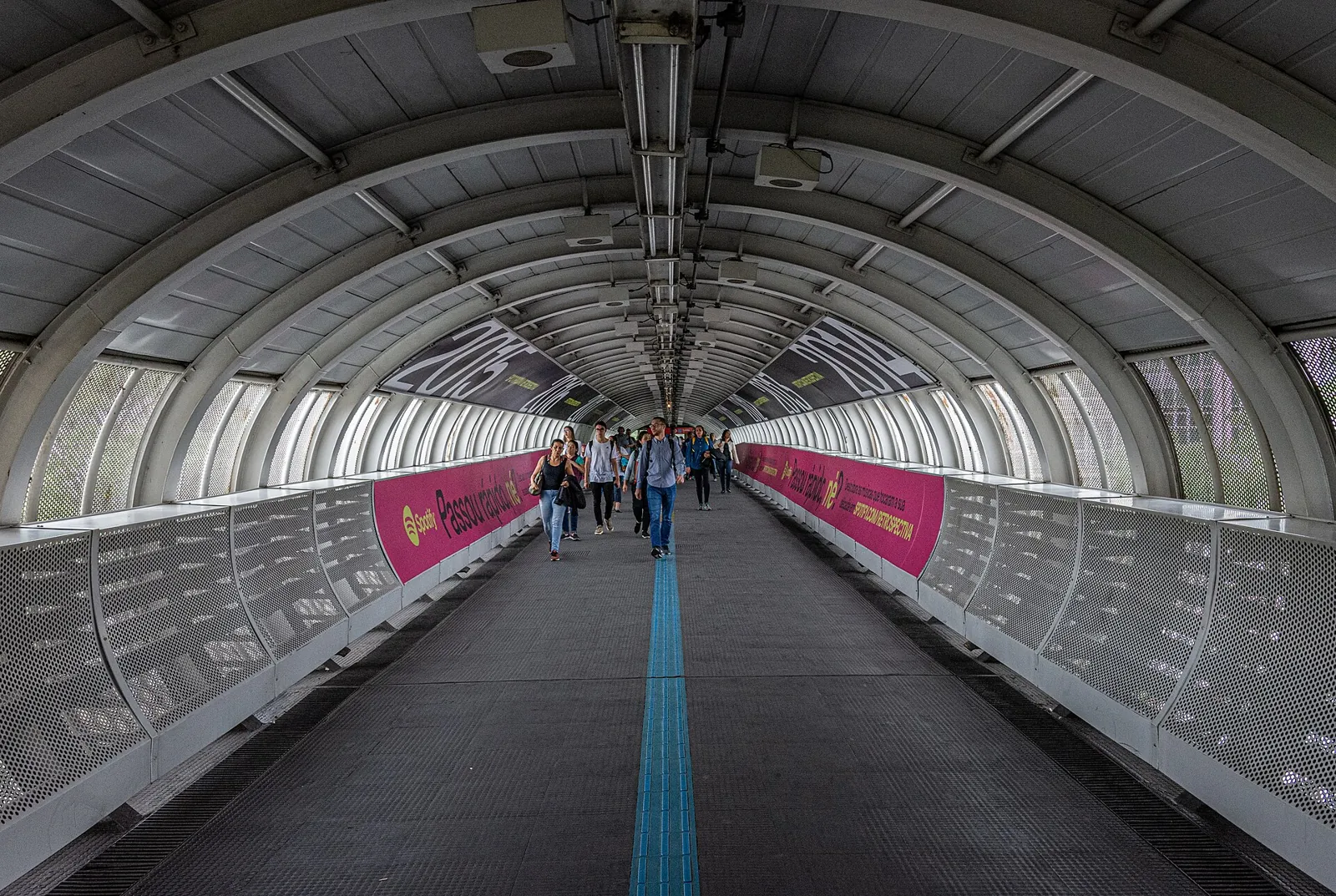
The covered walkway of the Line 9-Emerald station at Vila Olímpia, the rail link for the office district.
You will read that a good São Paulo apartment sells in 60 to 90 days. We found no published series that supports any such number for used apartments, and the closest figures point to longer. Brain puts the average time to sell a new launch at 8.8 months in 2026, up from 7.8, with Barra Funda near 4.9 months and Vila Clementino at 21.1. Secovi-SP's August 2026 figures imply 8 months of stock in the affordable segment and 13 in mid and high-end, and for the largest units, above 180 m², it reached 21 months.
Your competition is new stock. Brain counts 117,000 unsold new apartments in the city, about 25% of everything for sale, including 15,600 already finished. Pinheiros has the largest pile among districts at more than 3,400. A developer can offer payment terms that a private seller cannot, so an older apartment needs a real advantage in size, location or fee.
Pricing evidence is better. In CRECISP's February 2026 survey of used sales, 39.8% closed at the asking price, 43.4% within 5% below it and 14.2% at 6% to 10% below. About 60% of apartments sold had up to 50 square meters, and 35.1% of sales were above R$ 500,000. Banks financed most deals, so as a general observation a clean matrícula, a regular built area and a current AVCB widen your pool of buyers. A unit under the HIS or HMP rules can be sold in its first 10 years only within its band.
Foreign sellers face capital gains and paperwork, covered on our page for foreign sellers, including a procurador if you are away. Whether the 3.5% IOF applies to sale proceeds or rent sent abroad is unsettled, so get current advice before you price the net. You can list a home here for free, or browse homes for sale and the brokerage directory. Those weighing a beach market instead often compare the exit in Salvador, where FipeZAP's price rose 10.38%.
What goes wrong in São Paulo
Buying a studio that turns out to be social housing
A compact unit in a good neighborhood may be HIS or HMP. For 10 years you are limited on who may buy and rent it, and short lets are prohibited. Read the matrícula, the sign at the building and the contract, and ask a lawyer to read Decreto 64.244/2025 against your own income and plan.
Assuming the building allows short lets because it is silent
After REsp 2.121.055 a convention that sets residential use and says nothing else is no comfort, and the STJ's binding ruling on Tema 1.443 is pending. Get the registered convention and the assembly minutes from the manager. If you need short-let income to make the numbers work, ask for a building whose convention expressly authorizes it.
Paying ITBI on the reference value without asking
The city's system may calculate on its VVR when that exceeds your price, although the STJ and recent TJ-SP rulings hold that the declared price prevails absent an individual proceeding. Look up the VVR early and ask a lawyer whether to request an Avaliação Especial or go to court. A later refund suit is possible but takes time.
Reading next year's IPTU from this year's bill
Lei 18.330/2025 reset the value tables. Our reading is that the 10% annual cap only slows the rise until the bill reaches the calculated tax. An apartment whose bill looks low may climb for years. Ask for the current notice, note the assessed value, and work out the tax on the slices in the law.
Trusting a neighborhood average for flood risk
Flooding in the prime band is block by block. Residents near one Line 4 station reported new flooding after construction, and many Vila Olímpia residents in QuintoAndar's survey see some risk. Ask the front desk about garage flooding, check insurance claims in the minutes, and visit in a January storm.
Buying without asking about a generator
Three outages since 2023 hit millions of Enel customers, the last taking six days to clear. Without backup, a high-rise can lose its lifts and water supply. Ask what the generator covers and read how the condominium paid for it.
Missing the contaminated-land register
Land contaminated by metals, solvents or fuels is on the register in Itaim Bibi, Santo Amaro, Mooca and Barra Funda. A listed lot can still be housing, with conditions, but any new permit goes through the city's environmental group. Search the IPTU number on GeoSampa before you buy a house for redevelopment or an off-plan unit.
Valuing a lot on a zoning map that a court has replaced
The July 2024 map fell on 26 August 2026 and the January 2024 map returned, with motions still pending. Lots marketed for extra height may no longer have it. Ask which map the seller's numbers use and get the current block classification from the city.
In asking prices, FipeZAP's latest reading (September 2026) is R$ 12,206/m², up 3.64% in twelve months. Itaim Bibi runs near R$ 20,000. Values declared to the city for tax are much lower, as the price table on this page shows.
What yield does long-term rent give on a São Paulo apartment?
FipeZAP's gross long-term yield for the city is 6.43%, before condominium, vacancy, IPTU and tax. Your own result depends on the fee, which can pass R$ 2,000 a month in Itaim Bibi or Jardim Paulista.
How much is ITBI in São Paulo?
It is 3%. The city says the base is the reference value whenever it exceeds the price, while the STJ's Tema 1113 protects the declared price until the city proves otherwise in an individual proceeding. On a sale at R$ 1,000,000 the tax comes to R$ 30,000 if no dispute arises.
Can I rent my apartment on Airbnb in São Paulo?
It depends on the building and the unit. HIS and HMP units cannot be let short-term at all. In other residential buildings the STJ's May 2026 ruling requires two-thirds approval, and a binding decision is pending. See the short-term rental guide.
What does HIS or HMP on a matrícula mean?
It means the unit was built under the city's social-housing incentives. For 10 years its sale and rental are limited to families in an income band, with sale prices capped at up to R$ 537,673 in 2026. Ask a lawyer before you buy one as an investment.
Is there a flood risk in Jardins, Itaim or Moema?
None of these has the river-plain risk of Jardim Pantanal, yet street flooding happens block by block in heavy storms. Check the city's GeoSampa map and ask the building about its garage during January storms. The flood guide explains the maps.
How safe is São Paulo for residents?
The city recorded 530 homicide victims in 2025, about 4.6 per 100,000, and the rate is far lower in districts such as Itaim Bibi. Phone theft is the common risk in busy prime areas, with Pinheiros at the top of one ranking.
How long does a São Paulo apartment take to sell, new or used?
No reliable figure exists for used apartments. New launches take about 8.8 months on average, and large new units much longer. In one 2026 survey about 83% of used sales closed at or within 5% of the asking price.
Which airport should I use?
Guarulhos handles the long-haul flights and sits about 32 km out by road. Congonhas is inside the city for domestic trips, and since 2026 has a monorail link that keeps limited hours.
How much do I need for the investor visa here?
The threshold for São Paulo is R$ 1,000,000, higher than in the North and Northeast. The visa page covers the paperwork.
Do foreigners face extra rules buying a São Paulo apartment?
Can a foreigner take a mortgage on a São Paulo apartment?
Banks financed most used sales in the 2026 CRECISP survey, but terms for foreigners differ. The financing guide compares Brazilian loans, seller terms and borrowing at home.
We use cookies, including Google Analytics, to understand how visitors use this site. You can accept or decline non-essential cookies. See our Privacy Policy.
The social-housing label on small apartments
This is the local trap most likely to cost a foreign buyer money. Since the master plan, developers have received building incentives for two social categories, HIS (Habitação de Interesse Social) and HMP (Habitação de Mercado Popular). The units look like any new studio or compact apartment, often in expensive neighborhoods. Press accounts of a council inquiry listed developments in Pinheiros, Vila Mariana, Perdizes, Vila Nova Conceição, Vila Clementino and Itaim Bibi. The city's figures, reported in June 2026, are that at least 321,000 such homes have been built and that they make up about 75% of the city's housing production.
Under Decreto 63.130/2024 and Decreto 64.244/2025, the unit must stay within its category for 10 years from first sale or the occupancy permit. The housing department says sales and rentals in that period are limited to families in the income band, that buyers must not own another residential property, and that short lets are prohibited, platforms included. Testimony to the inquiry reported in October 2025 said an investor need not meet the income test but must declare the unit will be rented out, so the tenant must qualify instead. Have a lawyer read the decree as it stands on the day you sign.
Enforcement is real but uneven. The city reports at least 926 irregularity proceedings covering about 171,000 units. It has fined 45 builders and managers R$ 44.1 million over 1,054 units, and sent platforms lists covering 62,812 units, after which Airbnb and Booking.com began removing ads. By June 2026 it had also halted a tender for automated monitoring, so violations still surface mainly through prosecutors' complaints and registry offices. The council inquiry's report, approved on 19 May 2026, proposed a voluntary regularization program and tougher penalties, and sent its findings to state and federal prosecutors and the police.
The registry will not warn you the way it did. In 2025 alert notes began appearing on matrículas of suspect units. In April and May 2026 a court ordered them removed after a challenge by the developers' associations, so the record now shows only that a unit is HIS or HMP. Prosecutors said registry offices had flagged more than 8,200 social units with signs of irregularity. A clean-looking record therefore tells you the category and nothing about any inquiry.
Courts have gone both ways on the use of these units. One São Paulo appeal panel barred an owner in a Vila Madalena building from short lets, and a judge annulled a convention change permitting them in a Pompeia building, yet another suit in that same building was dismissed. Buyers who say they were never told of the restrictions have sued to cancel their purchases, and those who won generally proved the builder had not been open about it.
Check four things: the matrícula for the classification, the official sign the city requires at these developments, the building permit, and the sales contract. As a general observation, a compact unit priced near one of the caps above deserves the question at once. If you do not fit the income band and you still want a small unit in Pinheiros or Vila Madalena, ask for a unit outside these categories in writing. Off-plan buyers should read the off-plan guide as well.