A district of Porto Seguro with a heritage square, protected coast and contested land, for second-home buyers and short-let owners ready to pay for title work first.
The city's tax table gives Praça São João its highest land value in the district, R$ 900 per square meter against R$ 43.64 for the rest of the village; no sale data is published.
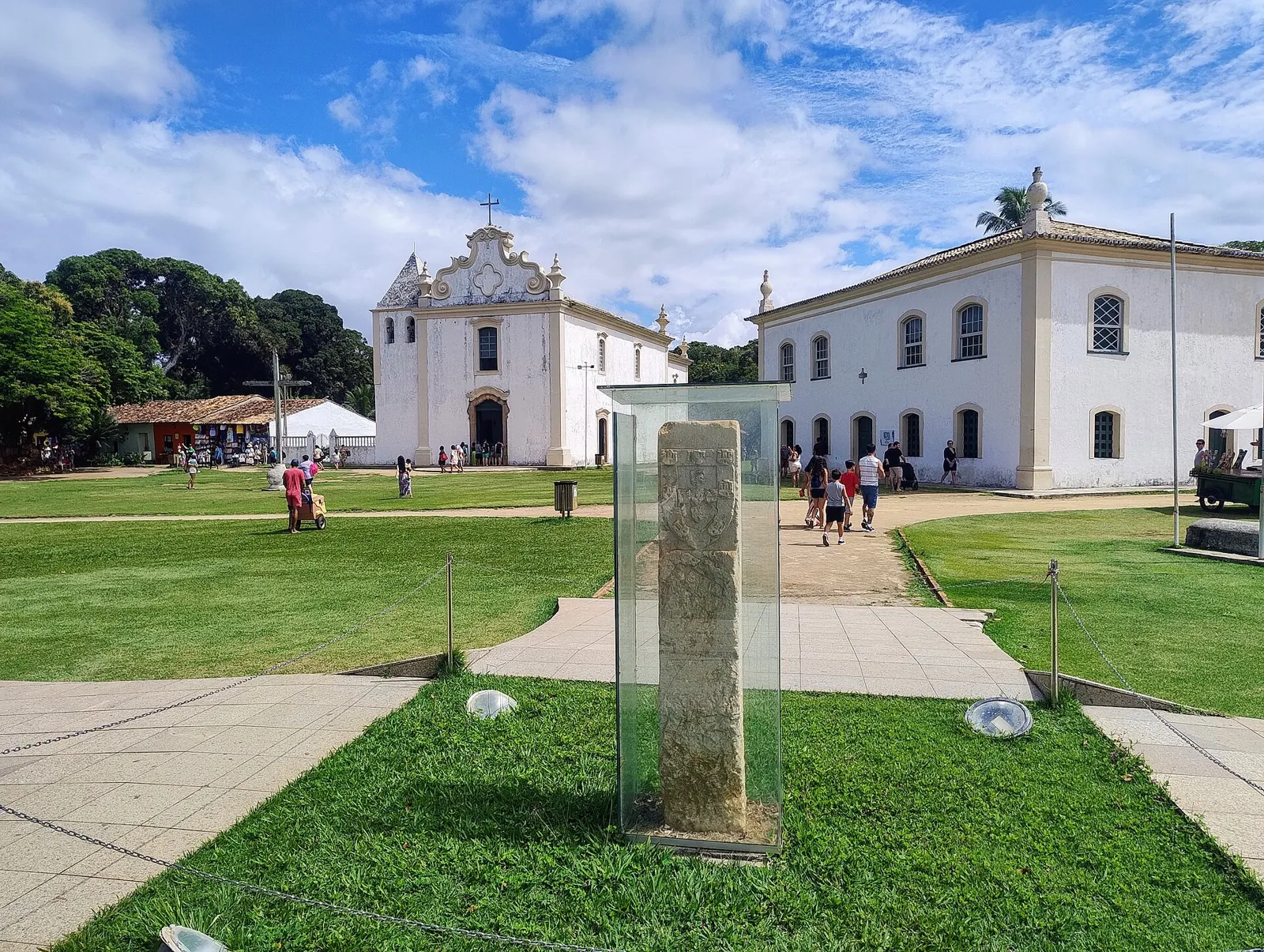
Praça São João Batista: The square itself; the city's top land value in the district, and IPHAN reviews work here.
Rua Carlos Alberto Parracho: The way into the square, taxed at about a third of the square's land value.
Rua da Gameleira: Grouped with Parracho in the tax table at R$ 312 per square meter.
Avenida Minas Gerais (Rua Principal, BA-987): Restaurants near the square, everyday shops and pharmacies further in, cheaper inns on the way to the bus station.
Ladeira da praia: The slope to Coqueiros, partly paved and shared with cars; about a 10-minute walk.
The beach-side zone has a tax land value of R$ 567.28 per square meter, against R$ 200 just inland of the Arraial road; no sale data for the beach is published.
Rua da Cuba: Named in the tax annex as the start of a road to the beach; a reference point for the Z-48 zone.
Estrada para praia: The road from Rua da Cuba named in the tax annex; a limit of the R$ 567.28 zone.
Estrada Municipal Arraial/Trancoso: The road that divides the beach-side zone from the R$ 200 zone inland.
Estrada para Itaquena: Runs south behind the beaches toward Itaquena, forming the zone's western limit.
The tax annex sets land at R$ 200 per square meter in the 500 m closest to the sea and R$ 66.67 in the next kilometer; no sale data is published for this stretch.
BA-987 toward the Caraíva junction: The paved start from Trancoso; the tax annex puts this strip at R$ 60 per square meter.
Dirt road past the Rio dos Frades: Guides call it the BA-283. It passes Imbiriba, with potholes after rain.
Outeiro das Brisas gatehouse road: The fork for the condominium and the last stretch to the cliff.
Access to Curuípe: About 5 km of dirt from the sign, ending at the cliff-top parking.
Estrada para Itaquena: The coastal road north toward Trancoso's beaches, passing the disputed Itaquena land.
Altos de Trancoso's land value for tax is R$ 450 per square meter; a broker listed 233 m² in Vilas do Altos at R$ 3.9 million in late 2026.
Rua Porto Livre: Named in listings for houses in Altos de Trancoso; forest-backed lots.
Rua do Telégrafo: A 1,700 m² property was listed here at about R$ 8 million with an R$ 890 fee; check it is the Trancoso street.
Rua Projetada: The placeholder street name on Casa Coqueiros in Vilas do Altos; ask for the registered address.
Estrada dos Macacos: A named tax zone at R$ 87.28, far below Altos; listings use the Macacos name.
Rua João Vieira up to Rua dos Sabiás: A tax zone at R$ 140 in the village, the cheaper alternative to a gated lot.
Suits
A second home used in December, January and July
Buyers with their own title lawyer and months for searches
Short-let owners who can carry long quiet months
Renters wanting a season near the beach, booked early
Look elsewhere for
Anyone who needs a hospital without crossing a river or a long road
Buyers who want an index price behind the deal
Anyone counting on steady monthly rent to cover costs
Trancoso has no price index
FipeZAP, the asking-price index behind most city figures on this site, does not cover Trancoso, and no other published index was found. The only market-wide number is the median on our own index: R$ 11,273 per square meter, drawn from a mere 7 listings that state an area, out of 47 tracked, whose median asking price is R$ 3.8 million. Use it as a rough guide only. Seven listings cannot describe a market where one broker's page runs from a 233 m² villa at R$ 3.9 million to a 6,600 m² property at R$ 33.2 million.
What the press reports comes from people selling property. A report published in August 2026 by Paraíba Business, citing Forbes, quotes a partner at one local agency saying her firm's properties have not resold below the previous transaction, with gains of about 15% a year. That describes one firm's deals, and no index backs it. The same report quotes another agency pricing plots between R$ 2.7 million and R$ 3.5 million, with a developer on villas from R$ 25.5 million and 23 branded estates sold. A February 2026 item from Valor's property section, which looks like sponsored content and which we could read only in a news aggregator's summary, mentioned plots around R$ 10 million and mansions at R$ 120,000 a night. Neither gives a price per square meter.
The brokers' explanation is scarcity: protected land, occupancy rules and few plots left. Part of that holds up in the public record, since the state's protected area covers 31,900 hectares of this coast and federal heritage rules reach the village. Another limit on supply gets less attention: large blocks of land here have disputed title. The chapters on title and indigenous claims matter more here than any price chart.
New supply is arriving in small, branded lots. Mitre, a listed developer, approved the purchase of four properties in Trancoso in October 2023 for a project under the Daslu Properties name. One project close to the square sells 21 m² apartments as quotas in a project company. No public record breaks buyers down by origin. The visitor flow gives one clue: Porto Seguro's tourism office projected 888,530 visitors to the whole municipality between 20 December 2025 and 22 February 2026, and Argentines were nearly all the foreigners it expected.
Scale matters. Porto Seguro had 168,326 residents at the 2022 census, and IBGE estimates 182,630 for 2025. The Trancoso district counted 18,618, of whom 15,118 live in areas classed as urban and 3,500 in rural ones.
Buyers who want a beach village with some price data can compare Búzios, also outside FipeZAP, with an index median of R$ 18,571 from 9 listings, and Jericoacoara, at R$ 8,571 from 7. Those who want a heritage town on the coast also look at Paraty. Buyers who want Bahia with an index behind the city price can start from Salvador, which FipeZAP put at R$ 8,691/m² in September 2026.
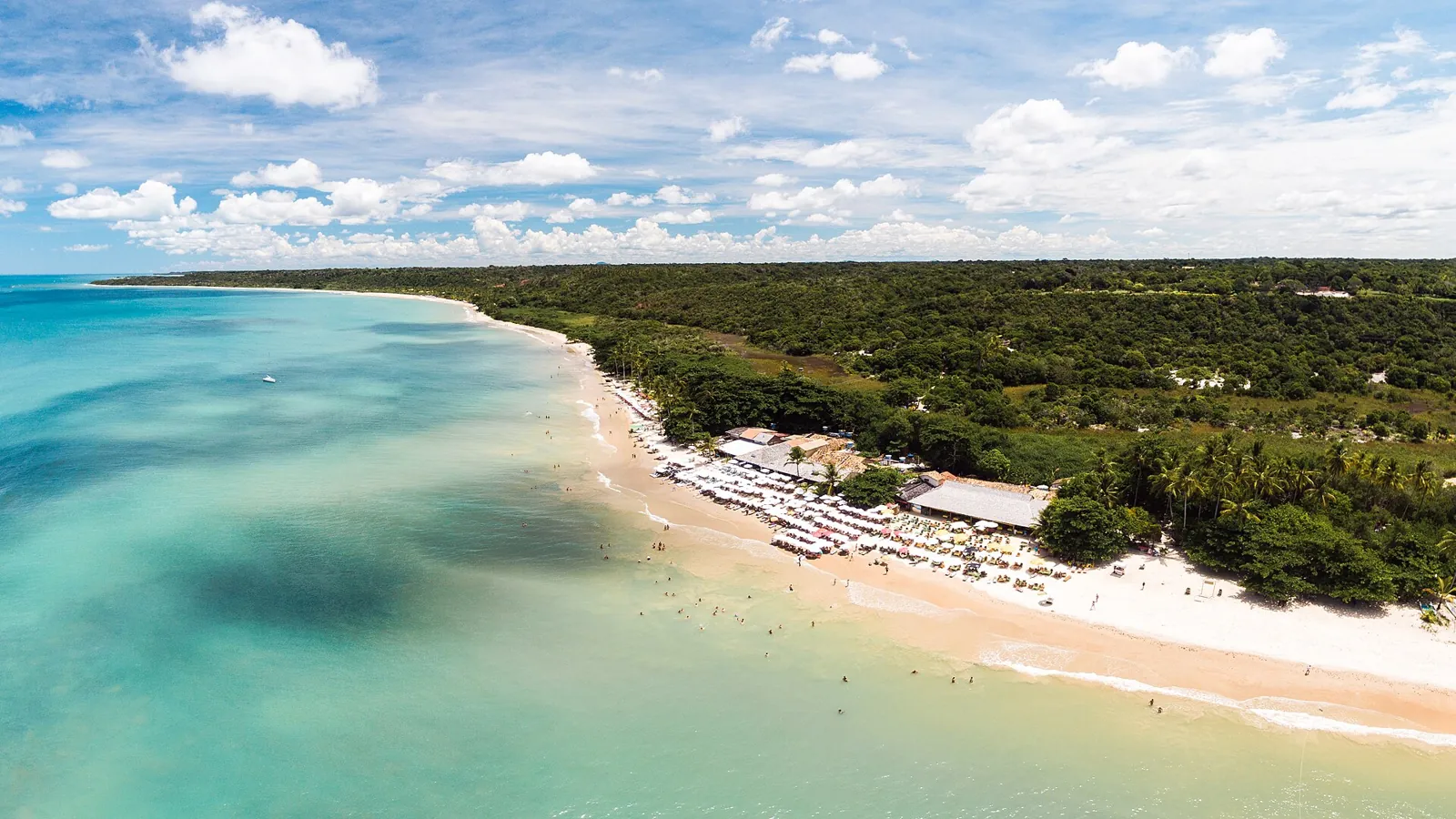
Praia dos Nativos has more inns at the sand line than its neighbor across the Rio Trancoso.
Trancoso is a district of the municipality of Porto Seguro, with no city hall of its own. Its taxes and permits answer to Porto Seguro, and federal land cases have gone to the court in Eunápolis. Property records can sit in the Porto Seguro registry or in the combined registry and notary office in Trancoso, so ask which holds yours and search both. The village sits on a cliff top, with the beaches below it, the protected coast south of it and the ferry to the airport to the north.
The cliff-top village
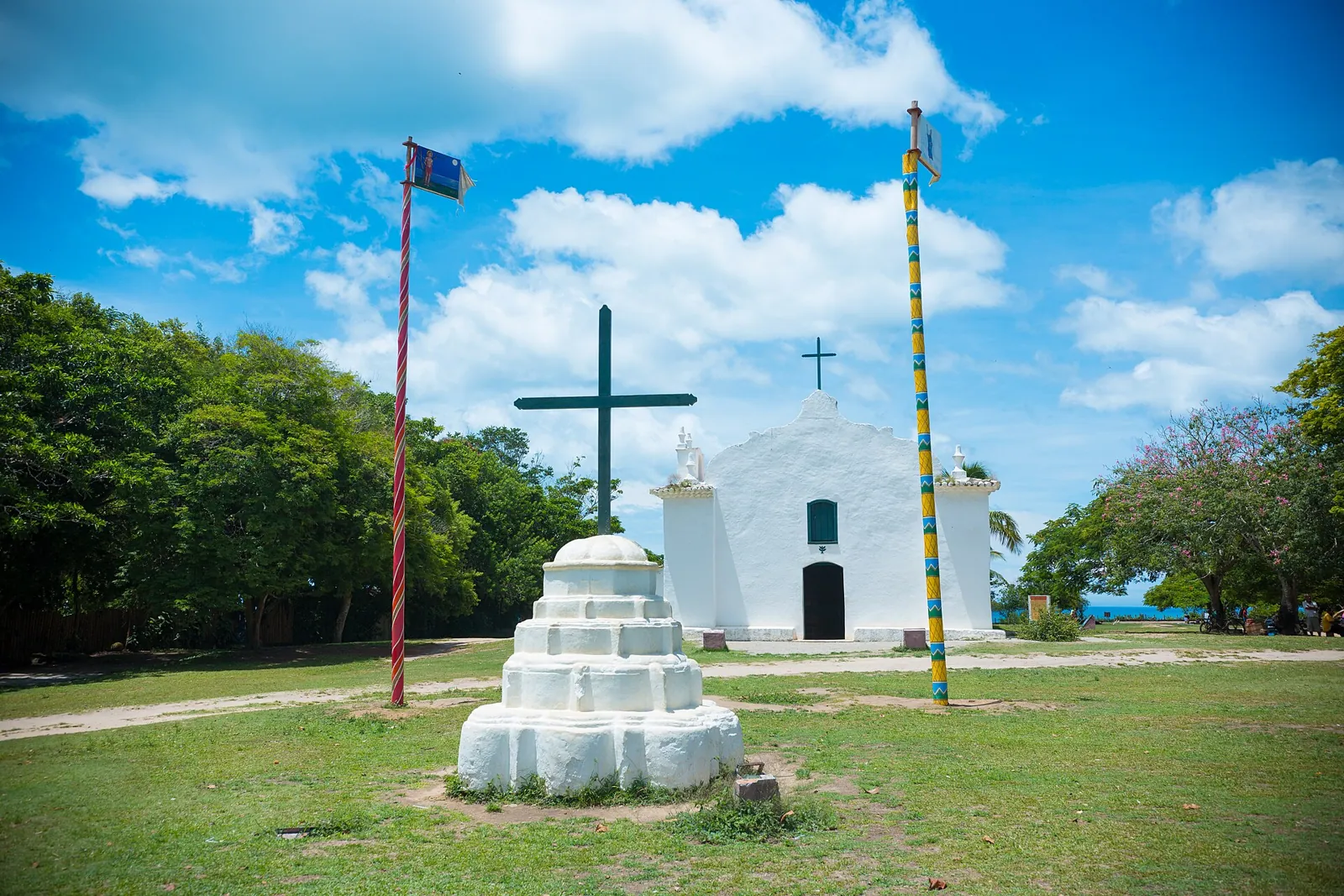
O Quadrado, officially Praça São João Batista, is a compact rectangle of about 400 meters with a church at one end. Rua Carlos Alberto Parracho leads into it. Avenida Minas Gerais, also called Rua Principal or the Estrada para Itabela (BA-987), is the working street: restaurants near the square, then plain shops and pharmacies, then cheaper inns toward the bus station. The further inland, the less tourist trade and the lower the prices.
The beaches, south to north
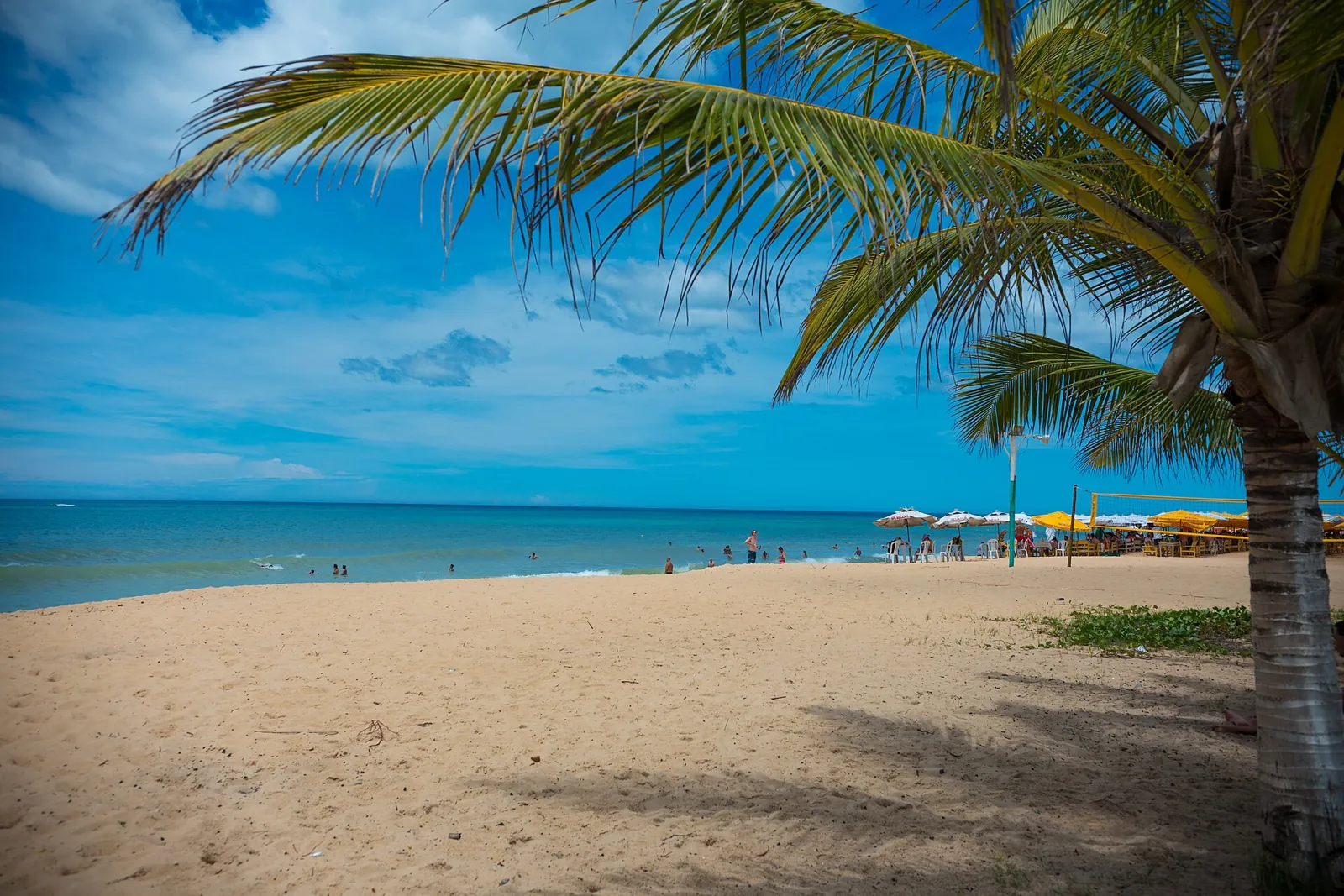
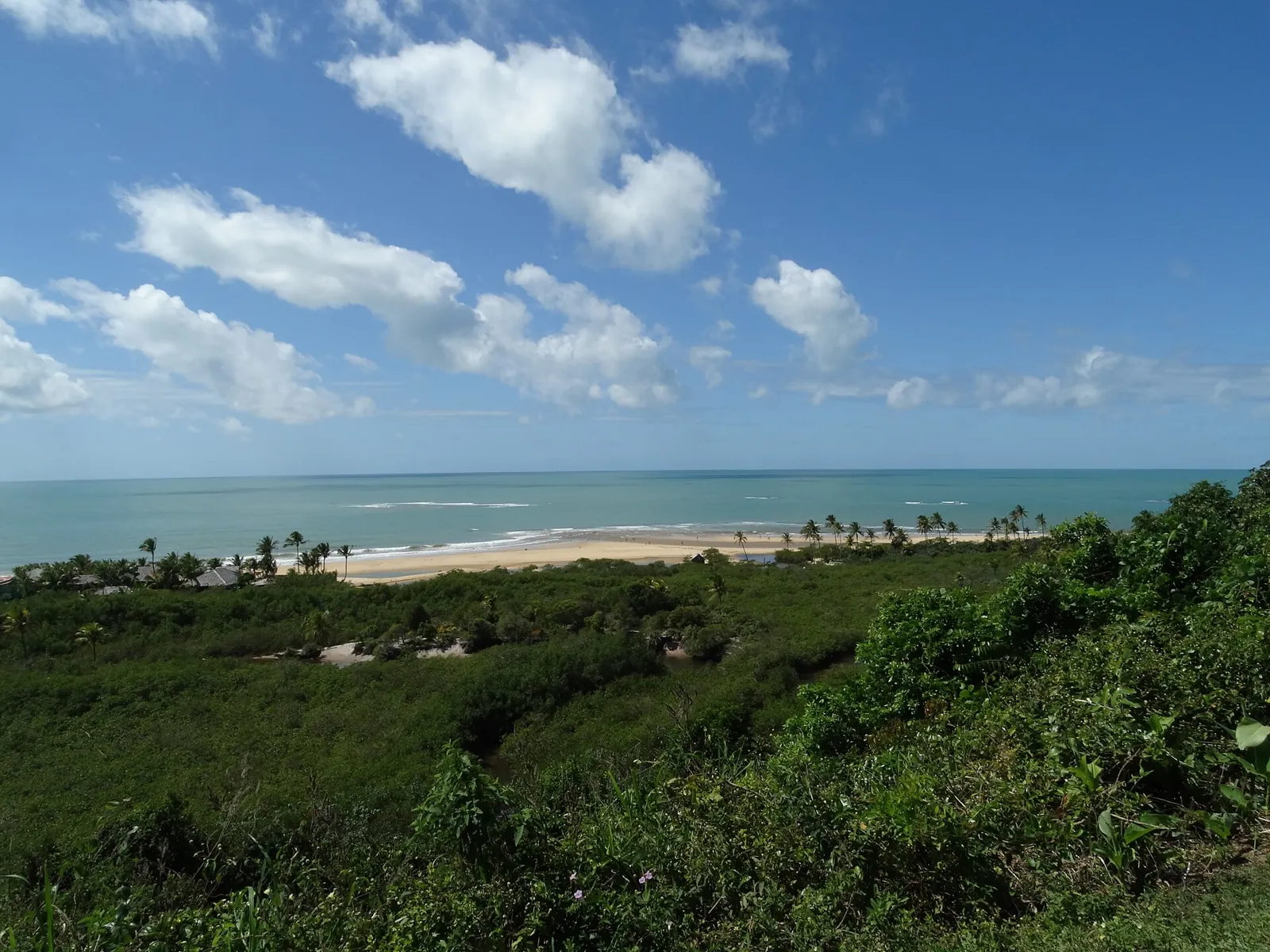
Travel guides and the Terravista site name Itapororoca, Rio Verde, Coqueiros, Nativos, Rio da Barra and Tartarugas. The Rio Trancoso separates Coqueiros from Nativos: at low tide you can wade it, and at high tide it takes more effort. Coqueiros and Nativos are about 1 km from the square. Rio Verde is a little under 4 km from the village and Rio da Barra is about 5 km north of it.
Gated land north and on the ridge
Terravista, on the Estrada Municipal at km 18, describes itself as more than 400 hectares of conserved forest with 18 golf holes on the cliffs, two named condominiums and a private runway. Its published coordinates put it a little north of the square. Altos de Trancoso is its own subdivision on the cliffs, and one rental listing puts it about 8 minutes' walk from Coqueiros.
South of the pavement
The road to Praia do Espelho is 22 to 24 km, most of it unpaved after the first 6 km. A 2025 guide gives the beach's official name as Curuípe and places it in the Caraíva district, a detail worth checking on any deed. The gated Outeiro das Brisas sits on that access road, which means the name "Outeiro" is used for land far from the village. Caraíva is about 36 km from Trancoso.
North toward the ferry
Arraial d'Ajuda is about 28 km north, roughly 40 minutes by car. Beyond it the ferry crosses the Buranhém River to Porto Seguro and the airport.
The church closes one end of the Quadrado, officially Praça São João Batista, on the cliff top.
This is a house market. Of the 39 short-let listings in AirROI's October 2026 report, 27 were houses, 11 apartments or condominium units and one a small hotel. Nine had five or more bedrooms. Published sale listings show the same range, and none we found describes a high-rise.
Three kinds of product turn up most. Large houses in gated subdivisions are the first: a house with 450 m² built on a 1,539 m² plot in Altos de Trancoso, and houses of 500 m² and 550 m² shown on Terravista's site. Small villa compounds are the second, such as Casa Coqueiros, a 233 m² three-suite with a private pool, at R$ 3,947,508 in Vilas do Altos. The third is new: Trancoso Spot, about three minutes from the square, has 35 units on two floors with 6 garage spaces; those on sale measure about 21 m² and are sold as quotas in a project company, which the seller's page says dissolves after delivery so the quotas can convert into units with their own registry files. The off-plan guide is required reading for that, since owning part of a company differs from owning a registered apartment.
Condominium fees vary with the shared services. One broker's page shows R$ 890 a month for a property on Rua do Telégrafo, R$ 1,440 for a 320 m² unit on Rua da Pousada and R$ 1,700 for a 1,181 m² property. Ask for the accounts and the last assembly minutes; the fee guide lists the warning signs. As a general observation, on unpaved internal roads the fee is often what keeps access open, so a low fee deserves a question.
Water and sewage
We found no published plan or coverage figure for water and sewage in the Trancoso district. The 2022 census gives the municipality as a whole: of 60,234 occupied homes, 35,757 (59%) were on a sewer or storm network, 10,333 (17%) had a septic tank not connected to any network, and 12,873 (21%) had a rudimentary pit. Trancoso residents complained in 2022 that the newer occupied neighborhoods lacked basic sanitation. For any house, ask who supplies the water, where the sewage goes and when the septic tank last got emptied, and ask for that in writing. Embasa, the state utility, supplies water in the village, and after a December 2021 storm it needed up to 48 hours to restore it.
Official land values and asking prices by area
The most useful public document on relative prices in Trancoso is the city's own tax table. The Planta Genérica de Valores (the land value schedule for property tax) sets a reference value per square meter of land, zone by zone. These are tax values, well below the asking prices further down, and the annex carries no date, so check the current year's figure. They are still the only official ranking of Trancoso's streets.
Land reference values for property tax, Porto Seguro annex III, part C
Zone
Area
R$ per m² of land
Z-33
Praça São João (the Quadrado)
900.00
Z-42
Terravista
567.28
Z-48
Beach side from the Rio da Barra to the Fazenda Itapororoca limit
567.28
Z-50
Caraíva riverfront, Jambreiro and village beach
567.28
Z-35
Altos de Trancoso subdivision
450.00
Z-33A
Rua Carlos Alberto Parracho and Rua da Gameleira
312.00
Z-34
Estrada para Itabela (BA-987)
200.00
Z-37
Inland of the Arraial road, Rio da Barra to Rio Trancoso
200.00
Z-41
First 500 m from the sea, Rio Verde creek to Rio Caraíva
200.00
Z-36
Rua João Vieira to Rua dos Sabiás
140.00
Z-39A
Estrada dos Macacos
87.28
Z-41A
Next 1 km inland of Z-41
66.67
Z-38
BA-987 from the Caraíva junction to Trancoso
60.00
Z-39
Rest of the village
43.64
Z-40
Other land around Trancoso
6.40
Asking prices sit far above those values, and they are hard to compare because sellers divide by different areas. The table below shows what one broker's page listed in late 2026. The per-meter figures are our arithmetic, except the Casa Coqueiros one, and the page gives a single area per listing without saying whether it is built or lot area.
Sample asking prices, Lopes listing page, late 2026
Property
Asking
Area shown
R$ per m²
Casa Coqueiros, Vilas do Altos
R$ 3,947,508
233 m²
16,916 (broker's figure)
Rua da Pousada, condominium
R$ 4,200,000
320 m²
13,125
Condominium, 7 bedrooms
R$ 12,500,000
1,181 m²
10,584
Estrada do Rio Verde, house
R$ 33,215,000
6,600 m²
5,033
Rua do Telégrafo, house
R$ 7,992,000
1,700 m²
4,701
Claims of "R$ X per square meter in Trancoso" need one question: per square meter of what? A 21 m² quota unit at R$ 767,885 to R$ 874,919 works out, by our arithmetic, at R$ 35,500 to R$ 40,500 for each square meter of private area. A 2018 Correio report quoted local agents at R$ 800 to R$ 1,000 per square meter for undeveloped land in the Itapororoca area. Both figures can be accurate and they measure different things. Compare like with like, ask for the built area and lot area separately, and ask whether the price includes the furniture.
Year-round rent and who needs it
No published index, rent survey or yield exists for Trancoso, so this site quotes no long-let yield here. Numbeo's figures for the city of Porto Seguro, updated in October 2026 from just 4 contributors, show central one-bedrooms from R$ 1,200 up to R$ 1,500 and central three-bedrooms from R$ 2,200 up to R$ 3,500. We read them as a floor, not a Trancoso price, and we found no comparable number for the district.
The people who need year-round housing are the ones who work in tourism, the district's main business, and the pressure shows. A Tarde reported in 2022 that about 3,000 families linked to a rural movement had occupied at least three large properties around Trancoso since 2020. A petition from residents, with 600 signatures, backed the cause of land access and criticized the unplanned neighborhoods.
The 2022 census shows what happens to housing in a tourism municipality. Porto Seguro as a whole had 60,234 occupied homes, 11,874 vacant ones and 10,258 kept for occasional use. No district breakdown is published in the table we could read. As a general observation, an owner who can ask over R$ 1,000 per night in January has little reason to sign a yearly lease, so a renter may do better looking inland along Avenida Minas Gerais or in Arraial d'Ajuda.
We found no local source on deposits or guarantor practice, so assume the national rules apply and ask the agent which guarantee they accept. A foreign owner who does let by the year should read up on rental income tax for non-residents.
Short lets, in numbers and rules
The one named data source we found for Trancoso is AirROI, whose latest report covers October 2025 to September 2026. It tracks 39 active listings, a small sample, and its monthly figures are noisy for that reason. Average nightly rate: R$ 1,310. Occupancy: 32.5% of open nights. Average revenue: R$ 107,316 per active listing for the year, gross of cleaning, platform, management and tax. The median listing took about R$ 7,320 a month, the bottom quarter R$ 3,450 or less, and the top tenth R$ 38,900 or more. The best single listing, a six-bedroom home, took R$ 567,937.
AirROI, average per active listing, Trancoso
Month
Occupancy
Nightly rate
Revenue
Sep 2025
23.9%
R$ 1,300
R$ 5,876
Dec 2025
42.6%
R$ 1,527
R$ 23,291
Jan 2026
45.3%
R$ 1,553
R$ 24,759
Apr 2026
28.1%
R$ 1,140
R$ 13,040
May 2026
21.2%
R$ 1,124
R$ 9,464
Jul 2026
43.7%
R$ 1,210
R$ 22,358
Aug 2026
31.2%
R$ 1,086
R$ 13,475
The headline numbers in the press describe a different product. Correio found a mansion listed in December 2024 at R$ 800,000 for ten New Year nights and 12 guests, against R$ 18,000 a day at other dates, and said 83% of Trancoso's Booking.com lodging was already taken for the holiday. The 2026 Paraíba Business report quotes R$ 35,000 a night in high season at one villa, R$ 1.3 million for ten days at year-end, and a local partner who says September and October run close to full. AirROI's tracked listings do not show that in those months, at 23.9% and 29.6%, though large villas let through agencies may not appear in its sample. Ask any manager for a real statement from the actual house.
Rules
We found no municipal ordinance written for short lets. The tax code charges a Taxa de Turismo Sustentável of R$ 2 per room-night, which the executive may index, on "hotéis, pousadas, resorts, apart-hotéis, condomínios e similares", and money raised in Trancoso must stay in Trancoso. The code does not say how the tax reaches a private house let through a platform, so put the question to the Secretaria de Finanças. AirROI reports no permit numbers on any active listing, and one commercial site, BNB Calc, says a municipal registration is required but rarely enforced. We found no ordinance behind that statement, and lax enforcement gives no legal cover. A condominium may also restrict short lets: the national guide explains the general position, and the specific subdivision's convention decides the rest.
An environmental fee on out-of-town cars was due to start on 15 June 2026, at R$ 9.90 a day for a car, read from the plate. The city postponed it to August 2026 pending a decree, and no report we found confirms that charging has begun. Reports put the free period at either 6 or 8 hours. Check the city's site and tell guests before they arrive, because it will otherwise reach you as a complaint.
Still unsettled for non-resident hosts, and worth an accountant's time: whether a 3.5% IOF reaches rent or sale proceeds, how far CBS and IBS reach non-residents beyond the limits, and what becomes of the deduction of R$ 600 for short lets. The rental tax guide sets out what is known.
Short-let arithmetic
Starts from published figures (October 2025 to September 2026, 39 active listings). Set your own.
All taxes here are Porto Seguro's, under Lei 925/2010. The version on the city's site was compiled in 2021 and includes Lei 1.696/2021. The city's tax legislation page, read in November 2026, still posts that compilation and no later code or ITBI law, but we could not search every municipal gazette, so have the city confirm the numbers below before you budget.
ITBI, the transfer tax, has a trap in its headline number
Article 143 sets 6% on ordinary sales, 4% on bank-financed property and 2% on low-income homes. A separate paragraph then gives a 50% financial discount to anyone who pays after signing and before the transfer is registered. A buyer normally pays before registering, so the rate met in practice is 3%, or 2% on the financed part, and one calculator site lists 3% for the city. On the code's wording, a payment outside that window owes the full rate. The article's own text has a slip, "6,00% (três por cento)", which is one more reason to get the figure on the city's form. The base is market value and cannot fall below the city's updated value. The national tax guide covers disputes over that base.
Worked example
Purchase costs at the discounted ITBI rate, 2026 Bahia fee table
Price
ITBI at 3%
Escritura
Registration
Total
Share
R$ 1 million
R$ 30,000.00
R$ 9,555.60
R$ 9,555.60
R$ 49,111.20
4.91%
R$ 3.8 million
R$ 114,000.00
R$ 19,379.08
R$ 19,379.08
R$ 152,758.16
4.02%
R$ 5 million
R$ 150,000.00
R$ 25,192.90
R$ 25,192.90
R$ 200,385.80
4.01%
Without the discount, the R$ 1,000,000 case rises by R$ 30,000. Certificates, surveys, a lawyer and any laudêmio on federal or municipal land come on top. In a market with this much title risk, a real title review is part of the purchase price. The closing costs guide lists the rest.
Annual IPTU on a house
The base is land area times the zone value above, plus built area times a construction value by standard, from R$ 301.99 per square meter for the lowest house standard to R$ 2,000 for the highest. Homes then pay 0.5% up to R$ 65,133 of assessed value, rising in steps to 1.2% above R$ 651,334. Vacant land pays 2%. Commercial buildings pay 0.9% to 1.5%. The code allows a discount of up to 15% for settling the year in one payment by the due date, with no debts to the city. A lot touching two streets is assessed on the more valuable one.
Four rules hit Trancoso harder than a city apartment:
Land beyond five times the built area is taxed at the vacant-land rate (article 167). On a 3,000 m² lot with a 300 m² house, 1,500 m² falls at 2%. At Terravista's R$ 567.28 that is about R$ 17,000 a year on that part, by our arithmetic, before any factors.
Uncovered built areas count at half value, so decks and pergolas are taxable.
A gated condominium is one of the listed factors the executive can apply, and location and tree-cover factors can add up to 25%.
A building or extension never declared to the tax office can be assessed back to 1 January of the fifth prior year, under article 169. In a market full of informal additions, ask for the city's record of the built area and compare it with what you see.
By the same tables, a 450 m² top-standard house on a 1,539 m² lot at Altos de Trancoso comes to about R$ 1.59 million of assessed value and R$ 19,100 a year, before factors. A modest 100 m² house at construction standard F on a 300 m² lot in zone Z-39 comes to about R$ 300 a year.
This is the chapter to read before anything else. Elsewhere in Brazil, a clean matrícula (the property's registry file) is close to the end of the search. In Porto Seguro the state's own court inspectors questioned the registry itself.
What the inspectors found
The Corregedoria-Geral de Justiça, the Bahia court's oversight body, inspected the notaries and registries of the Porto Seguro judicial district and ran an extraordinary inspection of the registry and notary office in Trancoso. As reported by Bahia Notícias in June 2024, its report spoke of "caos registral" and of an office working as a repository for whatever document was presented. It listed, as allegations and testimony: areas belonging to the state and the Union ignored, along with traditional occupants, vacant public land and preservation areas; parcels released from registrations blocked by a state land action; registrations of unspecified areas; subdivisions larger than the original registered area; and entries not linked to the prior registration. The report itself named the effects: higher risk when buying in Porto Seguro and insecurity for families holding titles.
The holder of the Porto Seguro property registry was removed from duty in April 2024 and lost the post in August 2024, after the oversight body found that handling of a land regularization had produced duplicate registrations and overlapping areas. The April inquiry also listed subdivisions exceeding the registered area and old public titles accepted without checking their authenticity. The full Bahia court removed three judges in June 2024 in an investigation that covers land grabbing, and in 2025 a labor court judge was removed for up to 140 days in a probe of alleged beachfront sales in Trancoso preservation areas. The reports present those matters as allegations under investigation, not findings of guilt. For a buyer, the practical point stands either way: titles issued in those years deserve a closer look.
A registered title can still fall
Three cases show how. In September 2025, a Supreme Court justice halted a removal order over about 3,121 hectares in the Itaquena area, which the State of Bahia sold to a company in 1979. He found signs the title may be void, because the 1967 Constitution required Senate authorization for a sale of that size and the file showed none, and he ordered the registrations marked unavailable. In July 2026 the federal appeal court halted an eviction of the Pataxó village on that land, noting that the title is still under review. In May 2025, that same court annulled any private titles affecting Fazenda Araponga, inside the Barra Velha indigenous land. And at Itapororoca, a person holding a 1962 municipal aforamento letter (a long lease from the city) took a developer to court over 28 hectares; the state court halted works on that plot and upheld a R$ 1.68 million fine in July 2018. We have no information on how that case ended.
Possession-only land
Posse (possession) without a registered title is part of the local land market. In the Itapororoca case the developer's defense rested on a cadeia possessória, a chain of possession. Do not take an IPTU bill as evidence of ownership: under article 168 the taxpayer can be the owner, the holder of the useful domain, or a possessor of any kind. The ITBI article likewise taxes the assignment of rights and of a usucapião claim. So a seller can have paid taxes for years and own nothing a registry would recognize. Occupied areas add a second layer: at Mirante Rio Verde, a 112-hectare farm inside the protected area, a 2021 repossession was carried out and later halted, and A Tarde reported in 2022 that the case had stalled for eight months. The possession guide explains the limits of a possession purchase.
Municipal and federal landlords
The code lists "laudêmios, foros, arrendamentos" as city income (article 251) and can enroll unpaid ones as tax debt (article 315). New municipal aforamentos are banned, but existing ones are still collected (article 378). So look for that word in the chain. On the federal side, no published list maps terreno de marinha across Trancoso plot by plot. The city's inspectors at the 2024 Itapororoca wall recorded no intrusion on marine land, which shows the question gets answered one site at a time. The regime is explained in the terreno de marinha guide.
Foreign buyers and large plots
Law 5.709/1971 limits rural land for foreigners: free up to 3 módulos de exploração indefinida, a cap of 50 for an individual, a municipal ceiling of a quarter of the surface with 40% of that for any one nationality, a mandatory public deed, and nullity for a purchase that breaks the rules. The module size for Porto Seguro sits in annexes to INCRA's Special Instruction 5 of 2022 that we could not open, so it stays unconfirmed here: ask INCRA, the federal land agency. The classification can surprise you: state minutes from 2025 describe a 51.8-hectare farm that sits in the municipal urban-expansion zone and in the protected area's farming and strict-protection zones at once. See the rural land guide.
What to check
Take the full chain of matrículas back to the original title, and have a lawyer who is not paid by the seller read each link. Look for foreiro, aforamento, domínio útil, ocupação, and any state or old public title. Our title check guide names each certificate.
Pay a surveyor to compare the ground, the matrícula description and the subdivision plan, because area mismatches are what the inspectors flagged.
Search both the Bahia state courts and the Eunápolis federal court for the property, the seller and the parent farm, not only the lot.
Ask Funai in writing, and check the property's coordinates against any indigenous land polygon.
Ask the state land agency about any discriminatory action on the parent area.
Ask your lawyer about staging payment until registration, and check any power of attorney at its source: a sale registered on a proxy from a notary without authority, with a suspected false ID, was among the April 2024 allegations. The power of attorney guide sets out what a proper one looks like.
Pataxó land claims and what they mean for a buyer
Porto Seguro has several Pataxó territories at different legal stages, and they sit close to the land buyers look at. This is a live legal situation: recheck it when you are about to sign.
Indigenous land cases around Trancoso, status as last reported
Territory
Where
Status
Barra Velha do Monte Pascoal
About 52,700 hectares in Porto Seguro, Itabela, Itamaraju and Prado
Boundary review finished at Funai. Declaratory ordinance unsigned as of April 2026, with drafts from 2013 and March 2023; our search turned up no report of a signature since. Court orders require the process to finish.
Aldeia Velha
Near Arraial d'Ajuda, Porto Seguro
Homologated by Decree 12.000 of April 2024. A Supreme Court justice lifted the decree's effect for one company and ordered the process reopened. Eviction ordered over about 1,275 hectares in June 2026, then halted by the same justice on 25 June while appeals are heard. No later decision found.
Lagoa Doce, on Fazenda Itaquena
Near Itaquena, Trancoso district
The 2024 auction judge saw no proof of demarcation, while the Pataxó say a process is under way. About 200 people live there. Title under review on Supreme Court orders, and eviction halted in July 2026.
Imbiriba
On the dirt road toward Espelho
Described as already demarcated in 2024 press.
Comexatibá
About 28,000 hectares in Prado
Declared by the Justice Ministry on 17 November 2025. Later stages remain.
Ponta Grande
Porto Seguro
Still being identified by Funai. An eviction over 134,000 m² next to it was halted in a decision published in March 2026.
The 2025 Supreme Court ruling
The court rejected the marco temporal in December 2025, with the ruling published on 18 March 2026 in ADC 87. That is the thesis that indigenous claims depend on occupation on a fixed date in 1988. As quoted in the federal prosecutors' 2026 technical note, the ruling gives a private party with good-faith title a right to prior compensation from the Union for necessary and useful improvements and, where resettlement is not possible, compensation for the bare land. It also treats improvements as made in good faith only until the Justice Minister declares the limits. So a house started after a declaration may not be covered. Have your lawyer read the ruling itself and tell you what it means for your plot.
What it means in practice
Nobody can tell you from a published document whether a given Trancoso lot lies in a future boundary. A court decision quoted in the prosecutors' note says that delay leaves communities and landowners alike in total legal insecurity. We could not find a public map placing Trancoso's village or the Espelho stretch in or out of the proposed Barra Velha limits, so ask for the coordinates and check with Funai. A court saying "no demarcation here" is also a limited comfort: the federal court in Eunápolis said that of the 179-hectare Reunidas Itaquena auction in 2024, and in 2025 the Supreme Court stepped in over a far larger area in the same holding.
There is a daily-life side too. Protesters closed the Trancoso junction and the accesses to Caraíva and Espelho in July 2026, and a state highway in Arraial d'Ajuda in June 2026. In August 2022 land occupiers closed the road to Curuípe, Itaporanga and Caraíva. Rental guests and contractors feel those days. A house's access road is part of the risk, even when its title is clean.
The Barreiras cliffs near Praia do Espelho, the stretch reached by dirt road south of Trancoso.
Two separate systems control building on this coast, plus the city's own permit. Neither publishes a simple rule sheet for Trancoso that we could find, so a plan has to be cleared case by case.
Federal heritage
Decree 72.107 of 1973 made the entire municipality of Porto Seguro a National Monument, with its urban area, the old captaincy site and nearby historic places, Monte Pascoal above all, to be entered in the federal heritage registers under a special protection regime. A January 2026 press report dates the listing of the Cidade Alta to 1968 and says the protected perimeter was widened in 2000 to about 800 properties, including Arraial d'Ajuda's historic district. Two 2026 press articles describe a 1974 step differently: O Antagonista says it extended protection to Trancoso, Arraial d'Ajuda, Caraíva and Vale Verde and that any change to a facade, roof or the square's lawn needs federal approval, while UAI says it listed only the Quadrado and forbids new building inside the perimeter. We did not find IPHAN's primary record. IPHAN, the federal heritage institute, treats the area as live: staff in Bahia name Trancoso and Caraíva among Porto Seguro's listed places, and its weekly decision sheets for the "Conjunto Arquitetônico e Paisagístico no Município de Porto Seguro" show real files. In February 2026 it refused a request at Estrada Arraial para Trancoso 726, and in May 2026 it approved one on the square itself, at number 437.
No published height, footprint or materials norm for Trancoso turned up, so do not trust a broker's summary of one. IPHAN's Bahia office takes a request for consultation before a formal application, which is the sensible first step. Allow time. A June 2026 letter from IPHAN's Bahia staff says the four technical offices outside Salvador share 10 professionals across the Recôncavo, the coast, the Chapada and the south, and it was written during a strike call. The price of skipping the process showed in January 2026, when IPHAN embargoed a 285 m² beach club under construction in Arraial d'Ajuda for lacking prior authorization.
The state protected area
Decree 2.215 of 1993 created the state's Environmental Protection Area for Caraíva and Trancoso (APA), 31,900 hectares, citing the sandstone cliffs, the Atlantic Forest remnants and the estuaries of the Caraíva and dos Frades rivers between the mouth of the Rio Trancoso and the Rio Caraíva. Its opening recital starts at the Rio Trancoso, so plots north of the river need a check against the boundary annex. Its zoning dates from a 1998 plan, approved by the state council's Resolution 2.532 in 2000. The zones named in recent state minutes include strict protection (ZPR), agro-forestry (ZAF), agriculture (ZAG) and controlled occupation (ZOC). The plan is old. A 2019 federal project set out to revise it, yet in August 2025 council members were still asking when revision would start, and a member recalled a state representative saying there was no forecast.
Changing a zone is possible and contested. At that same meeting a developer presented a request to turn 51.8 hectares of pasture and isolated trees into controlled-occupation land for a gated condominium, with the state council to decide after a technical opinion. Conservation members objected that the plan should not bend to private plots. So buying land because of what it could become means taking a zoning risk. Ask for the zone in writing from INEMA, the state environment agency, and from the city.
The federal Rio dos Frades Wildlife Refuge, 898.67 hectares created in 2007, sits inside the APA, and part of the disputed Itaquena land falls within it.
Beaches, walls and turtles
The Porto Seguro shoreline, Itapororoca included, is a sea turtle nesting area according to a 2024 report. In April 2024 the city's environment office embargoed a 104-meter wall on the sand at Itapororoca because heavy machinery broke a license condition, even though the work had an environmental authorization and IPHAN approval. Environmental leaders argued that the wall would leave eggs exposed to the high tide. We found no Trancoso-specific lighting rule, though a builder near the sand should ask the city and ICMBio, the federal biodiversity agency, about one. Permission from one agency does not protect a project from another.
Porto Seguro's Cidade Alta, where federal heritage listing began before it spread to the southern districts.
We found no official risk map for Trancoso. A search for a federal geological survey report on Porto Seguro's risk sectors turned up nothing we could open, so ask the municipal civil defense office directly and follow the flood and landslide guide. What follows is what the public record does show.
Cliffs
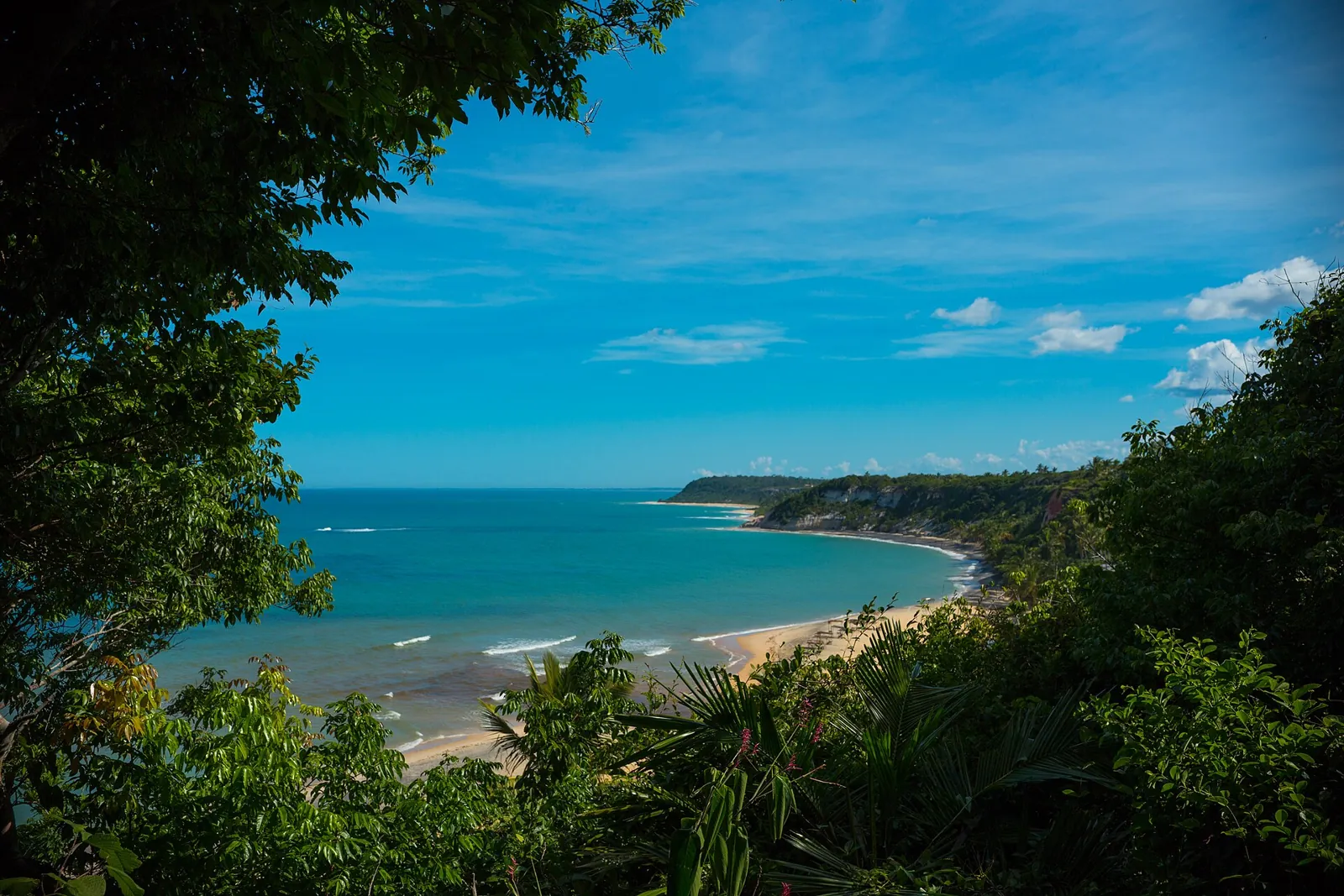
The 1993 decree names sandstone cliffs as the reason this coast was protected, and many of the valuable plots stand on or under them. A 2023 study by Lima and Maia in a Brazilian geomorphology journal found that the cliffs between Porto Seguro and Prado retreat through rockfalls and landslides, driven by weak rock, heavy rain and waves at high tide. It says several tourism businesses and homes have already lost significant ground, reports residents spreading tarps on cliff tops to keep rainwater out, and calls for avoiding construction near the edge. A house near a cliff edge, as a general observation, deserves a geotechnical report on drainage, setback and loads, whatever the listing says about the view. Terravista and Altos de Trancoso both sell cliff-top positions, and stairs or a lift between plot and beach are a maintenance item as well as a selling point.
Erosion
Claims about erosion at Itapororoca and Nativos could not be confirmed from any official survey. A 2007 academic study of the Discovery Coast found that a split in the along-shore sand drift near Itaquena leaves the stretch between Trancoso and Ponta Toque-Toque short of sediment and so susceptible to erosion, yet it also rated most beaches between Trancoso and Corumbau as stable or building out, with low damage potential. That survey is nearly 20 years old and names neither beach. On the ground, the nearest evidence is the 104-meter retaining wall at Itapororoca in 2024, and the reports on it do not say why it was being built. Before buying on the first row, ask neighbors for dated photos of the sand line, and ask why any wall or rock protection nearby exists. The Rio Trancoso also moves water across the sand between Nativos and Coqueiros, so a river-mouth plot needs its own look.
Storms and services
On 8 December 2021 a storm cut power and water in Trancoso for about two days. One inn lost most of its guests to Porto Seguro and Arraial d'Ajuda, residents reported collapsed houses, and the power company said flooded areas, collapsed ground and damaged roads slowed repairs. Rainfall at Caravelas peaks in November. As a general observation, water storage and a generator are worth pricing here; guides report that Caraíva's establishments often keep generators because of peak-time outages.
Roads
The road south of the village turns to dirt and sand. Guides call some stretches very potholed, especially after rain, and one advises against driving it at night. Any plot on that road depends on it for guests, deliveries and an ambulance.
Praia dos Nativos from the high ground, with the wet lowland behind the sand.
The Trancoso district has no published crime rate, so the figures here are for the whole municipality, which has more than nine times its population and includes the mainland city. They cannot be read as a Trancoso rate in either direction. They still should not be skipped.
The 20th Anuário Brasileiro de Segurança Pública, published in July 2026, ranks Porto Seguro fourth among Brazilian cities over 100,000 people for intentional violent deaths in 2025, at 71.2 per 100,000. That compares with 36.8 for Bahia and 19.1 for Brazil. Neighboring Eunápolis came second, at 85.1. The same yearbook puts Porto Seguro first in the country for deaths from police action, at 32.3 per 100,000, and those deaths are part of the 71.2. State police data reported by Correio counted 38 lethal violent crimes in Porto Seguro from January to May 2026, fourth in Bahia.
Reported cases tend to name the city's neighborhoods. In July 2026 police linked three killings over one weekend to a criminal group, including a shooting by a beach kiosk on the Orla Norte, in the city itself. A buyer's question is narrower: which streets, who patrols, and what the local condominium or neighbors have seen in the past year. Ask the police and residents, and read gated-community security as a monthly cost in the cost of living page, not as a guarantee.
Living here outside the holidays
Most serious needs are across the river. The Hospital Regional Deputado Luís Eduardo Magalhães in Porto Seguro handles about 6,000 emergency visits a month, and counts among the region's main references. Its third manager in under a year took over in June 2026: the state replaced the second after reports of a broken CT scanner, shortages of supplies and late pay for doctors. New ICU and emergency beds have opened in the past three years. We found no published details on the health post serving Trancoso village, so visit it before you rely on it.
For private care we found Unimed Costa do Descobrimento, whose local plan covers Eunápolis, Porto Seguro, Santa Cruz Cabrália, Belmonte, Itapebi, Itagimirim, Guaratinga and Itabela, with co-payments of 30% to 50% per procedure. The plan's published page gives no prices. Anyone with a serious condition should price a national plan and a transfer route to Salvador or São Paulo.
School directories list private schools in Porto Seguro city and one other, CEAD Centro Educacional Arraial d'Ajuda, which is on the Estrada do Arraial, but none we could find in Trancoso. Listed fees for elementary grades run from a few hundred reais to about R$ 1,463 a month before discounts. Numbeo has one data point for international primary schooling in Porto Seguro: R$ 15,000 a year. Families should confirm what exists and how the ferry fits the school run.
Daily shopping happens in the commercial center at the far end of the Quadrado from the church and along Avenida Minas Gerais, where supermarkets and pharmacies sit. Guides name no chain, and bigger shopping means Porto Seguro. Public transport is thin across the village, and one guide says ride-hailing apps do not operate. The cultural anchor is the Teatro L'Occitane, whose program comes and goes. No public count of foreign residents exists, and the visible foreign presence in the numbers is seasonal, chiefly Argentine. Readers planning to settle should read the guides on residency and driving; you will need a car.
Weather, and what each inspection visit shows
Neither Trancoso nor Porto Seguro has an INMET long-term normal we could find, so these figures come from Caravelas, the nearest coastal station with temperature normals, roughly 130 km south in a straight line. INMET's 1991-2020 file has no July or November high there, so the climate table takes those two months from its 1981-2010 file: 26.4 °C and 28.6 °C. Highs run from about 31 °C in February to under 27 °C in July and August, lows from about 23 °C to 18 °C. Rain totals about 1,430 mm a year with no dry season: November (214 mm) and April (172 mm) are the wettest months, February and August (71 mm) the driest. Canavieiras, about 100 km north by our map reading, records 1,753 mm, so treat the rain figures as a guide to the pattern, not the amount.
An inspection trip in January shows what guests see, and how a street behaves at its most crowded: parking, noise, water pressure, queues at the ferry. It hides what the house is like when nobody is around. Come in April, May or November to see drainage, roof leaks, mold, the dirt road after rain and the quiet months the rent has to survive. June 2026 press describes the low season as having fewer visitors, emptier restaurants and reduced prices, with the main attractions still open. With time for just one visit, choose the wet shoulder, then speak to a neighbor who has seen a New Year.
Press a month
JFMAMJJASOND
Bars show rain. Caravelas, INMET code 83498, the nearest coastal station with temperature normals, about 130 km south in a straight line. INMET's 1991-2020 file has no July or November high there, so those two values come from its 1981-2010 file, 1991-2020 except those two highs. Source.
Airport, ferry and the long way round
Porto Seguro's airport (BPS) is on the mainland side of the Buranhém River. Buenas Dicas puts Trancoso 47 km from the airport using the ferry and dirt road, and 77 km all on asphalt. Melhores Destinos' 10 km from the airport to Arraial d'Ajuda plus Correio's 28 km from Arraial to Trancoso would make about 38 km, so the ferry trip is 38 to 47 km by these sources, with one river crossing. One Trancoso hotel tells guests to allow about an hour by car. Flights reach it from Salvador in about an hour, Belo Horizonte in 1h20, Rio in 1h30 and São Paulo and Brasília in 1h55, according to that hotel's page.
International flights
JetSMART announced in August 2026 a seasonal Buenos Aires route from 5 January to March 2027, five times a week. Aerolíneas Argentinas began flying to Porto Seguro in 2024 and announced three flights a week for summer 2025-26; a September 2026 report on its summer 2027 schedule lists Porto Seguro but gives no frequency. We could open no airline or airport timetable for either, so both rest on trade press: check before planning around them. A December 2025 report credits the airport with regular flights to two international destinations without naming them, plus weekly charters from Córdoba from January to March 2026. Local projections for summer 2025-26 had 7,920 international passengers against 365,760 domestic. We could confirm no route to Europe or to the United States, so buyers from there connect through a Brazilian hub such as São Paulo, Rio or Salvador.
The ferry
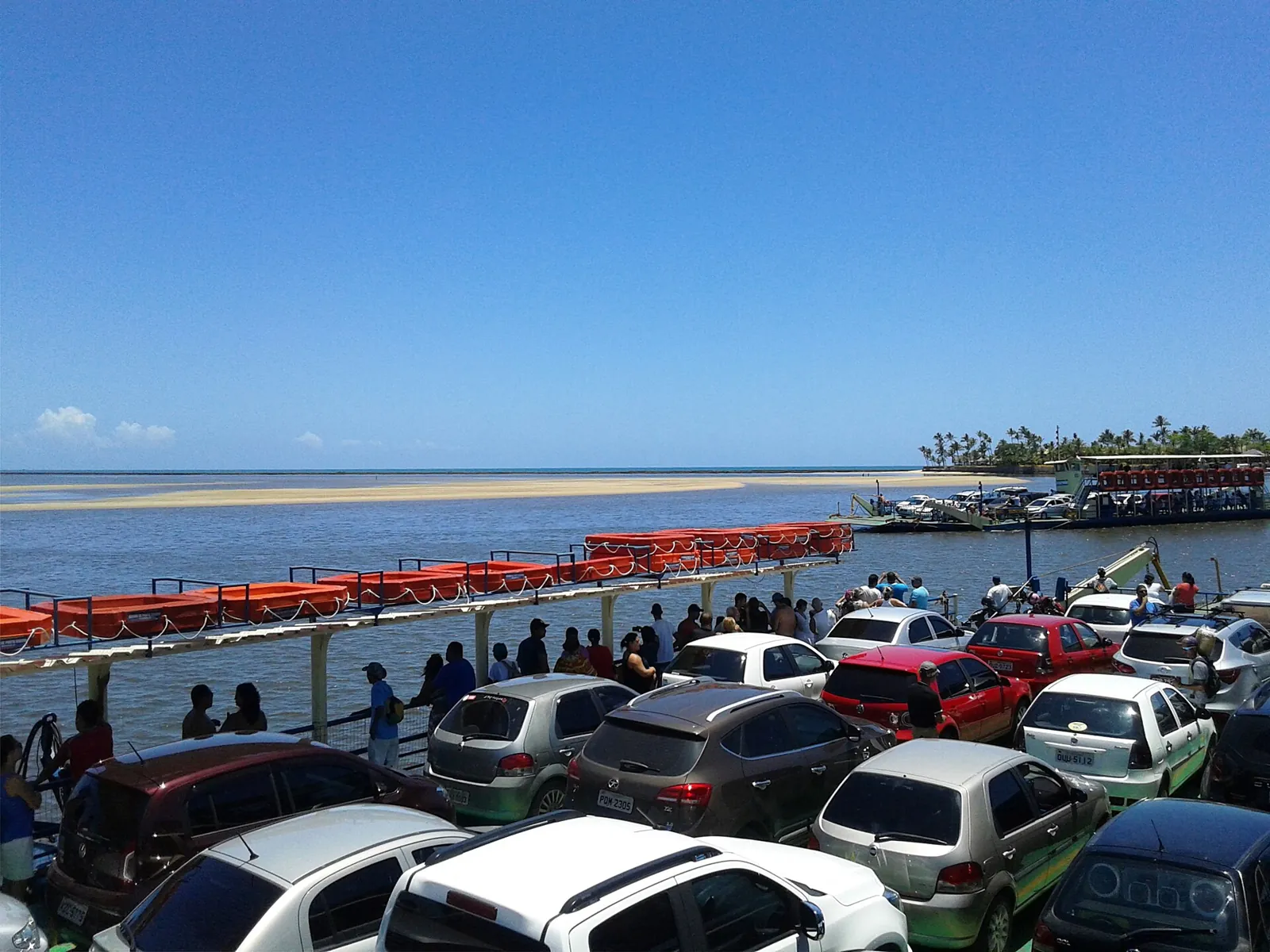
The ferry runs 24 hours and crosses in about 10 minutes. Published fares for a car with driver were about R$ 20 to R$ 21 on weekdays and R$ 25 to R$ 26 on Sundays and holidays when last reported, with pedestrians about R$ 5.50, charged only on the Porto Seguro to Arraial direction. The queue is the variable. One guide says it can pass an hour on busy days and suggests going early, or taking the road when you have a flight to catch; another reports up to two hours at New Year. We could not verify any current rule on truck hours, so builders should ask the city.
The road
The way round without the ferry is close to 80 km between Porto Seguro and Trancoso, starting on the BR-367 toward Eunápolis and then taking the BA-001. Drivers from elsewhere in Brazil come through Eunápolis without touching Porto Seguro's center. One guide calls the road quality poor, and it can still be the better choice when the ferry queue is long. Heavy materials for a build have to come along one of those routes, which affects construction costs. Arraial d'Ajuda sits on both.
Private aviation
Terravista (SBTV) has a 1,500-meter runway and an exclusive terminal, and its marketing says it runs 24 hours, about 15 minutes from the residences. Correio reports about 4,000 movements a year, and the municipality projected about 1,690 operations and 7,700 passengers for summer 2025-26. It filled up completely from 26 December 2025 to 4 January 2026, with overnight parking full and no slots left. A second field, Trancoso Rio Frade (SJFR), has a 1,300 by 30 meter dirt runway on the Rio dos Frades, and an ANAC authorization term, in a file dated 2024, lets a real-estate company run it as a public aerodrome.
Bringing a car
The visitor fee for cars with outside plates slipped from June to August 2026, and we could not confirm it is running yet. A June 2026 report caps a car at 10 daily fees a month, R$ 99. Owners who register a vehicle in Porto Seguro with Detran-Bahia are exempt, and residents and workers can register for exemption. Residents of the surrounding administrative region went from half price to full exemption in that month's changes.
The ferry over the Buranhém River: the short way to Trancoso from the airport, and the queue that decides how short it is.
Indigenous land law: the Supreme Court's December 2025 ruling, the unsigned Barra Velha ordinance, and the open Aldeia Velha and Itaquena cases can all move land values and access.
Registry: new management after the 2024 removals, with old entries still on the books.
Zoning: no date for revising the 1998 APA plan, while individual rezoning requests go ahead. An agreement between the city and INEMA to carry out a revision was reported as proposed in August 2025.
Flights: a new seasonal Buenos Aires route from January 2027.
Fees: the visitor vehicle fee, delayed from June 2026, with its start still unconfirmed.
The national tax reform: open questions for non-residents are tracked in the rental tax guide.
Selling later
Time on the market in Trancoso is not published anywhere we could find, and our own index has too few listings to say. Expect a thin market: the same few agencies, a small pool of buyers who can pay millions, and buyers whose lawyers will now read this same history of the registry. As a general observation, the things that shorten a sale are the ones that protect a purchase: a clear chain of title, a survey that matches the matrícula, built area declared to the city, IPHAN and environmental approvals on file, and a real rental statement. A resale buyer may well ask for all of them, so keep them from day one.
A foreign seller also has capital gains and the route for sending money home to manage. The guides on selling as a foreigner and on how the money comes in explain both, since the paperwork on the way in affects the way out. An owner can test the market on our free listing page, and buyers can compare with what is on offer at homes for sale or through the broker directory. To see how Trancoso sits against other markets, use the market compare table. Buyers who decide that a resale market matters more can compare Praia do Forte north of Salvador, and Pipa near Natal.
What goes wrong in Trancoso
Treating the IPTU bill as if it proved ownership
Porto Seguro's code taxes owners and possessors alike, so a seller's tax receipts show who pays, not who owns. Ask for the matrícula, then read the chain behind it with a title check.
Trusting a matrícula from the years under inspection
State inspectors alleged duplicate registrations, overlapping areas and subdivisions larger than the parent property in this district. Have a surveyor compare the ground with the description, and look up the original farm in court records.
Hearing that the land has no indigenous claim
A broker's word, or even a judge's remark in a separate case, does not settle this. The Barra Velha ordinance is unsigned, and the Aldeia Velha and Itaquena cases have reversed more than once in the past two years. Ask Funai in writing and give it coordinates.
Budgeting ITBI at the wrong rate
The code says 6% with a 50% discount for paying before registration. Sellers quote 3%. Both are the same thing only if the payment falls in that window, so get the amount on the city's form.
Buying a big lot and forgetting article 167
Porto Seguro charges 2% on any land past five times the built area. Work out that figure for the specific lot.
Inheriting an undeclared extension
The city can assess undeclared building up to five years back. Compare the IPTU record of built area with the house, and settle the gap in the contract.
Designing before asking IPHAN and INEMA
Both can stop a project, and so can the city's environment office, as a 2024 wall and a 2026 beach club both show. Ask for a consultation first, then pay the architect.
Taking New Year rates as annual income
The R$ 800,000 holiday package makes the news. AirROI's median listing took about R$ 7,320 a month over its latest year, before costs. Ask for a full year's statement from the actual house.
Buying a quota and thinking you bought an apartment
Some new units are sold as quotas in a project company. Ask what you own, who controls the company, what happens at completion, and treat any projected income as the seller's estimate. The off-plan guide is the place to begin.
Underestimating the road
Beyond the village, access can mean dirt, sand, a ferry queue or a blockade. Drive it after rain, and at the hour your guests would arrive.
No. It is one of five districts of Porto Seguro, with 18,618 residents in the 2022 census. City taxes and permits come from Porto Seguro, whose population was 168,326.
What does property cost in Trancoso per square meter?
No index measures it. Our index shows a R$ 11,273 per square meter median on only 7 listings, and individual asks run from about R$ 4,700 to over R$ 16,000, depending on which area the seller counts.
Can a foreigner buy a house in Trancoso?
Yes, in the same way as elsewhere in Brazil, with a CPF and a registered deed. Rural plots face the caps in Law 5.709, and that is where large farms and sítios need a closer look.
How much is ITBI in Porto Seguro?
Nominally 6%, with a 50% discount for paying before registration, so 3% in the normal case and 2% on a bank-financed part. The code was compiled in 2021, so ask the city to confirm.
Is Trancoso inside indigenous land?
No published map we found settles it. The 52,700-hectare Barra Velha boundary review is unsigned, and a Pataxó village sits on disputed Itaquena land in the district, so ask Funai about the exact coordinates.
Can I build whatever I want on my lot?
No. Expect IPHAN, the state protected area's zoning and the city's environment office all to have a say. We found no published height or footprint rule for Trancoso, so ask for a consultation first.
Is there a nonstop flight from abroad?
Only to Buenos Aires, as far as we could find, and only from trade press: Aerolíneas Argentinas' summer 2027 schedule lists Porto Seguro, and JetSMART announced a seasonal route from 5 January to March 2027. Other buyers usually connect through a Brazilian hub.
Do I have to take the ferry to reach Trancoso?
No, but the road avoiding it is close to 80 km, against 38 to 47 km via the ferry. The crossing takes 10 minutes, and the queue can take well over an hour at busy times.
What can a short-let house earn?
The answer from AirROI's latest report, on 39 listings: R$ 1,310 a night on average, 32.5% of nights booked, and a monthly median near R$ 7,320 before costs. Large villas let through agencies may fall outside that sample.
Is Trancoso dangerous?
No district figure exists. The municipality of Porto Seguro recorded a 2025 rate of 71.2 intentional violent deaths per 100,000 people, fourth among large Brazilian cities, with police killings a large share. Ask residents about specific streets.
Which beach is closest to the square?
Coqueiros and Nativos, each about 1 km away, on either side of the Rio Trancoso. See Praia dos Nativos for what differs between them.
Does the investor visa threshold differ here?
Bahia sits in the cheaper tier, at R$ 700,000. The investor visa guide covers the paperwork, and land with disputed title sits badly with a process that depends on a registered deed.
We use cookies, including Google Analytics, to understand how visitors use this site. You can accept or decline non-essential cookies. See our Privacy Policy.