A 1.3-million southern capital with flat prices and fast-rising rents, for long-term landlords and residents who check flood maps, pump stations and building services first.
FipeZAP gave R$ 10,745/m² for November 2025, a 9.8% rise in a year, while the median asking price across November 2026 ads is R$ 10,306/m², with a middle range from R$ 6,642 to R$ 16,298.
Rua Padre Chagas: Former bar street, now more lunch trade; tax-record average sale about R$ 2.24 million in 2025.
Rua Luciana de Abreu: Highest values in the neighborhood, R$ 7.13 million on average in 2025, and a history of demolition disputes.
Rua Tobias da Silva: Residential street averaging R$ 2.35 million in second-quarter 2025 sales.
Rua 24 de Outubro: Old main road, with shops, offices and busier traffic toward Auxiliadora.
Rua Félix da Cunha: Row of historic houses listed at the owners' request; check heritage status first.
Tax records show the city's highest average sale, R$ 2,074,948 in March to May 2025; FipeZAP gave R$ 10,826/m² in November 2025 and November 2026 ads ask R$ 10,289/m².
Rua Carlos Trein Filho: Second-highest average in the city, R$ 7.82 million, on April to June 2025 tax records.
Rua Antônio Parreiras: Averages R$ 2.48 million; appears on both Loft top-street lists.
Rua Pedro Chaves Barcelos: Averages R$ 2.37 million on April to June 2025 tax records.
Rua Jaraguá: Averages R$ 1.88 million, the entry level of the top list.
Avenida Nilópolis: Runs by the Praça da Encol; restaurants and shops.
A hillside once called unhealthy and home to freed slaves, now the leader in new-launch value, with no public park and a sharp price gap between studios and large apartments.
FipeZAP's highest of the listed neighborhoods at R$ 11,252/m² in November 2025, up 9.9%; November 2026 ads ask R$ 8,367/m², from R$ 14,577 for studios to R$ 7,417 at 100 to 150 m².
Rua Anita Garibaldi: Main street with shops, many bus and lotação lines and heavy traffic.
Avenida Mariland: Cafés and restaurants, shared with Auxiliadora.
Rua Artur Rocha: Restaurants and cafés on a residential side street.
Rua Farnese: Average sale R$ 6.53 million in 2025 tax records; some lists place it in Bela Vista.
Rua Comendador Rheingantz: Residential street with mid-rise buildings and palms.
A compact grid beside Moinhos de Vento with the ridge's highest asking rents, Avenida Nova York's bars and a mix of small new units and large older ones.
In ads from November 2026 the median asking price is R$ 9,483/m², 70% above the city's asking median, while tax records covering March to May 2025 show an average sale of R$ 693,593.
Avenida Nova York: Bars and restaurants, thickest near Rua 24 de Outubro; check late-night noise.
Rua 24 de Outubro: Old road, now shops and cafés, with a bottleneck at rush hour.
Avenida Cristóvão Colombo: Direct route toward the center with banks and pharmacies.
Avenida Plínio Brasil Milano: Corporate buildings, and a tenant source.
Rua Coronel Bordini: Cafés and a mix of buildings, quieter than the corner.
Suits
long-term landlords, against FipeZAP's 7.36% gross yield and rents up 10.23% in 12 months
residents who want a hospital and school cluster on higher ground
buyers willing to pay for a block-level flood check and a building-services inspection
people with family or business ties to Argentina, Italy or Spain, which keep consulates general here
Look elsewhere for
anyone expecting a beach: the city faces the Guaíba, and swimming is not why people buy here
buyers relying on quick price growth: FipeZAP shows +0.85% in 12 months
ground-floor or basement-dependent purchases in the low strip without a flood insurance quote in hand
short-stay buyers who need strong occupancy: published estimates start near 38%
Flat prices and climbing rents
FipeZAP's September 2026 figure for Porto Alegre is R$ 7,545/m², about US$ 1,390, up 0.85% in 12 months and 0.48% so far this year. That is the slowest 12-month figure among the twelve FipeZAP cities on this site, below Curitiba at 1.86% and Belo Horizonte at 1.97%. Rents went the other way, climbing 10.23% to a monthly R$ 46.78/m², which leaves a gross yield of 7.36%. Only Recife (8.3%) and Natal (8.03%) are higher on that list.
The price stall is recent. In November 2025 the index stood at R$ 7,520 with a 12-month gain of 6.12%, so the level has moved R$ 25 in ten months. Rents have a different story. Secovi-RS, the landlords' and agents' association, counted a 21.99% rise over the year ending August 2024, right after the flood, and 13.98% over the year ending August 2026, and it says rents have not gone back to pre-flood levels. Its president said in 2025 that would-be buyers were finding it harder to fit installments into their incomes, which he linked to rising rents. As a general observation, a high gross yield here reflects flat prices and buyers' doubts about some districts as much as strong rents, so read the flood chapters before you compare it with Natal.
Who is building, and where
Sinduscon-RS, the builders' association, counted 3,340 new units in 2025, up 17%, and launch value rose from R$ 2.6 billion to R$ 3.9 billion. From January to June 2026 mid- and high-end launches (from R$ 400,000) rose 18% to 1,205 units while sales fell 8% to 2,059 and unsold stock jumped 35% to 5,980. About 60% of those launches were studios and one-bedrooms.
Look at where they went. Menino Deus took 34%, Cidade Baixa 23%, Sarandi 13% and the Centro Histórico 9%, all districts that flooded in 2024. By value the order flips: Mont'Serrat led with R$ 260 million and Bela Vista followed with R$ 250 million. The report puts the gap down to differences in price, size and project type, and a housing-finance specialist it quotes links compact units to people living alone and to investors after short-stay income. Our own reading: small units are going up on the low ground and large ones on the hill.
Demographics matter for anyone thinking of an eventual sale. The 2022 census counted about 1.33 million people, against 1,409,351 in 2010, and IBGE's 2025 estimate of 1,388,794 was slightly down on 2024. In Moinhos de Vento people aged 60 and over make up 40% of residents, in households averaging two.
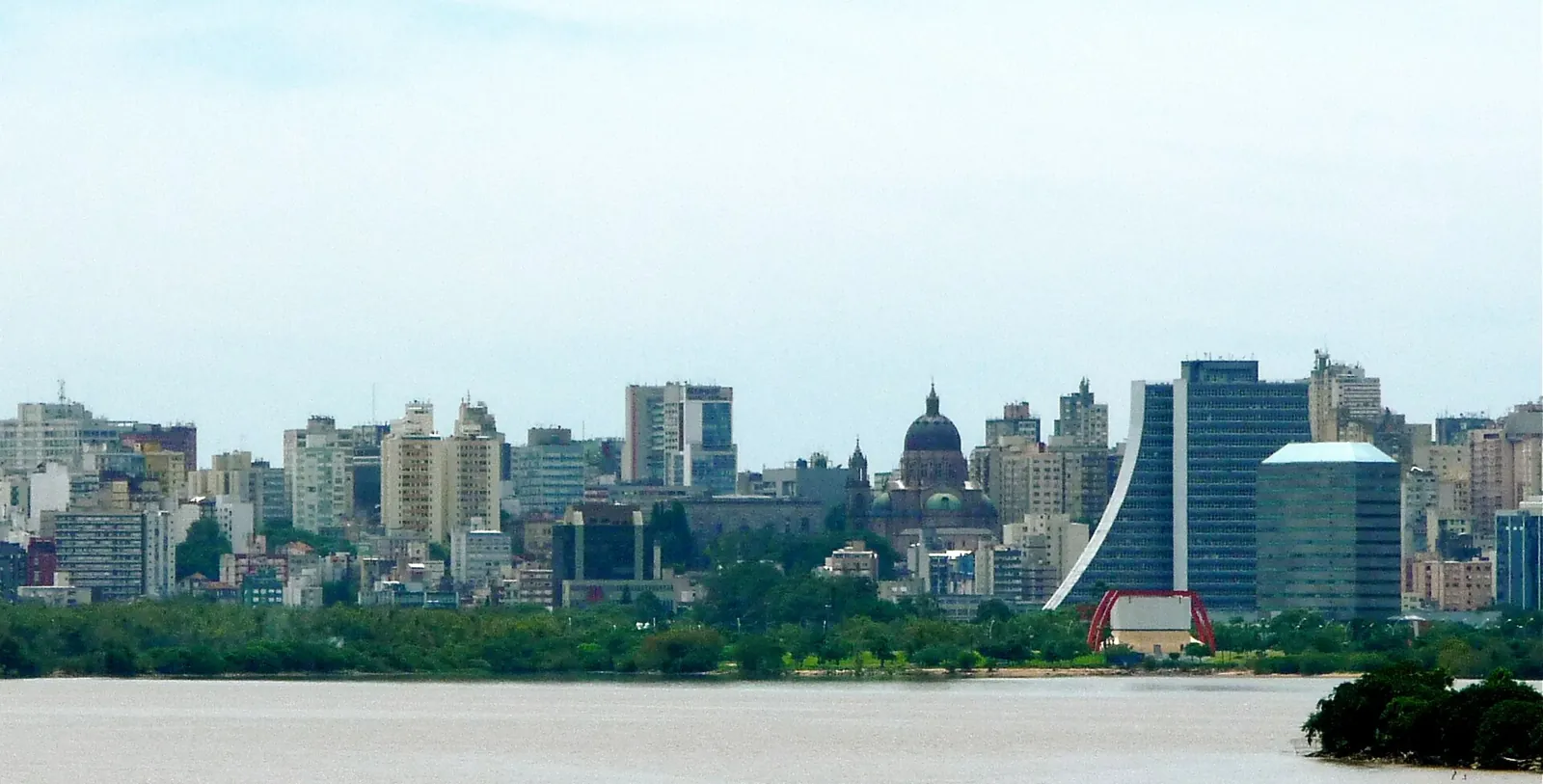
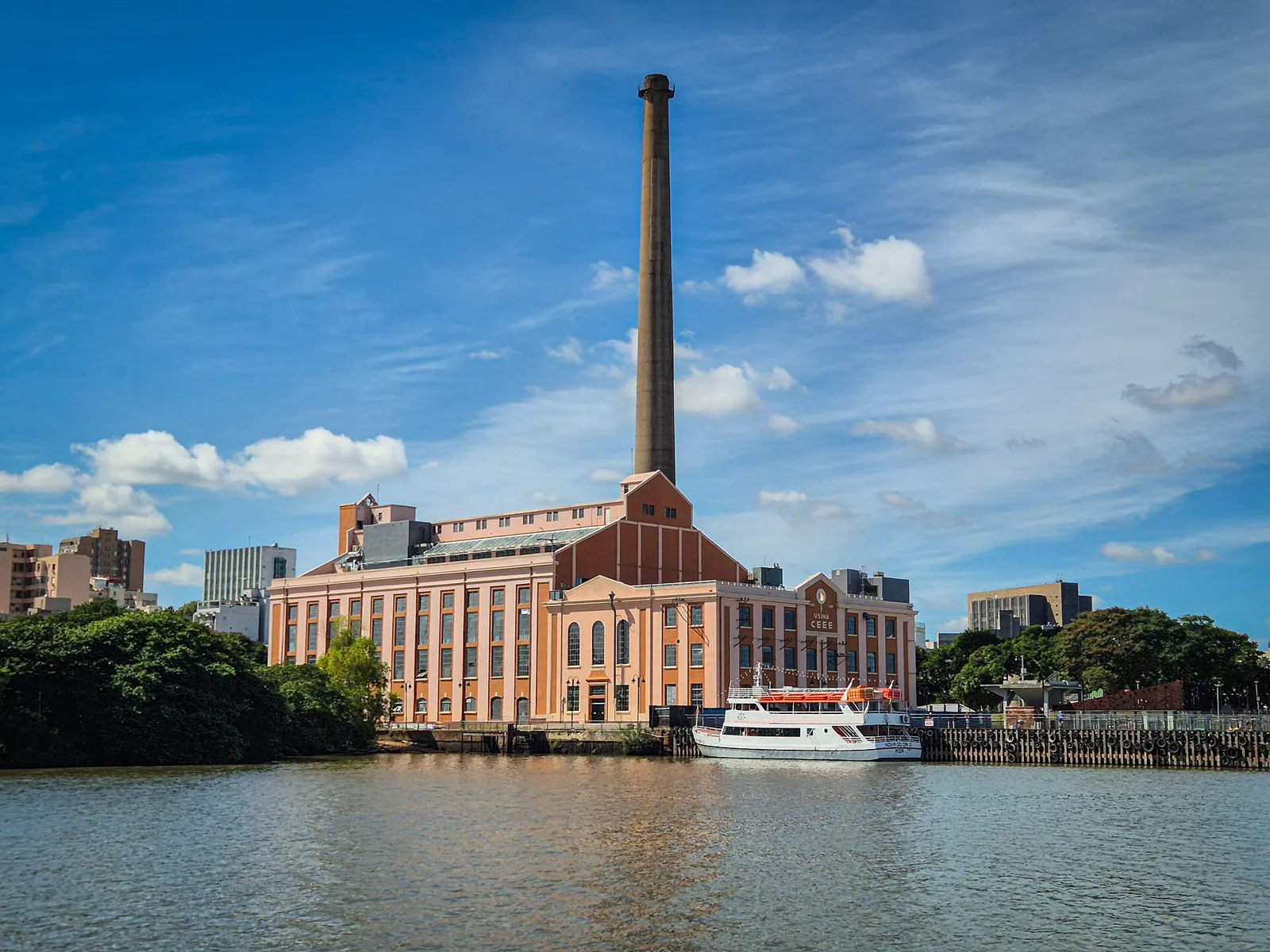
FipeZAP sale index, September 2026 report. 2026 is the 12 months to September. Inflation is not removed.Downtown Porto Alegre from across the Guaíba, the water body that sets the city's main physical risk.
The map that matters is a height map. Land rises from the Guaíba's edge to 311 m at Morro Santana, the highest of the city's 44 hills, and almost every buying decision comes down to how far up that slope you are.
The protected low strip. From Sarandi in the north to Cristal in the south, dikes and pump stations guard the Centro Histórico, Cidade Baixa, Menino Deus, Praia de Belas, São Geraldo, Floresta, Navegantes and Humaitá. These are the neighborhoods that flooded in 2024, mainly through the drains. Their asking medians are among the city's lowest, and new launches are concentrated there.
The ridge just east of downtown.Moinhos de Vento is about 2.6 km from the center, Mont'Serrat 3.8 km, Bela Vista 3.9 km, Auxiliadora 4.1 km and Petrópolis 4.6 km. Rio Branco, Independência, Higienópolis and Boa Vista fill the gaps between them.
The South Zone waterfront. Tristeza, Ipanema, Guarujá, Serraria and Lami have houses and river views, and the existing system does not protect them. A study covers extending it about 50 km to the Viamão border. For Guarujá and Serraria the options are a wall or raising Avenida Guaíba or the Praça Zeno Simon, all of which mean moving families, at about R$ 300 million to R$ 350 million, with the project still being finalized and the city still seeking funding.
The islands. The Arquipélago, in the Jacuí delta, floods first and has its own legal limits, covered in the title chapter.
Check the map before you accept a description. Auxiliadora sits further out than Moinhos, not between it and the center, and one published list gives Bela Vista only four neighbors: Santa Cecília, Rio Branco, Mont'Serrat and Petrópolis. Lists differ, and the 2016 neighborhood law moved some lines. Buyers weighing a hill address against a low one nearby can open the monthly budget page to see what daily life runs to in each.
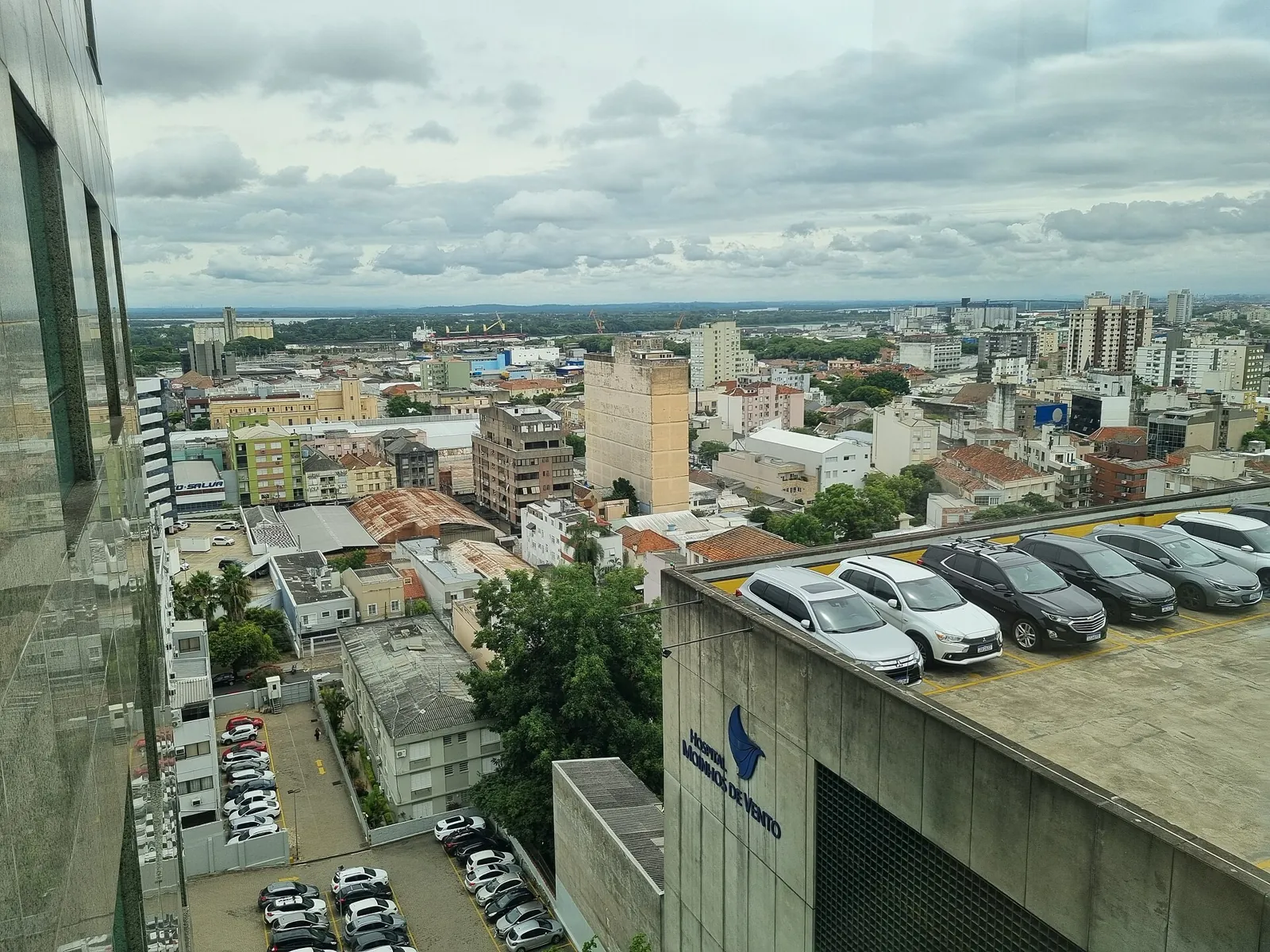
The view downhill from Hospital Moinhos de Vento toward the waterfront.
No question matters more when buying in Porto Alegre. On 2 May 2024 the Guaíba reached 3 m, the flood mark at Cais Mauá, and the 14 gates in the Mauá wall were closed. It peaked around 5 May, and a later survey by the Serviço Geológico do Brasil (SGB) with the army put the high-water mark at 5.37 m at Cais Mauá, above the 4.76 m of 1941 and revising the 5.35 m reported that week. It stayed above the flood mark for about a month, with a second peak on 14 May.
The river never reached the 6 m the system was designed for. IPH-UFRGS, the university's hydraulics institute, attributes the water in the city to failures in gates and pump stations. Hydrologist Fernando Fan described water passing through gaps in gates, over dikes and back through drainage pumps. At the worst moment only 17% of the 23 pump stations were running: 19 had been shut by flooding or power cuts.
How it reached each district
Centro Histórico. On 3 May water came in at the corner of Avenida Padre Tomé and Avenida Mauá, through pump station 17, while the wall itself stood, and spread as far as Avenida Farrapos. Press reports say the gate fault there had been on file since 2018; the city's water department, Dmae, gives a different timeline.
Cidade Baixa and Menino Deus. On 6 May a power cut stopped pump station 16 at the Rótula das Cuias. The city named Washington Luiz, Demétrio Ribeiro, José do Patrocínio, Rua da República, Lima e Silva and Venâncio Aires up to Getúlio Vargas as the first streets hit, and Avenida Borges de Medeiros went under near the state highway department.
Praia de Belas, Floresta, São Geraldo, Navegantes and Humaitá. Water came up through the storm drains.
Sarandi and the airport area. Dikes were overtopped.
South coast, far south and islands. These lie outside the system and took the water directly.
On 13 May the count stood at about 157,700 people and 39,400 buildings affected. City Hall's economic office counted some 45,000 business activities in 31 neighborhoods, 17% of the city's companies, with 310,000 formal workers.
Depths, and the official map
No official table of depths by street has been published. The closest public tool is IPH's emergency depth map, built from 2010 laser survey data at 1-meter resolution, which shows the depth each block would see at 5.5 m on the Cais Mauá gauge with the system failed completely. The authors checked it against satellite images of the flood and report good agreement, with some mapped areas that stayed dry. So it is a worst case at a slightly higher level than 2024, and it is the right starting point for any address. The link is in the authors' 2025 paper, and the national flood check guide explains how to use such maps.
Reported depths are scattered. Water stood knee-deep at Rua Grão-Pará and Rua José de Alencar in Menino Deus on 23 May, during a second round, when Rua Barão do Gravataí, Rua Botafogo, Avenida Praia de Belas, Rua Barbedo, Rua da República and Rua João Alfredo flooded again from the drains. Hospital Moinhos de Vento reported about 340 staff homes with water above 1 meter. To learn your block's number, ask the doorman, look for repainted plinths and read the condominium minutes of May and June 2024.
Dry streets lost water too
Do not read "not flooded" as "not affected". On 6 May roughly 85% of the city had dry taps. The raw-water pumping station feeding the Moinhos de Vento plant went under, and that plant supplies 21 neighborhoods, including all five covered in this guide. Its restart was still being estimated on 9 May, and Hospital Moinhos de Vento got normal supply back only on 20 May after being served by tanker from 3 May. A January 2024 storm had already left 73 neighborhoods and about 1.2 million people without water for up to five days, because 85% of Dmae's structures lost power.
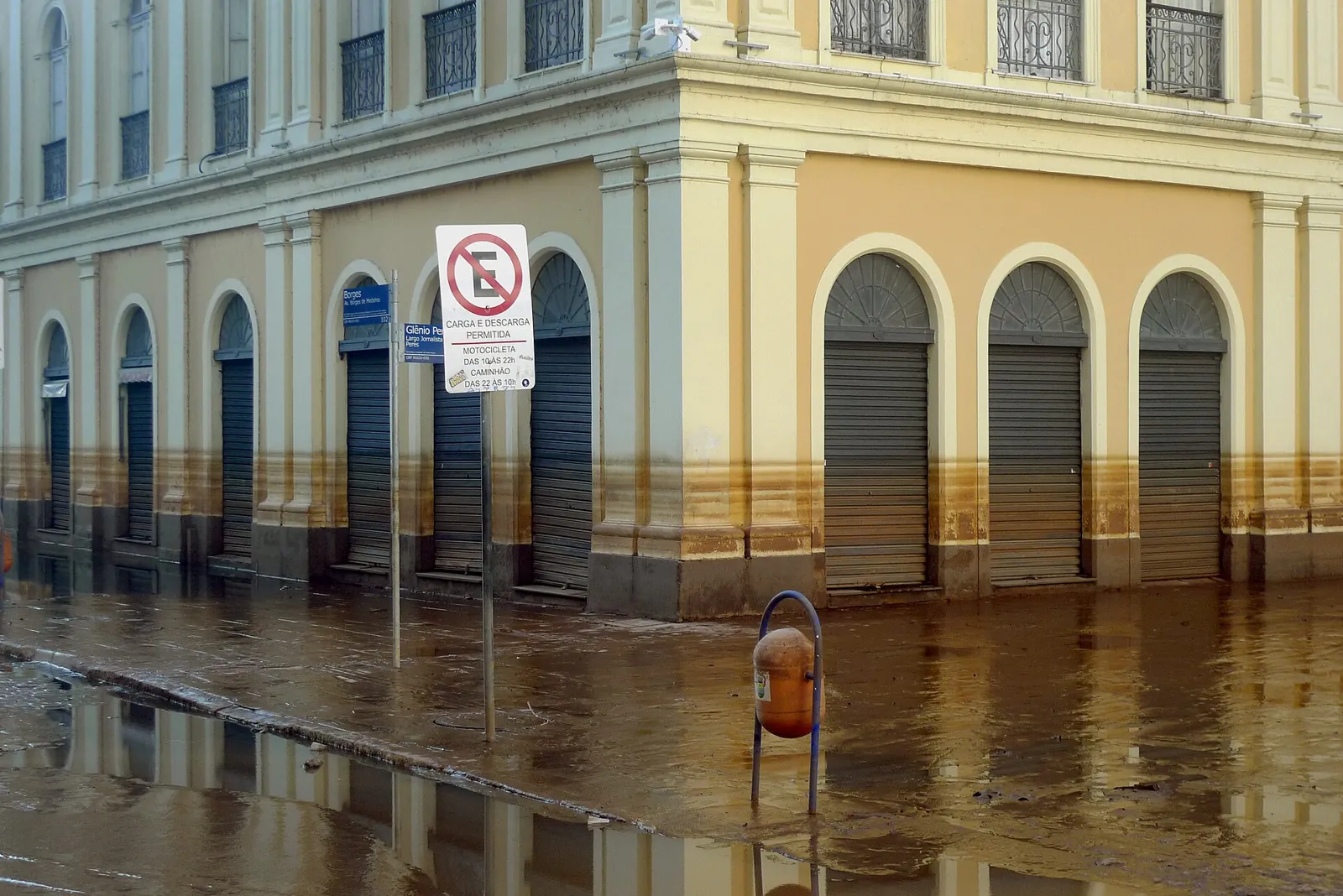
The stain on this facade marks how high the water stood during the May 2024 flood.
The system was built in the 1960s after the 1941 flood: 68 km of dikes (24 km against the Guaíba and the Gravataí, 44 km along streams), 23 pump stations and the Mauá wall, 2.6 km long and 6 m tall, half of it below ground. Avenida Castelo Branco, Avenida Edvaldo Pereira Paiva and the Freeway act as dikes. Dmae lists what has changed since 2024.
Flood works as listed by Dmae, 2026
Item
Status
Gates 3, 5, 7, 8, 9, 10, 13 and 14
Replaced by fixed concrete
Gates 11 and 12 at Cais Mauá
New gates, tested 8 July 2026
Gates 1, 2, 4 and 6
Reinforced
Fiergs and Sarandi dikes
Fiergs done January 2025; Sarandi segments 1 and 2 restored to 5.8 m
Water intakes at Moinhos de Vento and at Menino Deus
Flood protection added June to August 2026
Polders 7 and 8, Anchieta to Sarandi
Temporary works done August 2026; permanent works about R$ 300 million, tender expected first quarter 2027
Polder 10, Sarandi
About R$ 178 million; tender due by October 2026, publication not confirmed by us
Pump stations 5, 6, 8, 10, 12, 17, 18 and 20
Upgrades delivered in stages through 2027
Dual power for 37 stations
Expected November 2026
Assis Brasil dike, 670 m, to 7 m
Planned, about R$ 16 million
Drainage capacity
More than R$ 1.1 billion, due by 2031
Read that table two ways. The specific weak points of 2024 in the center have been worked on, and the gates are simpler now that most are fixed. But the North Zone is still unfinished: Extra Classe reported in April 2026 that a dike stretch between Assis Brasil and the Freeway had been removed, that section 3 of the Sarandi dike had no works, and that about 500 Sarandi families still lived in the flood zone. The 1960s design called for 7 m there and current works aim at 5.8 m. Fan's verdict that April was that the works help a lot but do not solve the whole problem.
The system has been used since. The Guaíba reached 3.45 m in June 2025, the fourth-highest on the list Jornal do Comércio published, and gates stayed shut into July. On 1 October 2026 the city closed seven gates on the northern side as a precaution, and water reached low roads on Ilha da Pintada. Power remains a soft spot: on 1 January 2025, 88 mm of rain and an outage hit 10 pump stations, generators failed to start at three, and the Centro Histórico, Cidade Baixa, Bom Fim, Floresta and the 4º Distrito flooded.
Following the river
SGB and IPH publish joint Guaíba bulletins. The numbers need care, because the Cais Mauá gauge and the Usina do Gasômetro gauge differ by 78 cm: at the May 2024 peak one read 5.37 m and the other 4.59 m. At Cais Mauá the flood mark is 3 m and the alert level about 2.5 m, so ask which gauge any report means.
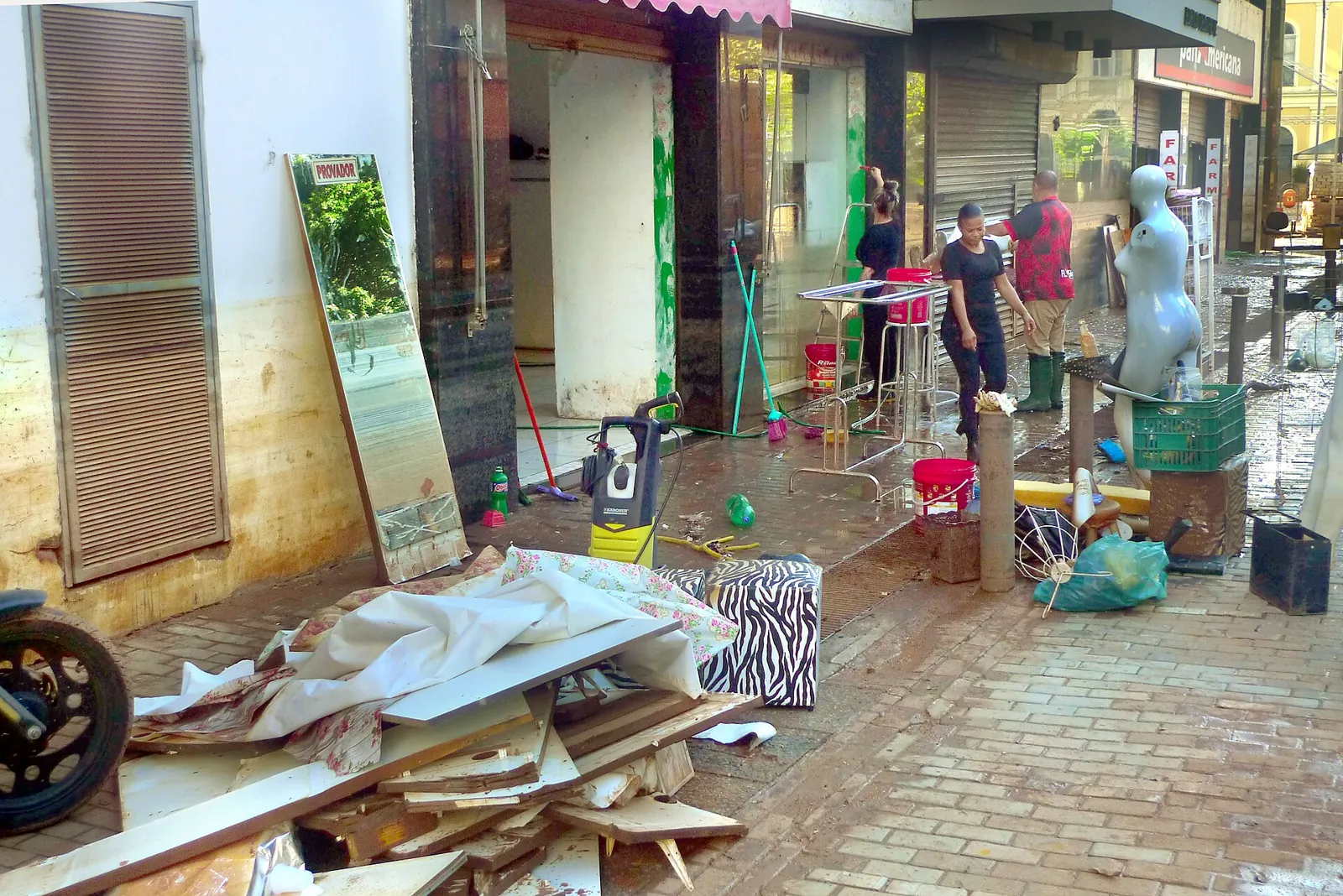
Street-level shops took the damage in May 2024, and owners cleaned up as the water fell.
This is an apartment city. Census figures show 94% to 97% of occupied homes in the five ridge neighborhoods are apartments, and 52.1% of homes citywide. What surprises newcomers is how much space older units offer: ads typically show 159 m² in Bela Vista, 134 m² in Moinhos de Vento and 120 m² in Mont'Serrat and Auxiliadora.
The ages tell a local story. Bela Vista was country estates carved into lots in 1970 and stayed low until the 1999 master plan allowed tall buildings. Petrópolis grew from 1920s estates and orange groves into lots sold through the 1950s, and its heritage disputes ran for about a decade. Moinhos mixes old houses with newer blocks, some on heritage lists.
Average monthly condominium fee, July 2025 (Loft, about 7,000 listings)
Neighborhood
Fee
Per m²
Bela Vista
R$ 1,400
R$ 8.40
Moinhos de Vento
R$ 1,300
R$ 7.44
Mont'Serrat
R$ 905
R$ 7.40
Petrópolis
R$ 750
R$ 6.13
Auxiliadora
R$ 648
R$ 5.69
Menino Deus
R$ 500
R$ 5.01
Citywide
R$ 512
not given
The fee guide shows how to read the accounts. After 2024, add three local questions. Where are the electrical panels, water pumps and generator, and did the building move them? Hospital Mãe de Deus in Menino Deus lost its whole electrical structure and planned a new substation on the second floor. How many days of water does the tank hold? Has there been a special assessment since May 2024, and is any still being paid?
Small units ask double
Size distorts every average. In Mont'Serrat, units under 50 m² were advertised at R$ 14,577/m² in November 2026, against R$ 7,417 once size reaches 100 to 150 m². In Auxiliadora the same split is R$ 14,211 against R$ 8,695. As a general observation, studios from recent launches sell on location and finishes, while large older apartments sell on floor area. Check which group a price comparison uses, and if you are buying a studio, remember the unsold stock counted in the market chapter.
Prices by neighborhood
Each of three published sources gives a different answer, because they measure different things. FipeZAP tracks listings with a set method. Loft's figure for January 2026 is its own survey. A Corrida dos Bairros uses the middle value of whatever apartments are advertised, so it moves with the mix of ads that month.
The citywide asking median in the same A Corrida round was R$ 5,573/m², well under FipeZAP's R$ 7,545, so never mix the columns. The month-to-month swings are also large: Auxiliadora's median fell about R$ 3,000 from September to October and regained about R$ 1,000 in November, so treat any one month as a rough mark.
What was paid, from tax records
Loft's reading of city transfer-tax records for March to May 2025 gives average sale values: Bela Vista R$ 2,074,948, Moinhos R$ 1,269,386, Mont'Serrat R$ 1,255,704, Petrópolis R$ 824,107, Auxiliadora R$ 693,593, Cidade Baixa R$ 298,458 and Centro Histórico R$ 273,181. Single streets go much higher. For April to June 2025, Rua Carlos Trein Filho averaged R$ 7.8 million and Rua Luciana de Abreu R$ 7.1 million.
How the flood shows in values
No published study isolates a flood discount by street. Three indications exist. FipeZAP showed Menino Deus down 1.1% in the 12 months to November 2025 when the city rose 6.12%. A director of the brokers' union Sindimóveis/RS told GZH that after the flood banks would not accept properties around Menino Deus and some deals were canceled. A director at the brokerage Foxter told Jornal do Comércio that the Centro and Sarandi had the smallest gains in 2025 and that some owners who never moved back listed their homes, pulling prices per meter down. Against that, FipeZAP showed Praia de Belas, which also flooded, up 25.1%, and Sinduscon's launches favor those same districts. An index for a whole city cannot tell you what a flooded ground floor and a dry tenth floor on the same street are worth, so ask an appraiser for sales on that block.
Long-term tenants and where they rent
IBGE's 2022 figures show 20.79% of Porto Alegre's homes rented, against 17.93% across the state. As a general observation, tenants fall into recognizable groups: students, hospital staff, downtown and state-government workers, and since 2024 families who left flooded homes.
After the flood, rents on the hill jumped. In July 2024 the rental index run by QuintoAndar and Imovelweb showed three-month rises of 26.62% in Mont'Serrat, 24.58% in Rio Branco and 22.56% in Bela Vista, which its data manager tied to low supply and demand in higher neighborhoods the water did not reach. A local agency reported an average of four prospective tenants per property in June 2024. Supply has since loosened: Secovi-RS counted 3,795 homes available in July 2025, up 20% in a year.
Students
The academic year pushes demand up early each year. Auxiliadora Predial, a large local agency, estimates a rise of about 30% from January to March, and the tenants want kitnets, studios and one-bedrooms, preferably furnished. That February 2026 report also gives gains of 33.1% in Bom Fim and 29.8% in Rio Branco, near the universities, without saying whether they measure rents or sale prices, or over what period.
Comparing yields
Asking-price gross yield in November 2026, per A Corrida dos Bairros
These are medians of two separate sets of ads, before fees, tax, vacancy and repairs, and FipeZAP's citywide 7.36% remains the benchmark. The highest numbers sit in districts that flooded, so set a flood year's lost rent and repair bill against them before comparing. The guide on rental tax for non-residents deals with the income.
On guarantees, federal tenancy law allows only one form per contract, and a contract-template site reports deposit and guarantor as what most landlords use here. Ask the agency handling your property which it accepts, and whether a tenant may offer guarantee insurance instead.
Short stays without a beach
As of November 2026 neither the city's pages nor the press showed any Porto Alegre law on short lets. Gramado took the other path and has charged 3% ISS, the municipal services tax, on nightly rates since March 2026, with platforms collecting it. Your first limit here is what the building's convention says, and the national short-let guide explains what condominiums can and cannot forbid.
The two published market readings disagree by a wide margin. AirROI's year ending September 2026 shows 3,503 active listings, R$ 236 a night, 37.6% occupancy and R$ 22,333 average annual revenue. Airbtics, on a year ending in August 2026, reports 3,799 listings on 16 October, R$ 229 a night, 53% median occupancy and about R$ 47,000 median annual revenue. Listing counts are growing quickly, up 65% in a year in Airbtics's count. Neither gives you a yield, and neither should be turned into one without your own numbers on fees and cleaning.
Seasons run against the beach markets. AirROI has July as the best month for revenue, on higher nightly rates, and February as the weakest, while occupancy peaks in March. It gives no cause; as a general observation, demand here comes from visits other than beach holidays. AirROI's guide names Cidade Baixa and Moinhos de Vento, plus Bela Vista, among its eight picks for guests, though it warns this reflects guest appeal and not earnings.
Three national points are still unsettled: a 3.5% IOF when sale money or rent goes abroad, whether non-residents past the limits owe CBS and IBS, and how the R$ 600 deduction treats short lets. Ask a tax adviser for the current position before you price a purchase on short-stay income.
Short-let arithmetic
Starts from published figures (12 months to September 2026 (AirROI, 3,503 Airbnb listings)). Set your own.
Two local features stand out. The transfer tax, ITBI, takes 3% of the higher of your price and the value the city sets, so declaring less gains nothing. And Rio Grande do Sul caps notary and registry fees per act at R$ 5,482.90, so the percentage falls as the price rises.
Cash deal of R$ 1,000,000 with 2026 fees
Item
Amount
Note
ITBI, 3%
R$ 30,000
Assuming the city's value does not exceed the price
Deed (escritura)
R$ 4,867.50
Band R$ 992,677.91 to R$ 1,240,847.60
Registration
R$ 4,454.90
Band up to R$ 1,116,762.80
Total
R$ 39,322.40
About 3.9%, before certificates, processing items and any lawyer
Above R$ 1,240,847.60 both fees stop at R$ 5,482.90. A R$ 3 million purchase pays R$ 90,000 in ITBI and R$ 10,965.80 in the two fees. The city's value can exceed your price, and the city's page says the tax then follows the higher figure. A 2022 STJ decision set a national rule on the ITBI base, so ask a lawyer how far the city may go beyond a declared market price. For how these compare elsewhere, see closing costs city by city and property taxes nationally.
The 0.5% ITBI rate applies to amounts actually financed under a residential loan or real-estate consortium with a term of at least 5 years, and to the buyer's FGTS funds, a worker's fund that foreigners without Brazilian employment will not have. So a cash buyer pays 3%, while a buyer with a qualifying Brazilian loan can ask for the lower rate on the financed part. The total at 0.5% stops at 68,000 UFM, about R$ 410,800 at the 2026 UFM of R$ 6.0411, and the excess pays 3%. In the 4º Distrito, projects approved under the +4D program can get ITBI exemption and up to 15 years off IPTU, as the changes chapter explains.
IPTU, the annual property tax
Residential rates are marginal, so each slice of assessed value pays its own rate:
Residential IPTU bands, 2026 (law-firm summary of the decree; reais approximate)
Slice of assessed value
Rate
Up to R$ 90,290
0%
R$ 90,290 to R$ 150,484
0.40%
R$ 150,484 to R$ 451,445
0.47%
R$ 451,445 to R$ 752,413
0.55%
R$ 752,413 to R$ 1,128,616
0.62%
R$ 1,128,616 to R$ 1,504,820
0.70%
R$ 1,504,820 to R$ 4,514,460
0.77%
Above R$ 4,514,460
0.85%
By those bands, a property whose assessed value is R$ 1,000,000 pays about R$ 4,850 a year before discounts. Paying in one installment by the February date earned individuals up to 11% off in 2026. A garage space with its own registration gets its own bill, so ask for both when you read the seller's tax papers. Unpaid 2026 bills fell into active debt after 9 March, with a fine rising from 2% to 10% after 31 March.
The base could change. The city filed a new value plan, PLCE 030/2025, in December 2025 and the council postponed the vote, so 2026 square-meter values rose only by a 4.68% correction. The proposal sets about 500 value zones and caps yearly increases at 10% or 42 UFM, whichever is greater. The city's figures say about 174,000 properties would get a lower value and tax and about 46,000, mostly of higher value, would be updated, so ask your adviser how the bill would change.
Heritage lists, irregular lots and the islands
Three land problems catch buyers here, and none involves the sea.
The heritage inventory
Porto Alegre had more than 5,000 inventoried properties in 2022, a list separate from formal listing. Under Law 12.585/2019 a property needs at least three of five qualities (historical, technical, ensemble, landscape, morphological) and can be blocked for study for six months, renewable once.
Two categories matter. A structuring property (estruturação) has to stay standing with its front intact, though the inside can change. A compatibility property (compatibilização) sits beside one and can be replaced only by a new building that keeps visual harmony, and work on either goes through the heritage team, Epahc. Both have been fought over in Petrópolis, where a list of over 700 fell to under 200 in 2022, with only properties south of Avenida Protásio Alves remaining, after a 2018 lawsuit froze those then listed. In Moinhos de Vento about 200 addresses were released and about 150 listed as of 2022. Inventories were also in hand for Avenida Bastian in Menino Deus and for Vila Assunção and Vila Conceição, and the Centro Histórico and 4º Distrito lists were due for revision.
The city's reports do not give a current list we could open, so before you pay land value for a house, ask Epahc in writing about the exact address. Selling unused building rights has been slow: 56 requests since 2020 had produced four completions by September 2022, and the mayor vetoed the new plan's extension of those rights to listed and inventoried properties in July 2026, but the council overturned that veto on 9 September 2026. The registry side sits in our title-check walkthrough.
Irregular lots
Demhab, the city housing department, counted 484 irregular areas with about 300,000 residents in 2021, and it delivers titles through Reurb, the federal regularization process, for areas consolidated by December 2016. Areas in mapped risk zones generally cannot be regularized unless the risk can be mitigated. As a general observation, lower prices on these plots come with possession and no registered title, and banks lend against registered title. Possession and title are compared in a separate guide. A similar habit exists higher up the market: Gramado's finance department offered a lower ITBI until June 2026 to coax buyers into registering old drawer contracts.
The Delta do Jacuí islands
Five of the city's 14 islands are inhabited, and they fall under the Delta do Jacuí State Park and Environmental Protection Area. State prosecutors filed a suit in 2008 seeking to finish the management plan and regularize land where people may live, and the court held hearings with residents of Pintada, Flores, Mauá, Grande and Pavão in August 2024. A new plan with TU Delft and the UN Development Programme, begun in 2025, lists land regularization as one aspect. We found no current rule letting a buyer treat an island house as a normal titled purchase. Ask the state environment department and read the registry record first.
Federal land
The terreno de marinha regime runs 33 m inland, starting at the high-tide line as set in 1831, on coasts and on rivers and lagoons as far as tides are felt, and we found no published list applying it to Porto Alegre's neighborhoods, so treat the question as open. The Praia de Belas landfill built after 1941 and other Guaíba waterfront plots are where to ask. If you see SPU, aforamento or ocupação on the registry record, stop and get a lawyer's reading.
The Usina do Gasômetro in 2025; a river gauge nearby gives one of the two readings residents follow.
Porto Alegre's numbers have fallen sharply. The state government reports homicides down from 330 in 2019 to 191 in 2025, vehicle robberies from 4,747 to 538, street robberies from 24,161 to 6,573, and robbery-killings from 15 to 3. Using IBGE's 2025 estimate, 191 homicides is about 13.8 per 100,000 residents; the calculation is ours. City Hall says Porto Alegre rose from 24th to 3rd among state capitals in the Centro de Liderança Pública's 2025 ranking of the safest capitals, though that is the city quoting a ranking in its favor.
Neighborhood data are thin. Police figures reported in November 2024 show that commercial burglaries had nearly doubled in part of the central region: in the same September to November window Moinhos de Vento went from 5 to 15, Rio Branco from 15 to 31, Cidade Baixa from 8 to 15 and Bom Fim from 3 to 13, mostly late at night. In the Centro Histórico, thefts and robberies in January 2026 were about half of January 2024 (195 against 367, and 78 against 145), according to the city and state figures.
Residents choose by block and by hour. On the ridge the checks are doorman coverage, street lighting and how a street feels after 10 pm; downtown, also how far you must walk from a garage. Compare with Batel in Curitiba if you are weighing southern capitals, and ask the manager what has happened on the block lately.
Hospitals, schools and foreign communities
For medical care this is one of Brazil's stronger cities. Hospital Moinhos de Vento has been on the Joint Commission International path since 2002, with another renewal reported in August 2026, placed 5th in Latin America and 3rd in Brazil in the 2026 IntelLat ranking, and appears with Hospital Mãe de Deus on Newsweek's World's Best Specialized Hospitals 2027 list. Hospital Mãe de Deus in Menino Deus was evacuated in May 2024, and its case is the clearest example of why floor plans matter. Santa Casa de Misericórdia and Hospital de Clínicas draw on the same water plant as Moinhos, and both reported normal supply by 21 May 2024. A hospital on higher ground gives Moinhos and Auxiliadora an advantage for older buyers.
Schools
In Petrópolis, the Pan American School at Avenida João Obino 110 describes itself as the city's international school and teaches from age 3 through grade 12, with Advanced Placement, US National and IGCSE listed on OpenApply. Colégio Anchieta, which turned 135 in 2025, describes itself as the state's only Jesuit school. Numbeo's crowd-sourced figure for international primary school is near R$ 126,000 a year, and the private schools' union Sinepe/RS reported an average 9.15% fee rise for 2026. Get the current year's price directly from admissions.
Consulates and communities
Argentina's consulate general is at Rua Coronel Bordini 1033 in Moinhos de Vento. Italy opened a new consulate general office in the Centro Histórico in May 2026, during the 150th anniversary of Italian immigration to the state. The United States has a consulate, reported in 2017 at Avenida Assis Brasil 1889, which closed briefly in October 2026 along with the other US posts in Brazil. Spain has a consulate general covering Rio Grande do Sul and Santa Catarina. For a foreign resident that means passport paperwork close by, and the residency guide covers Brazilian status.
Shops and parks
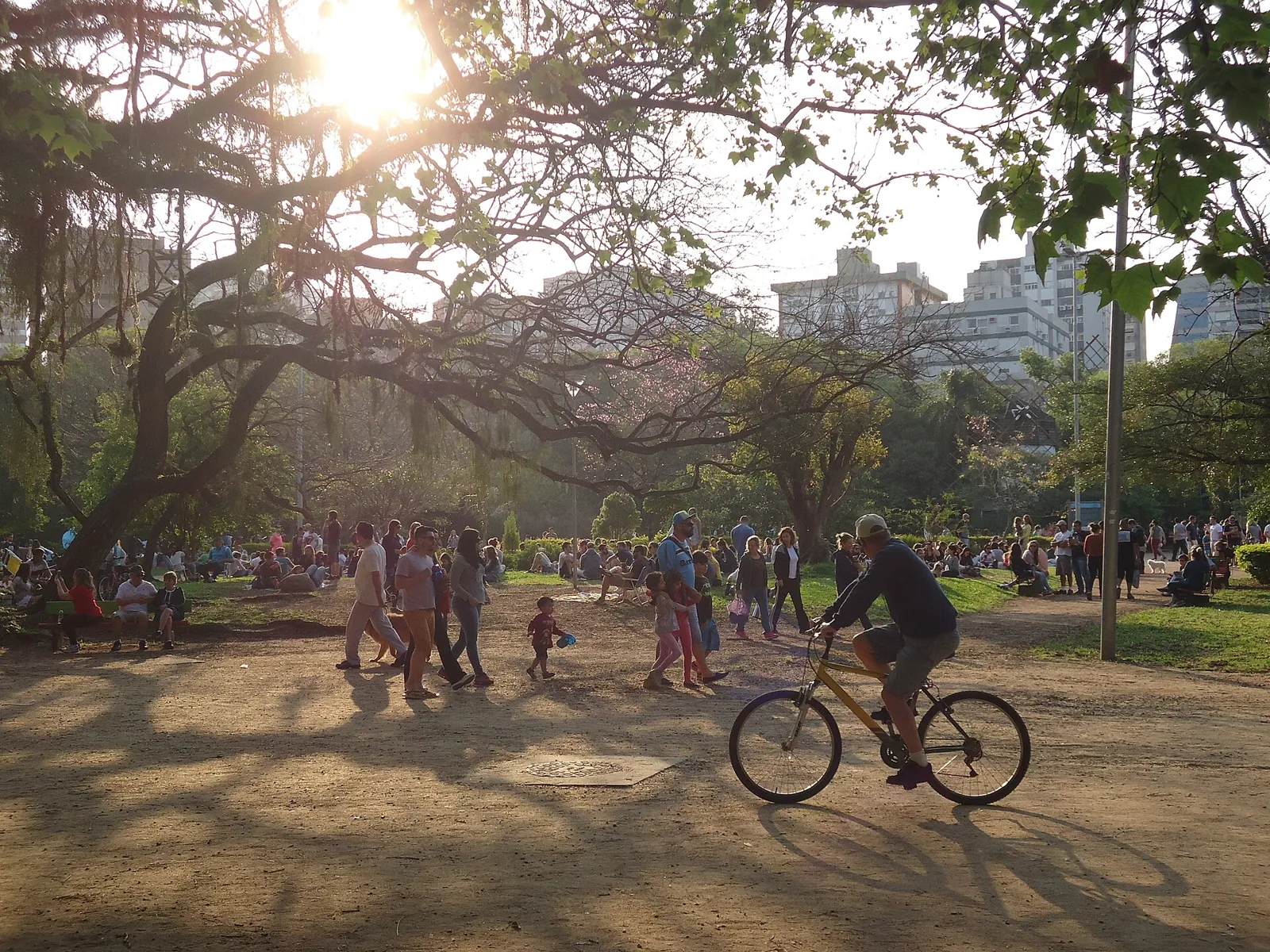
One neighborhood guide names Zaffari as the supermarket reference in Petrópolis; check the nearest branch on a map. Parque Moinhos de Vento, the Parcão, opened in 1972, and the Praça da Encol in Bela Vista are the green spaces QuintoAndar's pages keep sending ridge residents to. If you want a beach, compare Florianópolis, which runs about 1.8 times Porto Alegre's level on FipeZAP.
Thirty years of readings at INMET's Jardim Botânico station, 1991 to 2020, show four real seasons. January averages 31.0 °C by day and 20.7 °C by night. July averages 19.7 °C and 10.4 °C. Rain arrives all year, about 1,495 mm in total, with no dry season: the driest month, March, still gets 103.3 mm, and the wettest, July, 163.5 mm. Monthly extremes can be severe: September 2023 brought 447.3 mm, then the highest month since records began in 1916.
Buyers from warmer parts of Brazil should plan for the cold. As a general observation, apartments here lack the central heating a Northern buyer assumes, so winter comfort comes from orientation, insulation and whatever heater you add, and sun on the north side of a building matters. For the same reason, check for mold behind wardrobes in south-facing rooms, and ask about the state of the wiring if you will run electric heaters.
December to February. Hot, and many residents are away at the coast, in our general observation. You will see how an apartment copes with afternoon sun and how loud air conditioning units are. You will not see how the rooms behave in winter.
March to May. Students return and the rental market is at its tightest. A good time to learn what tenants pay and to ask about 2024 while memories are clear.
June to August. The best inspection for damp, drafts, cold floors and gas heaters. Book this trip if you intend to settle, and bring a coat.
September to November. Wet, so storm drains get a real test, and if the river is rising you can watch gauge bulletins live. Flood-prone streets show themselves after a heavy rain.
The hill towns are colder still. Canela and Gramado draw their visitors in July and in the Christmas season.
Press a month
JFMAMJJASOND
Bars show rain. Porto Alegre, INMET conventional station 83967 (Jardim Botânico), 1991-2020. Source.
Airport, trains and roads
Salgado Filho sits about 7 km from downtown by one weather site's count, on the low northern ground, which is why it closed. The terminal flooded and flights stopped in May 2024. Domestic service resumed on 21 October 2024 on a 1,730-meter stretch of runway, and the full 3,200 meters and 24-hour operation returned on 16 December, with the first international arrival on 19 December from Panama City. Traffic has recovered: 7.513 million passengers in 2025, slightly above 2023, and about 2.6 million from January to April 2026.
The international routes here are press-reported and unconfirmed: we could not read a route list on the airport's site, and the TAP and Copa pages we opened show fares without saying whether flights are nonstop. In June 2026 Jornal do Comércio, using operator Fraport Brasil's figures, listed direct flights to Lisbon with TAP (four a week), Panama City with Copa, Buenos Aires with Aerolíneas Argentinas and LATAM (eight a week), Santiago (10 a week from July) and Lima. On Copa the same report said seven rising to nine a week, while a trade blog in August 2026 said seven, then eight from December and 11 in January and February 2027. A seasonal Bariloche service was reported for June through August 2026, and the paper's August column said Azul would resume direct Montevideo flights in December 2026. The report names no airline for Santiago or Lima and no frequency for Lima, and we could not confirm either on an airline page, so ask which airline flies them. No United States route appears in these reports, so Americans must connect, for example through Panama City.
In the city
Trensurb, the metropolitan train, has stops including Mercado, Rodoviária, São Pedro and Farrapos in the city, and the Aeromóvel, a 1 km automated shuttle, links it to the airport. Its fare was R$ 5.00 after the July 2025 adjustment. It runs along the low northern strip, away from the ridge, and its São Pedro station flooded in January 2025, closing Mercado and Rodoviária.
The bus fare is R$ 5.30 and the lotação, a shared van, R$ 9.00. Taxi flag-drop is R$ 7.24 with R$ 3.62 per km by day. In Bela Vista most residents have their own cars, by QuintoAndar's account, and rush-hour jams form at Marquês do Pombal and 24 de Outubro in Auxiliadora. Buses from the bus station run to Gramado about every 30 minutes, and many also stop at the airport. To drive with a foreign license, read the driving guide.
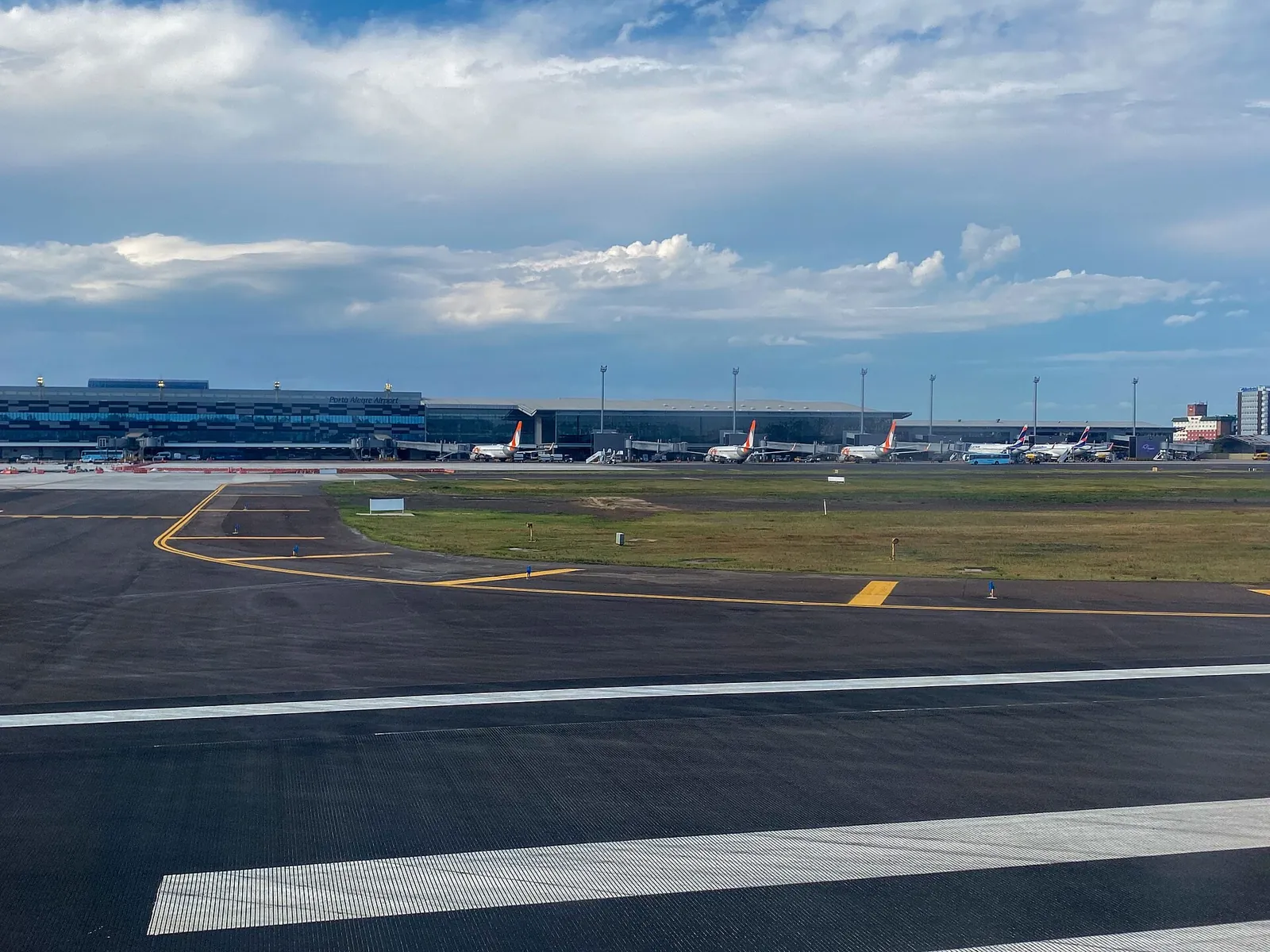
Salgado Filho in January 2025, weeks after the full 3,200-meter runway returned.
On 14 July 2026 the mayor signed the new Plano Diretor Urbano Sustentável (PDUS) and the Lei de Uso e Ocupação do Solo (LUOS), which sets what may be built where. They take effect 180 days after publication, about 10 January 2027 by our count, and the 1999 plan stays in force until then. Decrees on licensing and road classes are due in those six months. The mayor issued four vetoes. On 9 September 2026 the council upheld three and overturned the one on transferable building rights for listed or inventoried properties.
The heights reported in the votes matter most in the very districts that flooded. An amendment raises Menino Deus from 33 m to 60 m. South of the Freeway and Avenida Severo Dullius, the limit goes from 9 m to 60 m. Bom Fim and Cidade Baixa get more building potential, and an area near the Guaíba allows up to 18 m. The mayor's veto of the automatic exemption from the soil-permeability rule in the 4º Distrito stands. Critics say raising density in flood-hit areas ignores climate risk, and the city says the plan is designed around climate adaptation.
The law may yet be tested. The architects' council CAU/RS sued to halt the plan, citing public participation and a lack of risk maps, and federal prosecutors backed an injunction before signature. The mayor signed before any ruling. In May 2026 the regional federal court, TRF4, had held that CAU/RS has standing and sent the case back for a decision on the merits, and we found no ruling by early November 2026. A state prosecutor's report, published in April 2026, said the city attached the SGB's risk mapping, done before the 2024 disaster, as an annex to the plan with no urban policy for the mapped areas. Anyone buying off-plan should ask which plan a project's permit rests on, and the off-plan guide lists the contract points. Anyone buying an existing view should ask what the new rules allow next door.
Cais Mauá and the 4º Distrito
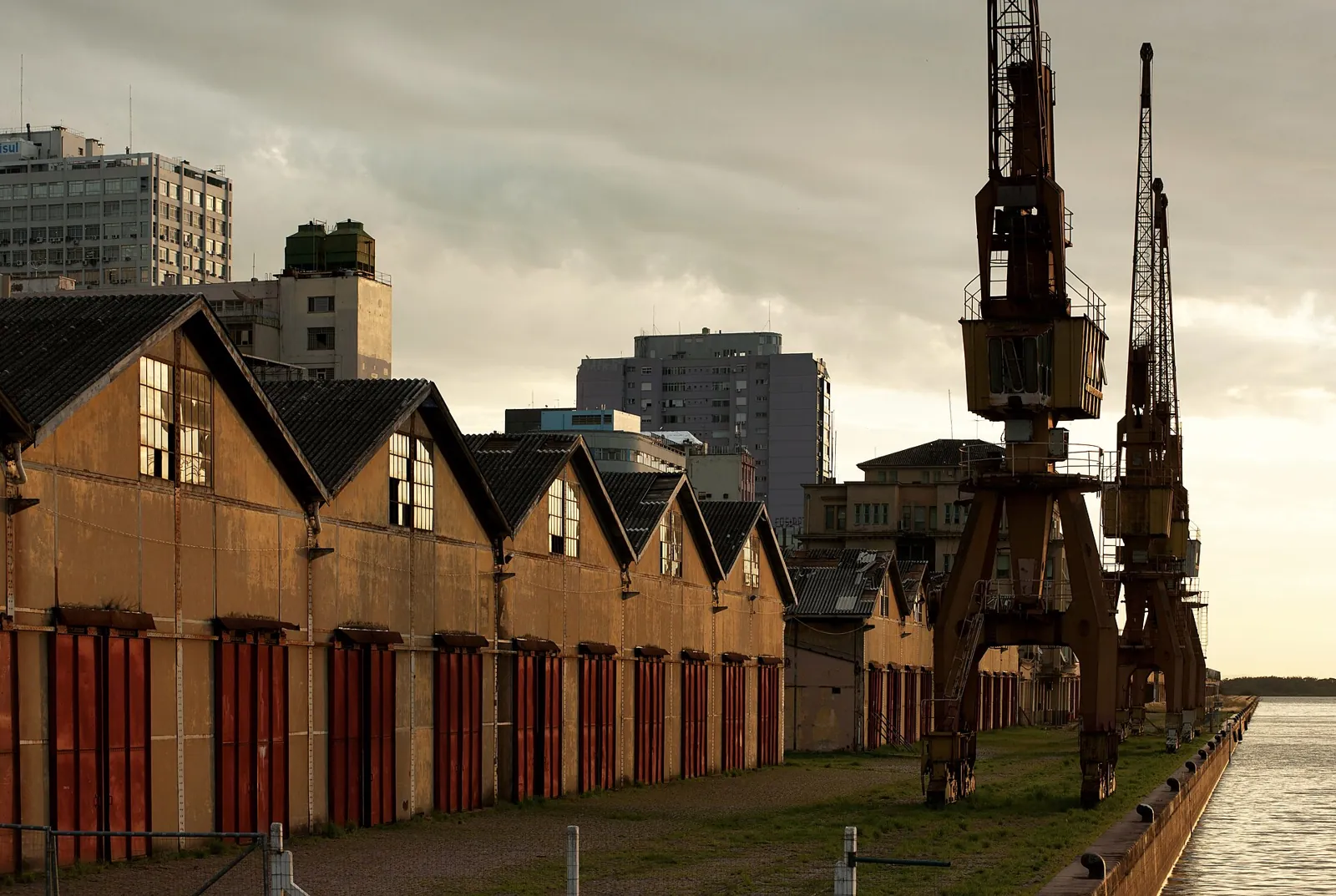
The old port is still waiting. The state ended its process with consortium Pulsa RS on 4 May 2026 after the group, winner of the February 2024 auction, asked for more time and did not meet the tender's requirements. The vice-governor said a new tender should come in 2026. We found none published by November, so do not pay for a future waterfront.
The 4º Distrito (Floresta, São Geraldo, Navegantes, Humaitá and Farrapos) carries the tax incentive. The +4D program under Complementary Law 960/2022 offers ITBI exemption and up to 15 years of IPTU exemption to projects approved by the planning department, and the state court upheld it in July 2025. New exemptions stop once a budget limit is reached, which makes it worth asking whether a given unit qualifies. The same district flooded in 2024 and again on 1 January 2025, so weigh the tax saving against that record. Asking medians there are low: R$ 4,667/m² in Floresta.
Power bills
The regulator Aneel opened a consultation in August 2026 on a CEEE Equatorial tariff review proposing an average rise of 22.31%, and 24.24% at low voltage, partly from the flood-year deferral. The review is due to take effect on 22 November 2026, we found no final figure by 3 November, and the proposal may change. Budget for it, particularly if you heat with electricity.
Cais Mauá's warehouses and cranes. The state ended the concession process in May 2026.
We could find no published time-to-sell figure for any neighborhood. A partial clue: A Corrida dos Bairros tracks how many of last month's ads are still online: about 40% in Moinhos and Auxiliadora, 53% in Petrópolis, and 63% to 65% in Bela Vista and Mont'Serrat for November 2026. Its counts swing with data sources, so read them as a rough signal and ask agents for recent days on market.
Picture your eventual buyer. As a general observation, on the ridge it is mostly older local households and professionals wanting to stay close to work, and the mortgage math limits them: at 2025 rates Loft calculated a minimum income of R$ 40,250 a month to finance an average Moinhos purchase and R$ 22,033 for Auxiliadora. In the low strip it is investors and first-time buyers, who are the ones most exposed to bank policy. After 2024 lenders held back in Menino Deus, as the prices chapter records. Before you buy on low ground, ask a bank whether it would lend on that block today, because your eventual buyer will need the same answer.
A flood history stays with an address. Every future buyer in this market can read the same map you did and will ask about 2024. Keep records of building works: moved panels, drain valves, generators, assessments paid. They are your sales pitch. For the tax and remittance side, go to the foreign seller's guide, and if you want a market with more recent price momentum to compare, FipeZAP has Salvador up 10.38% in the same 12 months, on very different risks.
What goes wrong in Porto Alegre
Treating a dry address as an unaffected one
Moinhos de Vento, Auxiliadora, Mont'Serrat, Bela Vista and Petrópolis are all on the list of the plant that went down in May 2024. Ask how many days the building's tank holds, whether the pumps run on a generator, and what residents did for those two weeks.
Neighborhood names that move in ads
Loft's own lists have put Rua Farnese in Bela Vista in one study and Mont'Serrat in another. The 2016 neighborhood law (Law 12.112) moved some lines: the Igreja de São Pedro went from Floresta to Moinhos de Vento. Check the address on the city's map, since a higher-priced name in an ad proves nothing.
Buying flood cover that will not pay enough
Only about a third of insured properties hit in 2024 had flood cover, and one case cited was R$ 50,000 of cover on a R$ 1 million home. In a June 2024 survey nine of 13 home insurers offered flood cover, and a broker said the postcode affects the price. Get a written quote with the flood limit before you sign, and read how the policy treats water from drains and basements.
Basements, garages and ground floors in the low strip
Hospital Mãe de Deus had to evacuate in a rush after its whole electrical structure went under, and water came back to its basement on 23 May. Residential blocks often keep services low too. Ask where the panels, pumps and lift machinery sit, whether non-return valves were fitted, and what the 2024 repair bill was. Parked cars below ground are a separate insurance line.
South Zone waterfront outside the dikes
Guarujá, Serraria, Ipanema and Lami have river views and no protection system. In July 2026 Dmae blocked drains and used mobile pumps, which kept Rua Jacipuia and Rua Oiampi in Guarujá dry, and it calls that a stopgap. The permanent project was still a feasibility study in August 2026. Budget for no dike, and walk the street after the river rises.
Paying land value for a house on a heritage list
A big-lot house in Moinhos de Vento or Petrópolis may be priced for a future building it can never become. Ask Epahc in writing about the exact address and its category, and make the purchase conditional on the answer if demolition is your plan.
Off-plan studios in a building cycle
Unsold stock rose 35% in a year while about 60% of first-half 2026 launches were studios or one-bedrooms. When you sell, you may compete with similar units on the same block. Check the convention on short stays, ask how many units the developer has sold, and compare the asking price per meter with the same neighborhood's older stock.
Assuming the IPTU bill will stay where it is
The old value plan still applies, with the new one parked at the council. Get the current bill from the seller and estimate what a fresh value would do, because the proposal allows yearly rises of up to 10% or 42 UFM until the gap closes.
The hospital was not directly hit, and none of the flood lists we opened names the neighborhood, but its water supply failed for about two weeks. Floresta, next door, did flood, so check the low edge on the IPH map.
Which neighborhoods of Porto Alegre flooded in May 2024?
Menino Deus, Praia de Belas, Cidade Baixa, Centro, Floresta, São Geraldo, Navegantes and Humaitá flooded through the drains; Sarandi and the airport area when dikes were overtopped; the south coast, far south and islands, which have no protection, directly.
Is the flood protection system fixed now?
Partly. Most old gates are now fixed concrete and two were replaced, but polders 7 and 8 in the North Zone wait on a tender expected in early 2027, and pump station upgrades run through 2027.
How do I check a specific address?
Start with the IPH-UFRGS depth map linked in its authors' paper, then read the national flood check guide. Ask for the condominium minutes from May and June 2024.
Can I get flood insurance in Porto Alegre?
Yes, as an added cover on home policies, though not every insurer offers it and limits can be small. Ask a broker for a written quote at that postcode before you buy.
What does FipeZAP say about prices and rents here?
What ITBI rate applies when buying in Porto Alegre?
3%, charged on your price or the city's value, whichever is greater, with 0.5% on amounts financed under a qualifying residential loan and on FGTS funds, up to 68,000 UFM in total. Details are in the closing costs guide.
Is the airport open again?
Yes. Commercial flights returned on 21 October 2024 and the full runway on 16 December 2024. It carried 7.513 million passengers in 2025.
Does Porto Alegre restrict Airbnb?
We found no municipal law as of November 2026, so the building's convention decides. Published occupancy estimates range from about 38% to 53%, so run your numbers at both.
Does the new master plan already apply?
Not yet. It takes effect 180 days after 14 July 2026, and we found no ruling yet in the court challenge, so permits filed until then follow the 1999 plan unless the transition rules say otherwise. Ask the planning department.
Is there a beach in Porto Alegre?
None a buyer should plan around. The city faces the Guaíba. The ocean coast is a separate market, and for sea-front buying, compare Campeche in Florianópolis.
What property minimum does the investor visa set here?
R$ 1,000,000, the figure that applies in the South. The visa guide lists the documents.
We use cookies, including Google Analytics, to understand how visitors use this site. You can accept or decline non-essential cookies. See our Privacy Policy.