There is no published figure for this zone; the median on our index is R$ 8,571/m², from just 7 listings across the area, and sellers treat the center as second only to the seafront.
Rua Principal: Busiest street, nightlife near the sea and pousadas further in.
Rua São Francisco: Parallel and calmer, with cheaper rooms and an evening food fair.
Rua do Forró: Lively, ends at the beach, with a calmer stretch further along.
Rua das Dunas: Quieter parallel street, heading for the sunset dune.
Rua da Matriz: The address CNN Brasil gave in 2023 for a hotel on Malhada.
The only published land figure is a broker's 2018 quote of as much as R$ 12,000/m² for beachfront; no current sales data exists, and front-row asks sit above the rest of the village.
Avenida Beira Mar: The seafront address used by Casa de Areia and others.
Rua Principal: Its beach end is the busiest spot at sunset and at night.
Rua do Forró: Ends on the sand, with late noise on beach event nights in one guide.
Rua das Dunas: Runs toward the dune and has a calmer feel.
Rua da Matriz: CNN Brasil lists this as the address of a Malhada hotel.
A market label for the village's quieter outer streets, with no official boundary: lower asks and calmer nights, but darker walks and more exposure to the land dispute.
No published figure exists for this label; the only public reference is a 2018 broker's R$ 1,300/m² for land by the entrance parking lot, and our read, with no published comparison, is that outer streets ask less than the center.
Rua Nova Jeri: About two blocks from Rua Principal, on one guide's description.
Rua das Dunas: Calm, with many pousadas, on the dune side.
Rua da Igreja: Above Rua do Forró, leading toward Pedra Furada.
Rua do Ibama: Small pousadas; check how the name appears on your title.
No published price exists for the lagoon shore; our index's R$ 8,571/m² median is village-weighted and thin, so check prices against recent listings and any share-sale prices in resort projects.
Avenida Manoel Teixeira: Town avenue with many small markets.
Avenida Manoel Marques de Albuquerque: Town avenue; a 2016 prosecutors' case names an Avenida Manoel Marques in the center.
Avenida Jericoacoara: Curving town road made official in 2026.
Avenida Afonso Fontes: Town avenue, with shops such as Mercantil Jb.
Holiday use by buyers who accept sand, wind and no cars
Small pousada operators who want a village with heavy visitor numbers
Kite travelers comparing the village with Preá
Patient buyers with a local lawyer who can follow the land case
Look elsewhere for
Anyone who needs a clean, bankable title this year
Families that need an international school or a full hospital close by
Buyers who want a car at the door
Beachfront buyers without a plan for a shoreline that is moving
The market in late 2026
No price index covers this market. FipeZAP does not publish Jericoacoara, so the one per-square-meter figure on this site comes from our market index, where only 7 advertised homes state a size: R$ 8,571/m² at the median. Across all 27 adverts there, the middle ask is R$ 3,000,000. Both numbers show what sellers ask, from a small sample, and neither shows what anyone paid. For scale, FipeZAP put Fortaleza, the state capital about 300 km east, at R$ 9,660/m² in September 2026.
Visitors drive the market. Movimento Econômico reported about 1.3 million visitors in 2025, about 450 lodging businesses in the village and roughly 14,500 beds. The municipal tourist fee raised R$ 16 million in 2024, up from R$ 15 million in 2023, according to Diário do Nordeste. The airport handled about 265,000 passengers in 2025 on Anac's count.
The freshest public account of who buys in the village itself is old. A January 2018 report in Diário do Nordeste dated a boom to 2015, with French and Belgian investors, and quoted a broker saying that even foreigners were finding land hard to buy. A 2024 Portuguese travel article describes Italians, Belgians and French settled here, without numbers. We could not find anyone who has counted foreign owners.
New money now goes around the village. In 2026 the tourism secretary of Cruz said almost no land was left from Preá to the Acaraú border, and Movimento Econômico listed Vila Carnaúba at Preá (over 500,000 m² for high-end homes) plus a group planning about R$ 400 million in three projects, two of them near Lagoa do Paraíso and a third, a hotel and water park in the village, still awaiting environmental licensing. Several projects sell shares in a unit, not a whole unit, a model covered in the housing chapter below.
Buyers who want a small protected resort with the same thin-data problem also read Trancoso's Quadrado, whose thin index median reads R$ 11,273/m², and Geribá in Búzios, at R$ 18,571/m². Those samples are small too, so read them as direction and no more. What sets this market apart is the question in the title chapter: who owns the land under most of the village.
Village, park and town
Jericoacoara is not a municipality. It is a village inside the municipality of Jijoca de Jericoacoara, whose 2022 census count was 25,555 and whose city hall collects the property taxes. That population figure covers the whole municipality. The village itself covers about 88 hectares on the figure used in the state's lawsuit coverage, and it has about 3,000 properties on O Povo's 2025 estimate.
Three zones matter to a buyer, and each sits under a different set of rules.
The village. It lies outside the national park, within Jijoca's urban area, as ICMBio told Diário do Nordeste in 2024. O Povo's report of the October 2026 appeal court decision puts it in one line: the village is not the park and the park is not the village. Its streets are sand. Melhores Destinos' hotel guide, read in November 2026, names Rua do Forró, Rua Principal and Rua das Dunas as the main ones, with Rua São Francisco and Rua Nova Jeri also in use. The central grid, the beachfront and the outer back streets each have their own page here.
The national park. Law 11.486 of 2007 redrew it at about 8,850 hectares in Jijoca and Cruz, and ICMBio now lists 8,863 hectares. ICMBio told Diário do Nordeste in 2024 that protected areas created on private land go through land regularization. The sand roads into the village cross the park, so treat any offer of land inside its limits with suspicion.
Jijoca town and the lagoon. The municipal seat is about 20 km from the beach, around Lagoa do Paraíso. Its protected area, a state APA of 3,995.61 hectares, lies mostly in Cruz.
Beyond those, Praia do Preá is about 11 km away over sand, in the municipality of Cruz, so its taxes, zoning and registry questions start again from zero. The airport is also in Cruz, some 30 km away. Camocim, a port town with 62,326 residents, is 1h15 to 1h30 away by car, according to a 2024 Catraca Livre guide.
A practical result: an address that says "Jericoacoara" may be in any of three municipalities' orbit, and the first check on any listing is which city hall and which registry it answers to.
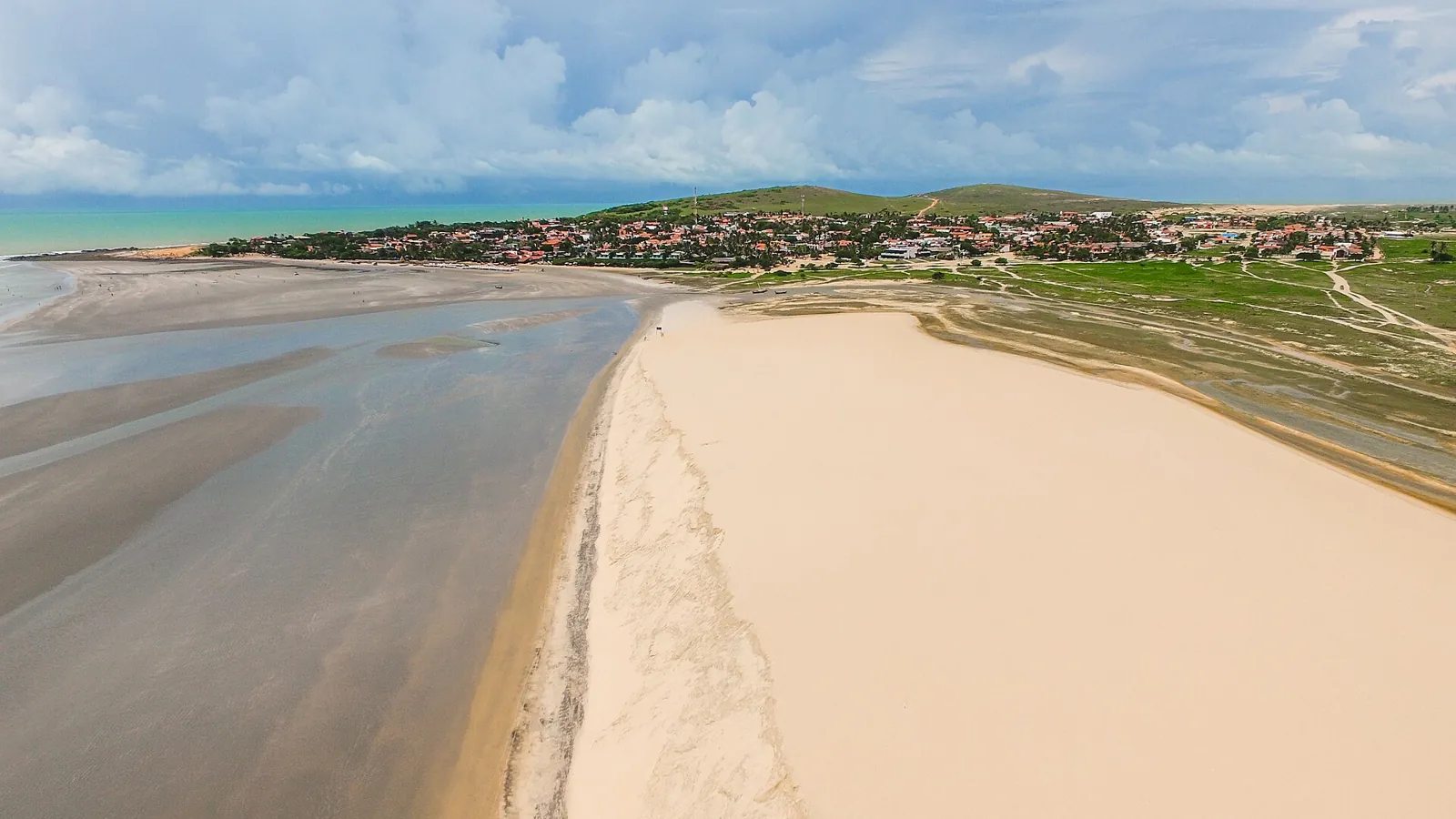
The village sits between the sunset dune, the tidal plain and the Serrote hill.
Expect pousadas, houses, small apartment blocks and lots, not high-rise buildings. A January 2018 report counted about 5,000 properties in the municipality's urban area, seat and village together, with 350 of them in hospitality. Idace, the state land agency, reports 743 geocoded lots in the village. AirROI's listing mix for the village, in 2026, is 45.8% apartments and 41.5% houses, with hotels and boutique properties making up most of the rest.
Height is the local rule everyone mentions. A state deputy told Diário do Nordeste in 2025 that since the 1980s the village has allowed a ground floor plus one, or first plus second floor, inside a 7-meter limit. The municipal text reads a little differently. Jijoca's land-use law is Lei Complementar 103/2009, rewritten by Lei Complementar 109 of 2017, and the December 2017 amendment, Lei Complementar 121, refers to authorization for only two floors in village buildings and a maximum height of 7.5 meters. It lets the second-floor slab be used with no roof structure built on it, leaves out anything below the ground floor, which may not be a home or lodging, and caps village projects at two parking spaces. The 2017 law itself and its annexes were too large for us to open here, so have your architect pull the current parameters for the lot. A 2020 amendment, Lei Complementar 150, also sets a 250 m² minimum lot and minimum setbacks of 3 meters front and back and 1.5 meters at the sides for the Special Tourist Interest Zone, so ask whether your lot is in that zone. Hold the listing's floor count against these limits, because the 2025 regularization law, covered below, excludes buildings over the permitted number of floors.
Costs of building were quoted at R$ 1,800 to R$ 2,000/m² in that 2018 report. That figure is eight years old and predates the fall in available land. Take a current quote that includes moving materials over sand.
Prices by area
Published price points, none of them a current sales index
Area
Figure
What it measures
Date
All listings on our index
R$ 8,571/m²
Median asking price, 7 listings with an area
2026
Land near the entrance parking lot
R$ 1,300/m²
Land, broker's quote in the press
Jan 2018
Beachfront land
Up to R$ 12,000/m²
Land, same broker's quote
Jan 2018
The same 2018 report said land at the village entrance cost about what beachfront land cost at Preá. As relative positions, and no more than that, Beira-Mar asks the most, the central streets follow, and the outer streets ask less. See current asks on homes for sale, and treat a land-case discount as a reason to ask questions.
Shares, gated projects and fees
Multipropriedade means you buy a time share of a unit, registered in your name. GAV Resorts announced 300 such units facing Lagoa do Paraíso in December 2022, with delivery promised for December 2026. The off-plan guide is worth your time before you sign one of these, because the delivery date is a promise and the lagoon's licensing has a history of court orders. No published condominium-fee range for the area was found, so get recent bills and the building's accounts, and read them with the guide to condominium fees.
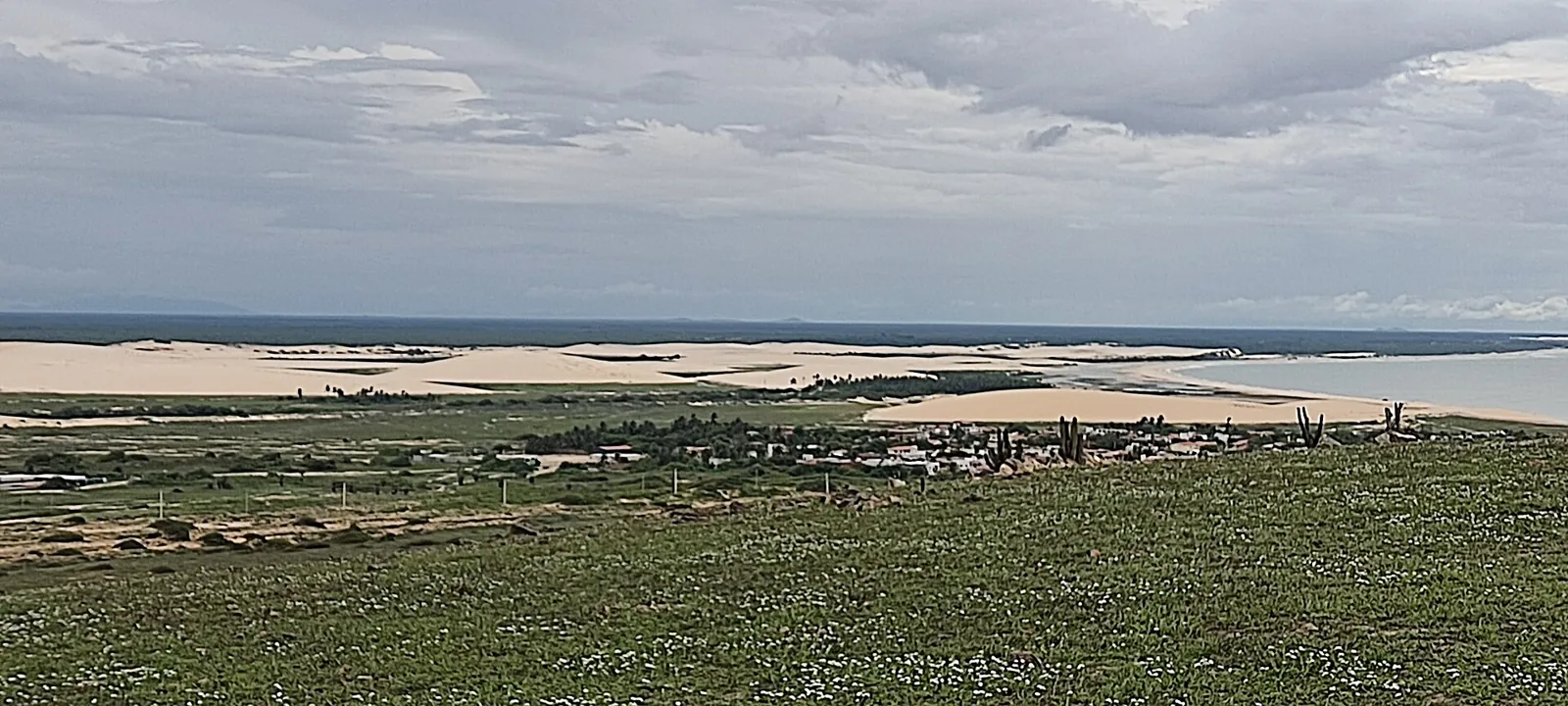
Houses, palms and dune fields seen from the hill above, in 2023.
No published rent index, vacancy rate or local guarantor survey for the village was found. Numbeo has no Jericoacoara page, and FipeZAP has no rent reading here. The nearest published anchor is Fortaleza, where a central one-bedroom shows as R$ 1,683 on Numbeo in November 2026 and a three-bedroom as R$ 2,894, and two commenters on that page, writing in 2023, said prices there looked low. Do not carry those numbers to the coast. They are a Fortaleza reading and nothing more.
Our general read is that the long-let market here is small because a house can earn more by the night for part of the year, and hospitality staff need somewhere to live. Expect year-round leases to come through word of mouth and local brokers on the brokerage directory, and expect owners to ask for an agreement that lets them take the house back for the holidays. Get any such clause into a written contract and read it against the Tenancy Law with a lawyer.
For a tenant, two local costs are easy to miss. Mineral water and groundwater quality are live issues in the village, covered in the utilities chapter, and most supplies come over sand. The household budget page separates what we could source from what we could not.
For an owner, the safer way to judge long-let income is to ask two local brokers for signed leases, not asking rents, on similar streets. Our own index carries too few listings to give a rent figure, and FipeZAP's gross yield is not published for this market, so this guide gives none.
Short-term renting
No municipal law aimed at short lets turned up in the pages of Jijoca's online law list read for this guide. BnbCalc, a data vendor, rates the area lenient and says hosts often register as individual microentrepreneurs, but it also tells readers to verify. Ask the Secretaria de Finanças what it wants, in writing, before you list. Rules in a building or gated project may be stricter, a point covered by the short-let guide for the whole country.
The only named market data used here comes from AirROI, which follows Airbnb listings. Its figures run lower than many sellers' spreadsheets.
AirROI, 12 months to September 2026, per active Airbnb listing
Area
Listings
Nightly rate
Occupancy
Revenue a year
Jericoacoara (village page)
142
R$ 408
32.3%
R$ 27,454
Jijoca de Jericoacoara (municipality page)
396
R$ 612
32.6%
R$ 57,320
Cruz, which includes Preá
276
R$ 815
26.1%
R$ 49,522
Camocim
155
R$ 594
21.9%
R$ 25,935
AirROI's averages mix rooms (27.5% of village listings) with whole homes, so a large house will do better and a single room worse. BnbCalc's municipal page, on a wider set of Airbnb and VRBO listings, shows top performers at R$ 293,000 a year and low performers at R$ 22,000, and even its own summary and stat cards disagree. Demand a seller's platform statements and tax records. You will find no short-let yield on this page, since we found no named source that calculates one here.
The year has two peaks. In the village, July 2026 earned R$ 8,393 per listing at 48.2% occupancy, and January R$ 5,297 at 41.9%. March and April earned about R$ 3,100, and May had the lowest occupancy at 23.7%. Wind brings its own guests, mostly to Preá, from July on.
Guests pay a municipal Sustainable Tourism Fee of R$ 41.50 for up to 10 days, plus R$ 4.15 for each extra day, with exemptions listed by a 2026 travel-trade report for children up to 12, people over 60, people with disabilities, Jijoca residents and workers in the village. Hosts who pitch a price should say it is extra. Law 975 of November 2025, amended in January 2026, also tells pousadas and agencies to report tour sales to the village's single-queue office for tourist transport, with 10% as the reference intermediation rate, so a lodging that resells outings should read it.
Taxes on the income are a national topic: see the rental income tax guide. Ask your accountant about three open questions: whether IOF at 3.5% is due on the rent or on the proceeds you bring home from a sale, what CBS and IBS will mean for non-residents above the thresholds, and what happens to the short-let deduction of R$ 600. All three remain unsettled. Buyers who want kite-season demand close to a big airport compare this coast with Cumbuco, about 40 minutes from Fortaleza, which holds the Senate's title of national kitesurfing capital.
Short-let arithmetic
Starts from published figures (12 months to September 2026 (AirROI, Airbnb listings in the village)). Set your own.
Everything below comes from Jijoca's tax code, Lei Complementar 107/2015, and Ceará's 2026 fee table. The later amendments we opened (110 and 111 of 2017, 123 of 2018, 146 and 149 of 2020, 159 and 163 of 2021, 172 and 173 of 2022) deal with street-lighting charges, fees, fines, waste collection and one narrow IPTU exemption and do not touch these rates. No title on the city's law list names a new ITBI or IPTU rate, but some amendments could not be opened, among them Lei Complementar 117 of 2017, so have the city's finance office confirm. The property tax guide and the closing costs guide set out the national rules.
ITBI, the transfer tax
The rate is 2%. Inside the Sistema Financeiro da Habitação, Brazil's regulated mortgage system, the financed share pays 0.5% and the rest pays 2%. As a general observation, few buyers here will qualify, because a bank needs a registered title to lend against. The base is set by the tax office from its own evaluation, and article 108 tells it to override a declared price it finds below market, using an individual valuation by a civil engineer. You then have 30 days to contest. The national guide explains how courts have treated declared values.
Three clauses matter locally. Article 101 makes whoever ends up with the final deed liable for tax on earlier transfers of rights in the chain, with arrears, so a house sold three times on private contracts can arrive with three tax bills. Article 106 leaves out of the base any construction the buyer proves was built at the buyer's cost, with a license, while the sale was still informal. Article 99 exempts only narrow groups, such as municipal public servants buying the home they live in, and it has no general first-home exemption.
The yearly IPTU bill
IPTU rates in Lei Complementar 107/2015, art. 15
Type
Assessed value in UFIRM
Rate
Residential
Up to 5,000
0.4%
Residential
Above 5,000, up to 7,000
0.5%
Residential
Above 7,000
0.6%
Non-residential, including a pousada
Up to 7,000 / up to 12,000 / above 12,000
0.8% / 1% / 2%
Unbuilt lot
Without infrastructure / with, walled and with sidewalk / with
1% / 1.6% / 2%
UFIRM is the city's fiscal unit, and the finance office can give you its current value. The code allows payment in up to 8 installments and a discount of up to 10% for one payment. Ask for the property's actual bill, since assessed value often has little to do with market price.
The clause to remember is this one. Article 30 says paying the tax does not make the city recognize your ownership, and article 33 lets land with an unknown owner, and buildings not yet regularized, enter the tax register on a precarious basis, for tax purposes only. An IPTU bill in a seller's name is not evidence of title here.
What closing costs come to at R$ 1,000,000
Assumes the tax office accepts the price and no mortgage is involved
Item
Basis
Amount
ITBI
2%
R$ 20,000
Public deed (escritura)
2026 table, code 002017, all charges
R$ 3,757 to R$ 4,718
Registration
2026 table, code 007009, all charges
R$ 2,565 to R$ 4,848
Opening a registry record and filing
Codes 007024 and 007025
R$ 350
Total
About R$ 26,700 to R$ 29,900
The range exists because the table caps the charge with a clause that can be read as a ceiling on the total or on the amount above the top band. Either way, notary and registry together come to under 1% of the price. On federal marine land add the laudêmio, the federal transfer charge, which the terreno de marinha and laudêmio guide sets out. Also budget for a local lawyer and a surveyor, which will matter more here than the taxes do. Preá and the airport side answer to Cruz, whose code also sets 2%, lowers it to 1.5% if the buyer pays before signing the deed, and taxes a financed share up to R$ 200,000 at 0.5%.
Who owns the ground under the village
Read this chapter before you look at any house. Since October 2024 the village has been in an open dispute over whether a private registry title covers most of its land. As of 3 November 2026, we could find no report of any ruling in the case and no public account of its progress this year. We also found no report of anyone being removed from a home because of it. A buyer can still inherit the problem.
The two stories
The state's story starts in the 1990s. From 1995 to 2000 Idace regularized the village, titled occupants and took unclaimed land into state hands. A state ordinance of 2000 cites a certificate from the Acaraú registry saying no prior registrations existed. The claimant's defense says that certificate belongs to a different seizure, tied to the old APA. The public record carried a reservation: if an earlier registered owner proved title, the state would recognize it. Occupants' titles flow from that process.
The claimant's story starts in 1983. Her then-husband bought three plots registered in Acaraú, which became Fazenda Junco I and passed to her in a 1995 divorce. She says the land overlaps the village. Reports state the overlap as about 80% of the village, or 73.5 of its 88 hectares. Her documents reached Idace in July 2023, and she calls the 1983 registration legitimate. Her family denies land grabbing.
How the numbers grew
The disputed entry is a single registry note. On 14 December 2007, in the new Jijoca registry, entry AV-545 merged records 542, 543 and 544 into record 545 and recorded a surveyed area of 924.49 hectares. The prosecutors' recommendation, cited by the press, says the area had been 441.04 hectares, while the claimant's side starts from about 714. A surveyor hired by the village's community council, a Federal University of Ceará professor, called the 109% growth unexplained, faulted the survey's datum and one measured line, and concluded the merged shape does not reach the village. The claimant's lawyers reply that the change reflects more precise measurement and a registry move, about 29% by their figure, and that it does not alter the overlap with the village.
The deal that stopped
In May 2024 the state's attorney general's office, the PGE, recognized the title and signed an out-of-court deal: she would give up everything occupied, by the PGE's account over 90% of her registered area, and take 19 unoccupied lots totaling 3.47 hectares. Her family's own figures put 55.3 of the 73.5 hectares as already titled to residents and merchants. Idace said the deal would keep people from being removed from their homes and businesses. The deal became public in October 2024, and residents protested. On 25 October the state prosecutors (MPCE) recommended stopping it, and the PGE froze it indefinitely by 1 November. The lots sit at the edges of the village, by the entrance, near the cemetery and near the emergency unit. The community council says at least 4 of the 19 fall in a municipal ecological area created in 2021.
Where it stands
State court. On 27 August 2025 the PGE filed suit in the single court of the Jijoca district against the claimant and the registry office. It says an expert review by Incra, Idace and ICMBio found 314.49 hectares of possession wrongly folded into ownership in 2007, and it asks the court to void the entry and return the area to the state's record. The deal stays frozen until a final decision.
The defense. Her lawyers say she will not give up her rights, that 42.39 hectares inside the village remain hers even if the 2007 entry falls, and that she may raise adverse possession (usucapião) as a defense or sell her rights to funds. In June 2025 they said litigation would reopen the whole area.
Titling. In June 2025 Idace said all titling, revision and regularization matters were on hold until Incra's forensic registry work ended. We could not confirm whether that has changed, so ask Idace directly.
Federal court, Sobral. Separately, three suits ask the federal government for compensation over park land. A ruling reported in 2024 recognized title and compensation at ICMBio's far lower valuation, and both sides moved on: her lawyer said he would appeal, and in November 2024 ICMBio asked the court to pause the Junco I case until ownership is clarified. The outcome of that request was not found.
What this means for one lot
The risk is uneven. A title traced to Idace on a built, occupied lot was protected under the frozen deal, but that deal is not in force. An unoccupied lot is more exposed, because those are the areas in contention. Possession-only property has the weakest position of all, since the governor himself said in 2024 that people occupying land they know is not theirs are in a precarious situation. See the posse and escritura guide on the limits of possession.
What to ask for
The full current matrícula, the registry record, from the Jijoca registry, and the chain back to its origin. Does it descend from Idace's state record, from records 542 to 545, or from neither?
Idace's own title document and its map position among the 743 lots.
Searches at the Jijoca court and at Sobral's federal court, in the names of the seller and on the land itself, following the title check guide.
A written answer on whether the lot is one of the 19 in the frozen deal, or a green area the council claims.
A surveyor's boundary check against the walls on the ground. An Idace survey in 2018 found about 11,000 m² of illegal advances, and the federal prosecutors have pursued hotels and pousadas over land since 2014.
A retention clause in the contract: part of the price held back until registration, drafted by your own lawyer, with no shared lawyer.
Rules from the park, the beach and the lagoon
Several public bodies have a say here, and none of them answers for the others. Before paying a deposit, work out which of these rules touch your lot.
The national park and its concession
The park was created by decree in February 2002 and redrawn by Law 11.486 of 2007. That same law abolished the old Jericoacoara APA, created in 1984, so a listing that says "inside the APA of Jericoacoara" is out of date. The current management plan was approved by Portaria 3,180 of 2023. Park visitor services went to Urbia Cataratas Jericoacoara under a 30-year concession in 2024. Its plan to charge R$ 50 rising to R$ 120 at the gates set off a long case: on 3 October 2026 the vice-president of the federal appeal court TRF-5 refused to send the company's appeal up, keeping the ban on charging people who only cross the park to reach the village. The company may charge for park attractions, and it can still appeal.
A second park fight concerns building a road from Preá. The federal prosecutors asked the court in May 2025 to stop it for lack of municipal licensing, and the state and federal prosecutors recommended pausing the contract that month. The concessionaire says ICMBio authorized its work. The federal court in Sobral had refused to stop the works, reasoning that they need ICMBio's authorization and no municipal license, and the prosecutors' appeal was pending when reported. We found no later decision, so if you are buying with the road in mind, ask a lawyer where that stands.
The beach
The SPU, which is the federal property office, says the sand strip and the terreno de marinha are federal. On 21 January 2026 it notified 15 beachfront businesses, which had already shown registrations for parts of their areas, to remove the rest within 10 days, or the SPU and the city would do it, following a federal prosecutor's recommendation. Two months earlier it stopped a city project on the beach. We found no report on what happened after the deadline. Inspect any seafront lot against the SPU's line, not the seller's wall.
The lagoon
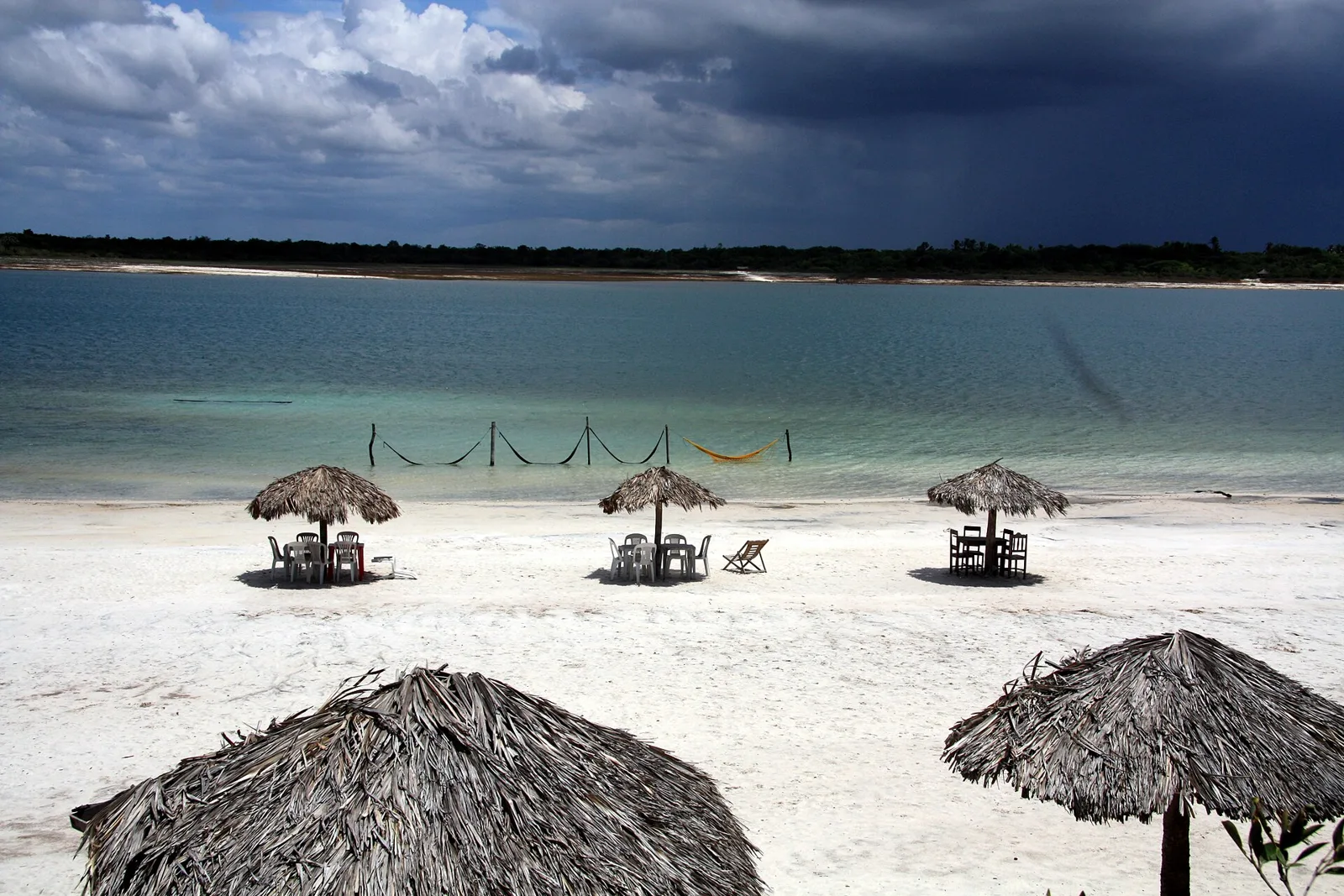
The state APA of Lagoa da Jijoca dates from 2000. In 2016 a local judge barred new environmental licenses until a management plan and council existed, and that plan was delivered in November 2019. The Lagoa do Paraíso page covers the rest, including the unresolved edge of the shoreline protection zone.
Buildings that were never legal
Jijoca passed amnesty laws in 2015 and 2017. The MPCE told the city in 2017 to repeal the second, and Law 501 of January 2018 did. A 2022 version, Lei Complementar 179, was revoked in August 2023 by Lei Complementar 188. Lei Complementar 204 of 2 May 2025 is the latest round. It lets finished buildings be regularized on payment of a fine, and it accepts possession proved by any suitable document with a notarized signature. It excludes buildings on or advancing over public land, in permanent preservation areas or over the permitted floors. On 17 June 2025 the state's chief prosecutor asked the state court to strike it down, citing the risk to the village. No ruling had been reported anywhere we looked as of November 2026. A permit issued under this law today may not hold, so have your lawyer check the case status before relying on one.
Foreign buyers
A foreigner can buy an urban home, with a CPF, as anywhere in Brazil: start with the CPF guide. Plots outside the urban perimeter around the lagoon or along the Preá coast can fall under rural limits, so check the rural land guide before signing. Closing from abroad is possible with a power of attorney, though nothing here makes a remote purchase sensible without a site visit.
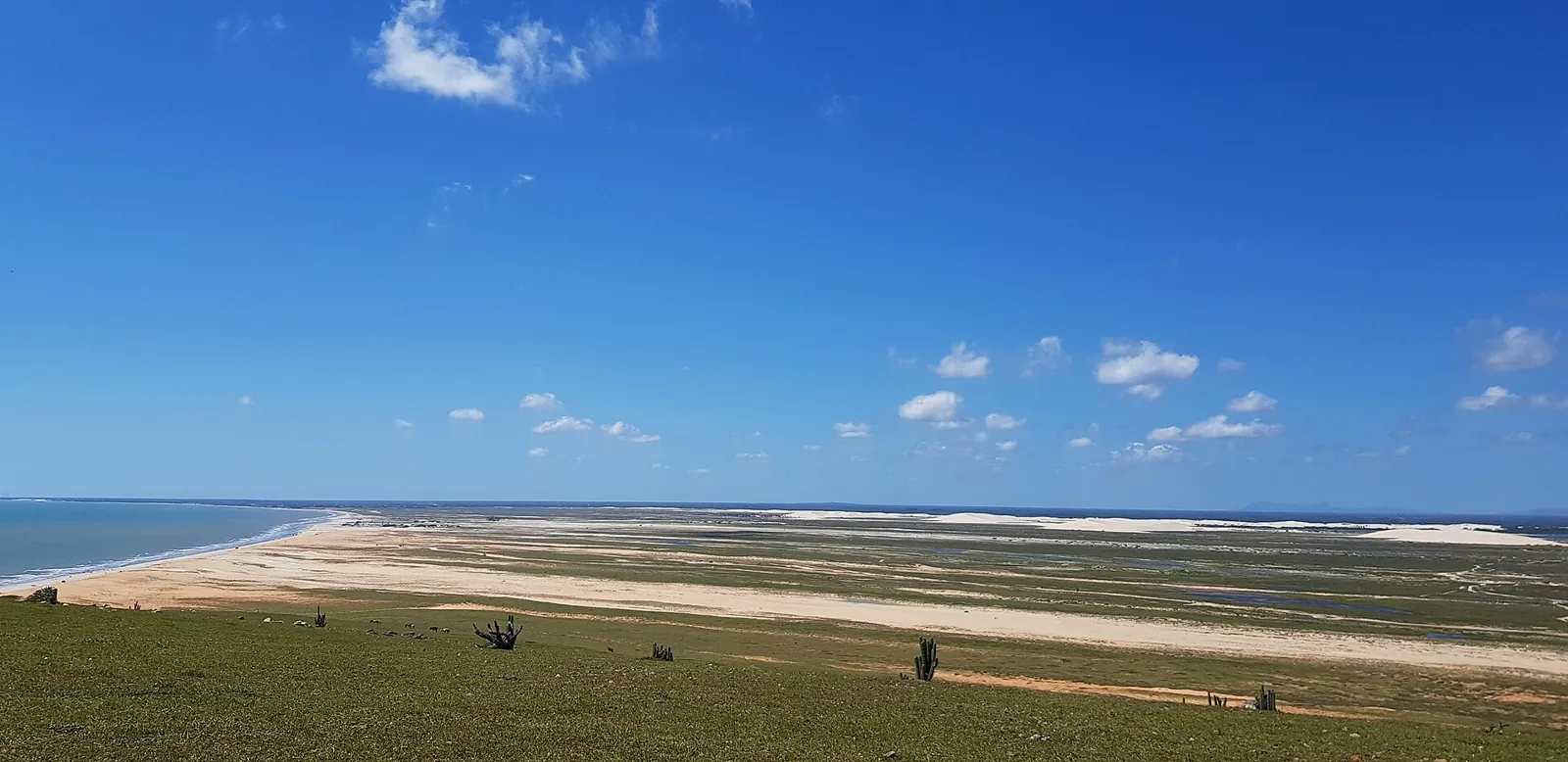
Looking out from the Morro do Serrote over the open land around the village.
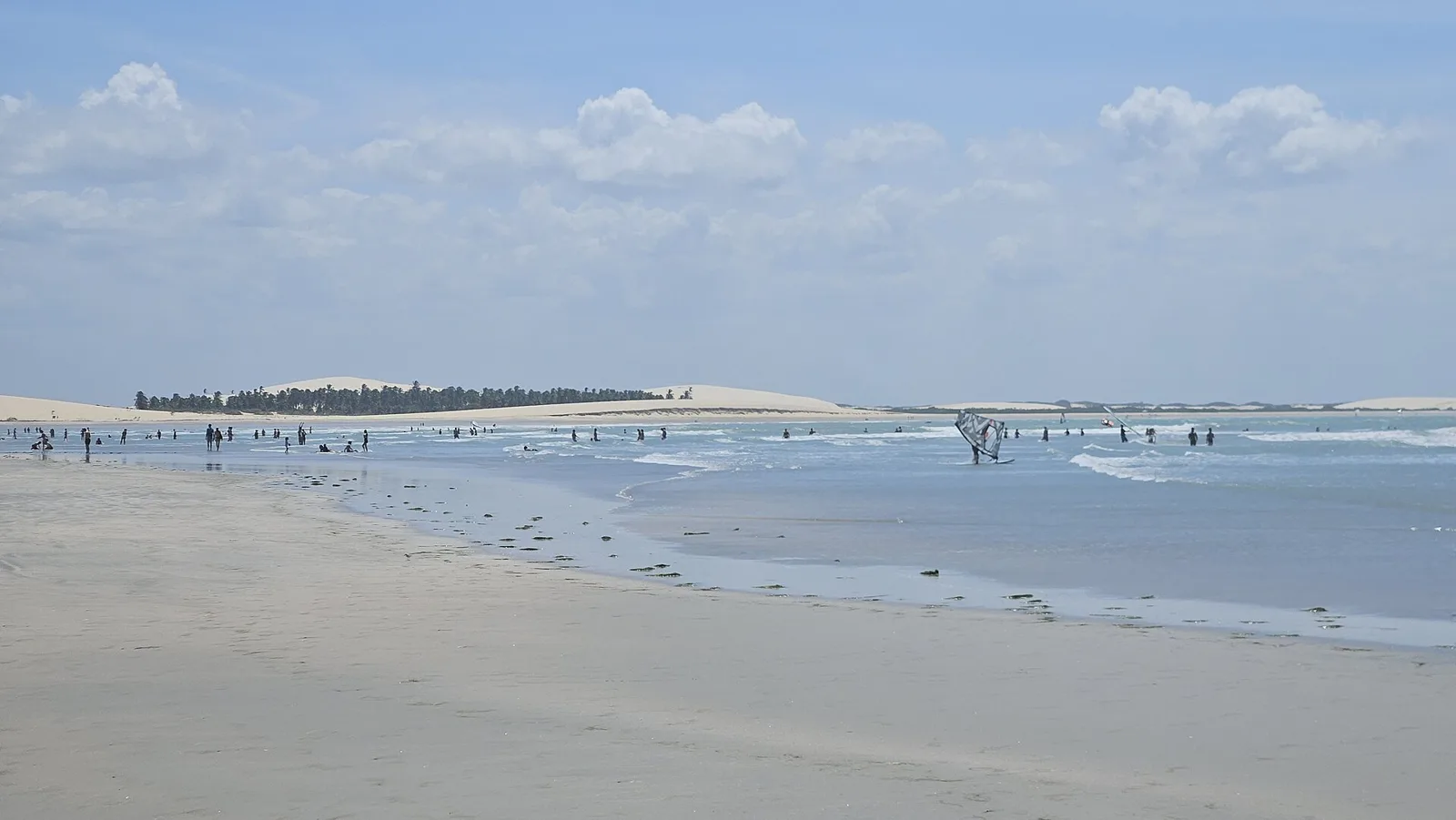
Ceará's coastal erosion plan, the PCEC, was launched by the state environment department in March 2025. It compared satellite images from 2016 to 2024. On the beach at the village it recorded a retreat of 48 meters, roughly 10 meters a year, the highest rate in Diário do Nordeste's table of the state's beaches. It marks 10 points of critical erosion between the village and Pedra Furada, and it classes Jericoacoara as an attention zone with high vulnerability.
The effects are already visible. Tides reach areas once used by beach stalls and pousadas, according to a November 2025 report, and some merchants have put up their own barriers, which researchers call emergency measures of low effectiveness. The village has no groynes of the kind used in Fortaleza. In April 2024 Cagece, the water company, said the sea had exposed sewer pipes near the beach, and it was studying a new line on parallel streets.
A study by the Federal University of Ceará's marine institute was due to start in August 2026, take about 12 months and produce vulnerability maps, pending park licenses. Until it reports, nobody can tell you with authority how far the sea will go, or what kind of protection will be allowed. The business council has already said it does not want an artificial-looking beach.
Moving sand
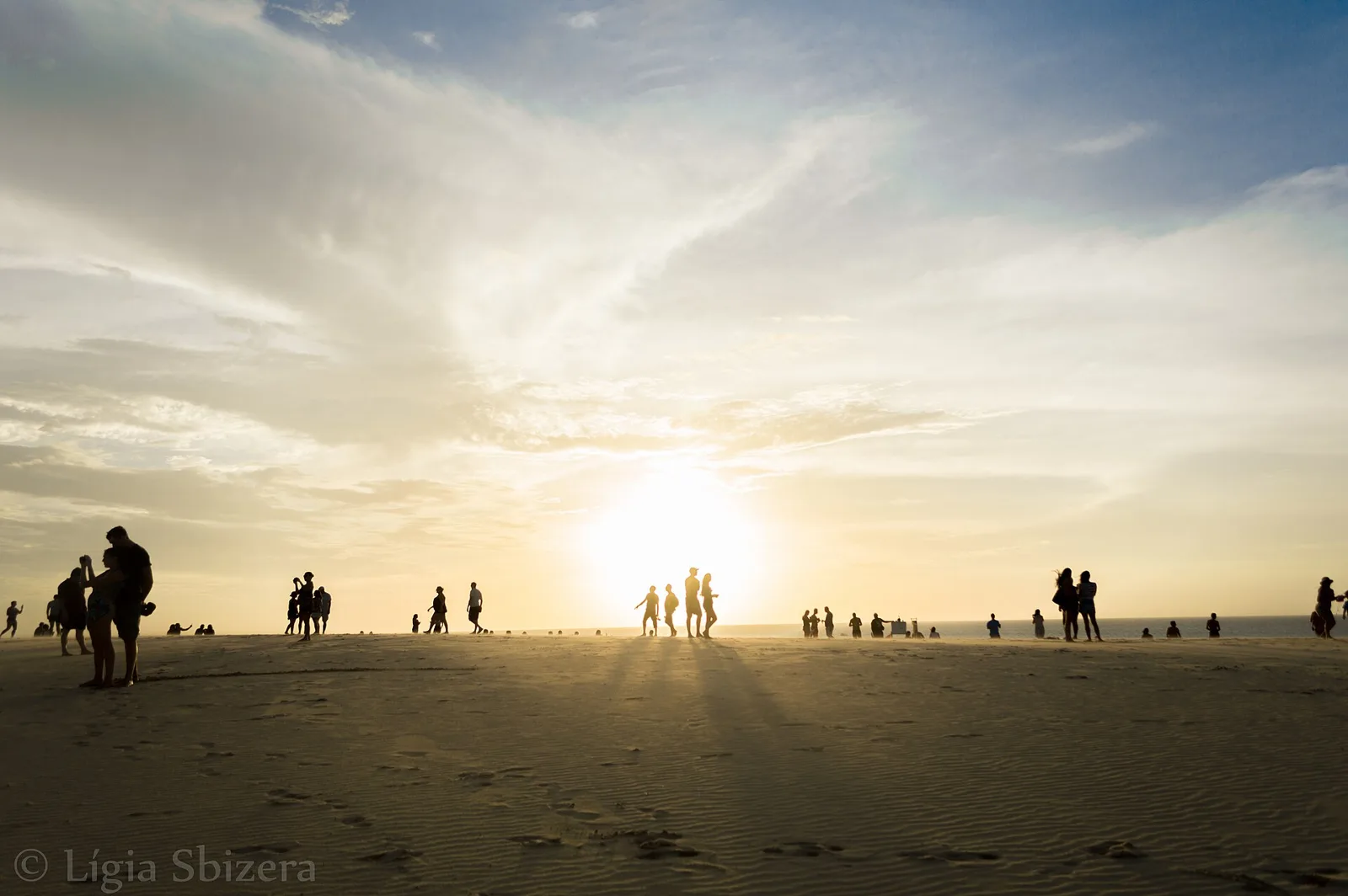
The Duna do Pôr do Sol has shrunk. Reporting in 2025 says it was lowered by over 50 meters, and Labomar's researchers blame wind in the dry second half of the year, plus crowds who loosen the sand. Tatajuba, in Camocim, is the warning from this coast: its old village was buried by dunes in the 1970s and 1980s. If a lot lies downwind of open sand, ask a geologist or an experienced local builder to read it.
Water in the streets
The MPCE's 2022 list of pending actions in the village includes urgent drainage works, because of recurring runoff. Visit in March or April to see it. Preá has its own version, covered on its page. For official maps, start with the flood and landslide guide, though a site visit in the rain will tell you more here.
Price the front row against those 10 meters a year, and ask how far a wall stood from the tide five years ago.
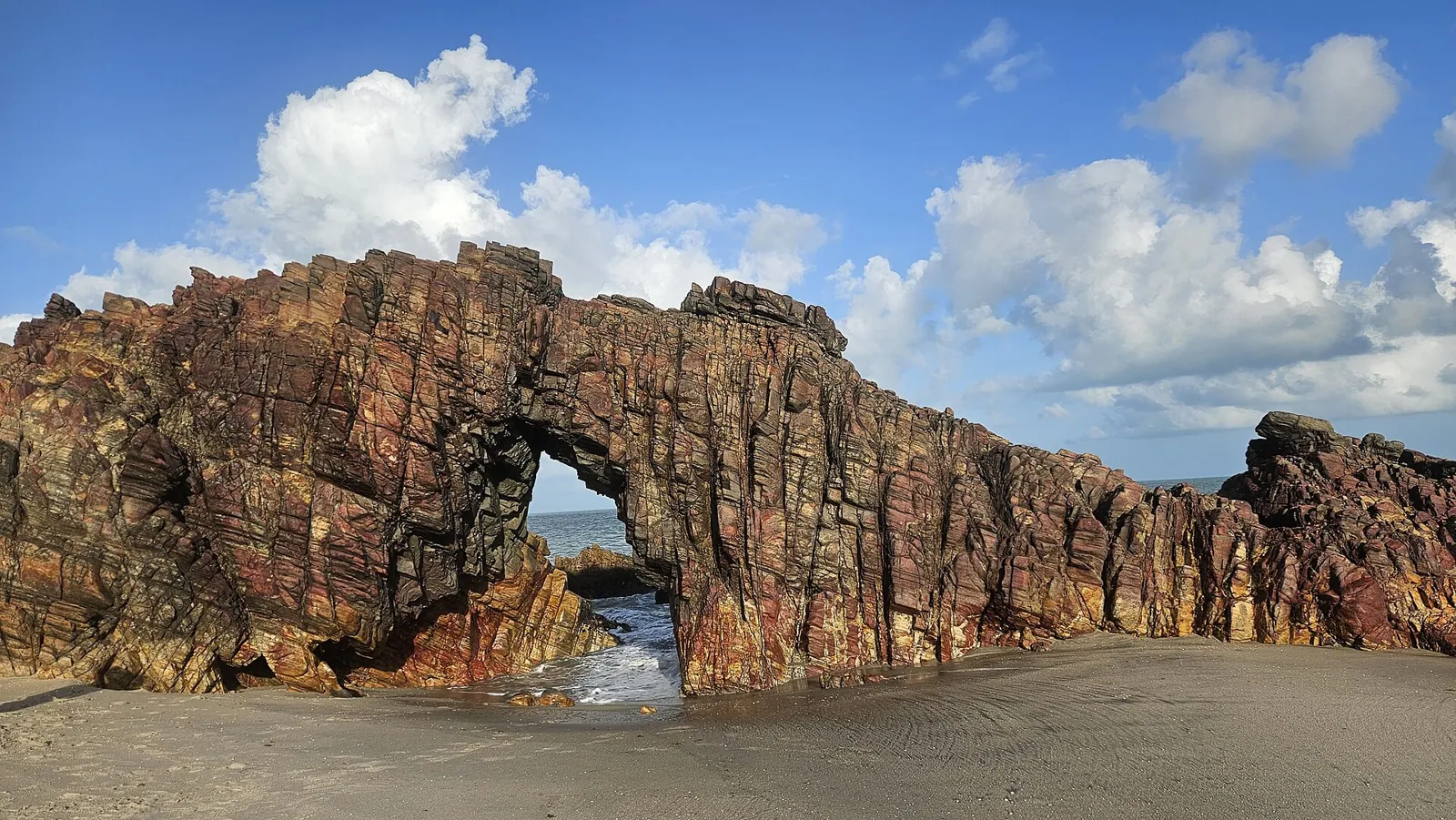
Pedra Furada marks the far end of the stretch where the state's erosion plan lists critical points.
The village's whole water supply comes from the groundwater under it, and its treated sewage is spread on the same sand. A team from the Federal Institute of Ceará monitored nitrate for 13 months in 2022 and 2023, in private wells and in taps on the public supply, and reported levels up to 11 times the Health Ministry's limit of 10 mg/L. They attribute this to effluent from the sewage plant, installed in 2009, which they call undersized. Cagece replied that its water is monitored as the ministry requires and that it acts at once on any variation.
The history explains why you should ask. A 2018 agreement with prosecutors found idle and misused sewer connections and uncontrolled wells, and it barred new water and sewer connections in areas of ICMBio interest without an inspection. In 2022 the MPCE said parts of that agreement remained undone. Wells drilled without a permit, and any that serve your pool, are a question for the seller.
Cagece said in January 2025 that it was investing about R$ 51 million here, including reverse-osmosis water treatment, double the sewage capacity and an ocean outfall, and that sewage coverage in the municipality stands at 93.8%. We could not confirm progress on those works in 2026. On 30 June 2026 a consortium won a 28-year contract at B3 covering sewage in 23 municipalities from Sobral to Jijoca, with about R$ 1.08 billion of investment, so responsibility for sewage is also about to change hands.
What to check on a house: a recent lab test of the tap and any well, the Cagece connection and last bills, the well's permit from the state water bodies, and what the 2025 regularization law requires, which is a link to the sewer or a septic system with a soakaway.
Power runs through an underground network, installed a little over 20 years ago, and residents chose not to have street lamps, according to Estado de Minas in March 2026. No recent report on outages in the village turned up, so ask neighbors and read a year of bills. A 2017 municipal law sets a street-lighting charge in bands by consumption, from 1.37% at 101 kWh a month up to 24% above 500 kWh for homes and 38.61% for businesses, so check how it appears on a bill. The same March 2026 article says the village has no bank branch or ATM, that most businesses take cards, and that cash means a trip to Jijoca.
Safety in published numbers
No municipal homicide rate for Jijoca was found in the sources we could open, so this guide shows none. Ceará's security department publishes figures by municipality on its own panel, which we could not reach, and that is the place to ask.
State figures give the background. Ceará counted 2,786 violent deaths from January to November 2025, down 6.6% from 2,983 a year earlier, according to Diário do Nordeste's report of official data. The Interior Norte grouping had 60 deaths in November 2025 against 81 a year earlier, and the report does not list which towns it includes.
Organized crime has reached the area. In December 2024 a 16-year-old tourist from São Paulo was found dead in a lagoon after disappearing from the village, and police said members of the Comando Vermelho had seized him on suspicion of belonging to a rival group, a link police later ruled out. Eight suspects had been arrested by July 2026. In September 2025 a man was arrested in Jijoca town after stoning a police vehicle outside the police station, reportedly on a faction's order.
Unlit sand streets shape daily choices. A 2024 travel guide warns that some stretches between outer pousadas and the center have no lighting, and it reports difficulty finding transport from them at night. A buyer weighing an outer street should walk it after dark, and an owner renting to visitors should tell them how to get home. Ask local police and the neighbors what has changed recently, since none of the published numbers are this fine-grained.
Clinics, schools and shops
Medical care in the village means the public emergency unit, the UPA, on the south edge, which Diário do Nordeste uses as a landmark there. Jijoca town, about 20 km away, has the municipality's other public services. For anything serious, plan on Fortaleza, about 300 km away. A buyer with a health condition should treat that journey as the main fact about living here. Plan prices and other household costs have their own budget page.
We found no international school anywhere in the municipality. Local schools are public, such as the state high school EEEP Sandra Carvalho Costa in Jijoca, with about 520 students. Parents after an international curriculum should compare Meireles in Fortaleza, and buy here as a holiday home.
Shopping splits by place. Jijoca town has the larger choice: a phone directory lists 25 markets in its center, with a cluster on Avenida Manoel Teixeira. As a general observation, goods reach the village over sand, which adds cost, and building materials cost more to move. A 2023 city law also bars animals from tourist cart rides in the village, so carrying things takes planning.
The foreign community is real but uncounted. Reports mention Italians, Belgians and French, and Bloomberg Línea describes foreigners, the French among them, drawn to Preá's wind. As a general observation, Portuguese remains necessary for dealing with the city, the registry and contractors.
If you want to spend long periods here, the residency guide sets out the routes. The investor visa threshold in Ceará is R$ 700,000, explained in the visa guide, so ask your lawyer early whether a house with a disputed or possession-only title could support an application.
Climate and when to inspect
The village has no entry in INMET's 1991-2020 tables. The nearest are Sobral, inland and hotter, and Fortaleza on the coast, which is the fair comparison and the one in the climate tool on this page. Fortaleza's highs stay near 31°C all year, with lows near 23 to 25°C. It takes 1,584 mm of rain a year, most of it from February to May. Climatempo's 30-year averages for Jericoacoara show the same shape on less water, about 1,190 mm, with 298 mm in March and single digits from August to November.
Wind is the local climate. Kite operators work from July to January, on Bloomberg Línea's and the Cruz diagnostic's figures. Melhores Destinos calls August the windiest month, reaching about 35 knots in the afternoon. As a general observation, salt and sand work on everything outdoors, so look at door tracks, metal fittings and air-conditioning units on any place you view.
What an inspection trip shows
Month
What shows
What stays hidden
March and April
Runoff, damp, drainage, low-season rents
Wind-season demand and night noise
July
Peak bookings, full lagoons, crowds
Flooding, and what a quiet month earns
September to November
Blowing sand, kite traffic, a dry beach
Rain problems; lagoons may be lower
Late December and January
Maximum noise, traffic at the entrance
A normal day in the village
Two visits, one in April and one in September, tell you most of what a seller cannot. Lodging for holidays needs booking months ahead, so aim for a quieter week if the point is to meet the registry and a surveyor.
Press a month
JFMAMJJASOND
Bars show rain. Fortaleza, INMET code 82397, the nearest coastal station with a published normal, about 300 km east, 1991-2020. Source.
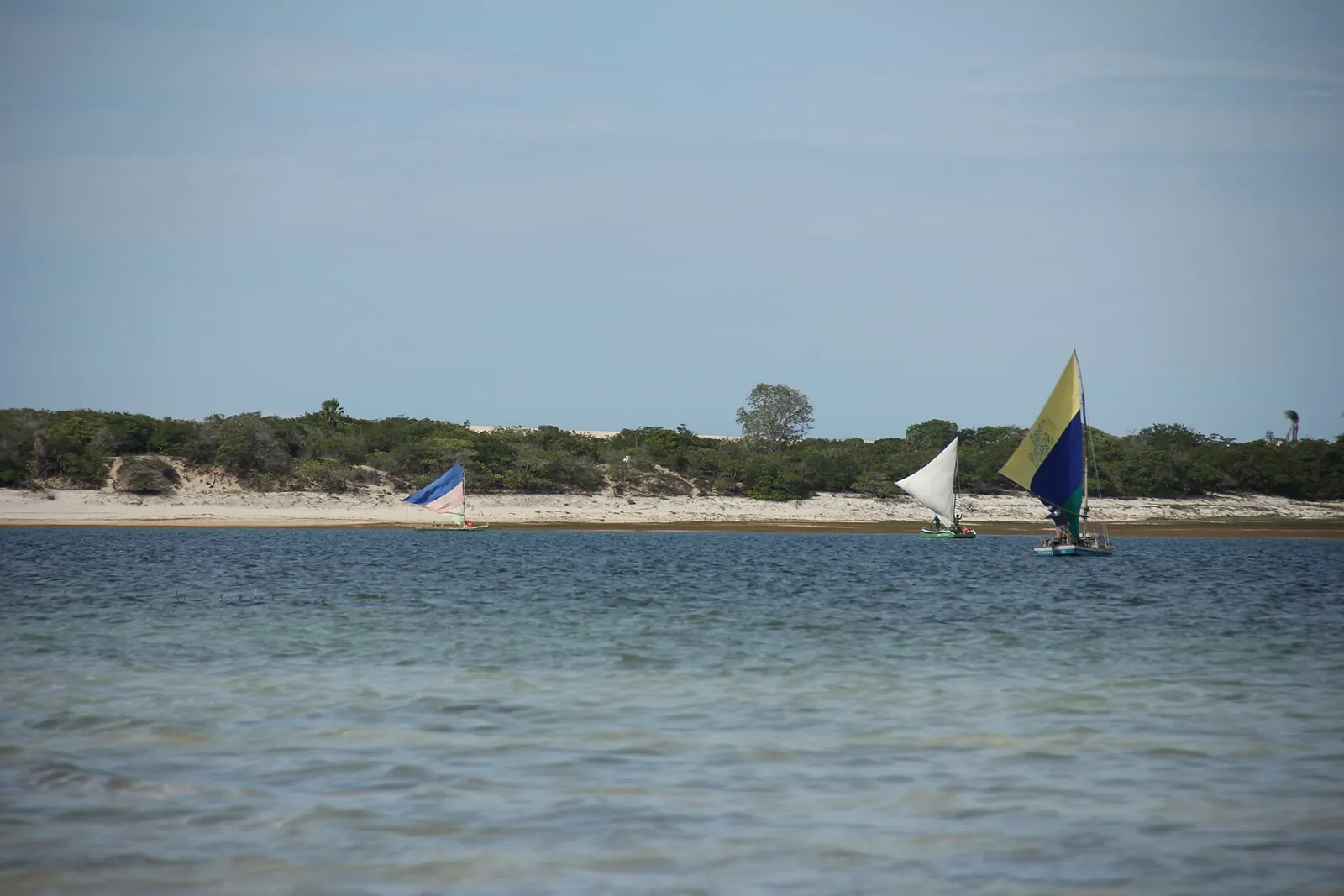
Sailboats on Lagoa do Paraíso. Motorboats are on the banned list in the lagoon's management plan.
There are no international flights to the airport. Fraport Brasil took over on 1 September 2026, and its chief executive has ruled out international service until 2029, because the terminal and aircraft apron cannot handle it. Diário do Nordeste reported in September 2026 that LATAM and GOL fly to São Paulo Guarulhos and Azul to Belo Horizonte Confins. We could not open the airlines' own schedules, so check current days and any seasonal changes. LATAM has announced five weekly flights to Brasília from July 2027. International arrivals connect through São Paulo or land at Fortaleza, some 300 km off and four to six hours by 4x4 transfer, partly over sand. Comparing the trip with Pipa, about 85 km south of Natal by road, is a fair test of how much the journey matters to you.
The car rule is newer than many guides suggest. Municipal Law 568 of June 2019 repealed the 2010 law and bars entry, circulation and parking of motor vehicles in the village. The exceptions are vehicles the city has credentialed, with a work order giving itinerary, date and passengers, and vehicles credentialed elsewhere by ICMBio or the state traffic department that drop visitors at their lodging and leave. Vans, minibuses and buses stay out, official vehicles aside. Article 6 tells village residents to register their vehicles to enter and stay, free of fees, and keeps the public lot for those without a garage. The law does not say how a part-time owner counts, so ask the city. Law 659 of 2020 sets the outside lot at R$ 40 per vehicle a day with no re-entry, the figure Melhores Destinos also quoted in November 2022. A 2022 law, 725, still amended the repealed 2010 text on well drillers' access, so have your lawyer confirm which text the city applies. Law 975 of November 2025 also sets up a single queue for tourist transport.
Vehicle numbers are a live argument. ICMBio told Diário do Nordeste in 2023 that 2,200 vehicles held park authorizations, and the mayor spoke of about 3,000 that year. The city asked the park to freeze new credentials pending a carrying-capacity study. We did not find one published. Law 568 sets no overall cap that we could find.
Roads: from Fortaleza take the CE-085 to Jijoca or Preá, then tracks over sand. Buses reach Jijoca, with a shuttle truck for the dunes. Transfer prices are in the monthly budget. For the rules on driving as a foreigner, see the license guide.
What is changing
The land case. A ruling at the Jijoca court, and then appeals, could change the value of many titles. Nothing suggests a quick end.
The master plan. Jijoca's plan dates from 2009. The city said in April 2025 that it had run since then without the legally required update, and that an update was in its final phase, with a public hearing to come. We found no approved new plan by November 2026, so ask before you design anything.
The state coastal law. State Law 19,294 of June 2025 requires coastal municipalities, Jijoca, Cruz and Camocim among them, to write their own coastal management plans, and its text sets no deadline.
The airport. Fraport plans about R$ 100 million of work under a contract to 2047, with the terminal first, to 2028, and the apron in 2028 and 2029. Its target is more than 1 million passengers a year by the end of the concession.
Science and erosion. The university's research station in Jijoca is scheduled for completion by mid-2027, and the coastal study should report around then.
Sanitation. The new sewage contract covers Jijoca, and Preá has its own R$ 99.9 million water, sewage and drainage project.
Neighbors. Hotels and resorts are planned around the lagoon and at Preá. An Anantara resort is expected there in 2028 on Bloomberg Línea's report.
Tax reform. The effect of CBS and IBS on short lets by non-residents remains unsettled, as noted above.
The list of things not changing matters as much. The village remains outside the park, and the rulings so far keep access to it free of park charges. Sand streets stay by local preference, and a business council director said in 2025 that he opposes asphalt, tall buildings and poles.
Selling later
Nobody has published how long a sale takes in this market, and we will not guess. Our index shows only 27 listings, and a thin market means a single buyer can set your price. Resale depends on three things you can test today.
First, paper. As a general observation, a registered title traced to a clear origin can sell to a Brazilian buyer with a bank loan, or past a foreign buyer's lawyer. A possession-only house can sell only to someone accepting the same risk, usually at a lower price, and the land case makes that buyer more cautious. If the case settles or the court rules, that gap may narrow, or widen, depending on which side your title is on.
Second, a legal building. Any part that exceeds the permitted floors or area needs regularizing, and the law allowing that is under court challenge.
Third, the sea. Buyers can now read the state's erosion figures in the press, and a seafront house's price will reflect them sooner or later.
Who buys? On the published evidence, hospitality operators, Brazilian and foreign, wanting a pousada, and second-home owners. A foreign seller also has to deal with capital gains and getting the money home, in the selling guide, and with heirs under the inheritance guide if the property outlives its owner. Owners who want to test the market can advertise here without charge, and should have the matrícula and building papers ready, because a buyer's lawyer will ask for them first.
What goes wrong in Jericoacoara
Taking an IPTU bill for proof of title
Jijoca's tax code says in so many words that paying the tax does not recognize ownership, and it registers untitled land on a precarious basis. Ask for the matrícula and the chain behind it. A registry search at Jijoca, and at Acaraú for older records, is the check.
Buying one of the empty lots at the village edge
The 19 lots in the frozen 2024 deal lie near the entrance, the cemetery and the UPA, and the community council calls them green areas. A seller may present an empty lot as a rare find. Ask Idace and the Jijoca court in writing whether yours is one of them.
Inheriting tax on a chain of private contracts
Article 101 of the tax code puts earlier transfers' ITBI, with arrears, on whoever finally takes the deed. A house sold repeatedly on private contracts can carry several unpaid bills. Have your lawyer add them up from each contract, and get the amount deducted from the price.
Paying for a third floor
A 2017 amendment to the land-use law refers to two floors and 7.5 meters in the village, and a state deputy cites 7 meters. Buildings with more floors are left out of the 2025 regularization law, which is itself under challenge. Measure the height, compare it to the land-use law with a local architect, and request the building's habite-se, its certificate of occupancy.
Pricing a sea view without pricing the sea
The state plan records 48 meters lost at the village beach, and the SPU has ordered structures off the sand. Ask how far the property's wall stood from the tide five years ago, using dated satellite images, and find out where federal land starts.
Trusting a seller's occupancy numbers
AirROI's village average is 32.3% occupancy and about R$ 27,454 of annual revenue per listing. A seller claiming several times that may be right for a good house, but should show platform statements and tax records for a full year, including March and May.
Assuming the tap water is fine
A 13-month study found nitrate far above the federal limit in wells and on the public supply, and Cagece disputes any failure in its monitoring. Test the water at the property with an accredited lab, and ask about any well's permit.
Confusing the municipality on the listing
Preá and much of the lagoon's protected area lie in Cruz. Taxes, registry and zoning follow the lot, not the brand name in the advert. Ask for the IPTU sheet and the registry office first, and read the correct city's rules.
It is in court. The state says most land was regularized by Idace from 1995 to 2000, and in August 2025 it sued to void a 2007 registry entry behind a private claim to about 80% of the village. No ruling has been reported as of November 2026. Read the title guide and hire a local lawyer.
Is buying a house in the village safe while the case runs?
Nobody can promise that, and this guide gives no advice on a particular deal. Occupied lots were to be spared under the frozen 2024 deal, which is not in force. The claimant's side has said a lawsuit reopens everything.
Is Jericoacoara inside the national park?
No. ICMBio and the federal appeal court both treat the village as outside the park, in Jijoca's urban area. The park surrounds it, and the sand roads cross it.
Can a foreigner buy property here?
Yes, with a CPF, on the same terms as a Brazilian for urban property. Rural limits can apply outside the urban perimeter, per the rural land guide.
What ITBI rate applies in Jijoca de Jericoacoara?
2%, or 0.5% on whatever a regulated mortgage finances. The tax office sets the base and may override a low declared price.
How much is the tourist fee?
R$ 41.50 a head, good for 10 days, plus R$ 4.15 per extra day, charged by the city. A separate park entry charge cannot be applied to people merely crossing the park to the village, under the rulings to date.
Can I drive right up to my house?
Generally no. A 2019 municipal law bars private vehicles in the village and sends visitors' cars to the outside lot. Residents register a vehicle with the city to enter and stay, so ask how a part-time owner is treated.
Are there direct international flights?
No. Scheduled flights go to São Paulo Guarulhos and Belo Horizonte Confins, and the operator rules out international service until 2029.
How fast is the beach eroding?
The state's plan records 48 meters lost on the village beach over 2016 to 2024, the fastest rate in press tables of its results. A university study was due to begin in August 2026.
Is the tap water safe to drink?
A published study found nitrate up to 11 times the limit, using samples from 2022 and 2023, and Cagece says it monitors quality as required. Test any specific property, and ask what has changed since the planned upgrades.
What does a short-let earn in Jericoacoara?
AirROI's 2026 village average per Airbnb listing is about R$ 27,454 a year, with a nightly rate of R$ 408 and 32.3% occupancy, with a wide spread between rooms and whole houses. Set that against the household figures on our budget page.
Is Preá better than the village for a kite buyer?
It is a different bet: kite schools, a paved approach, a different municipality and big projects next door, with weak basic services until its sanitation works finish. See the Preá page.
We use cookies, including Google Analytics, to understand how visitors use this site. You can accept or decline non-essential cookies. See our Privacy Policy.