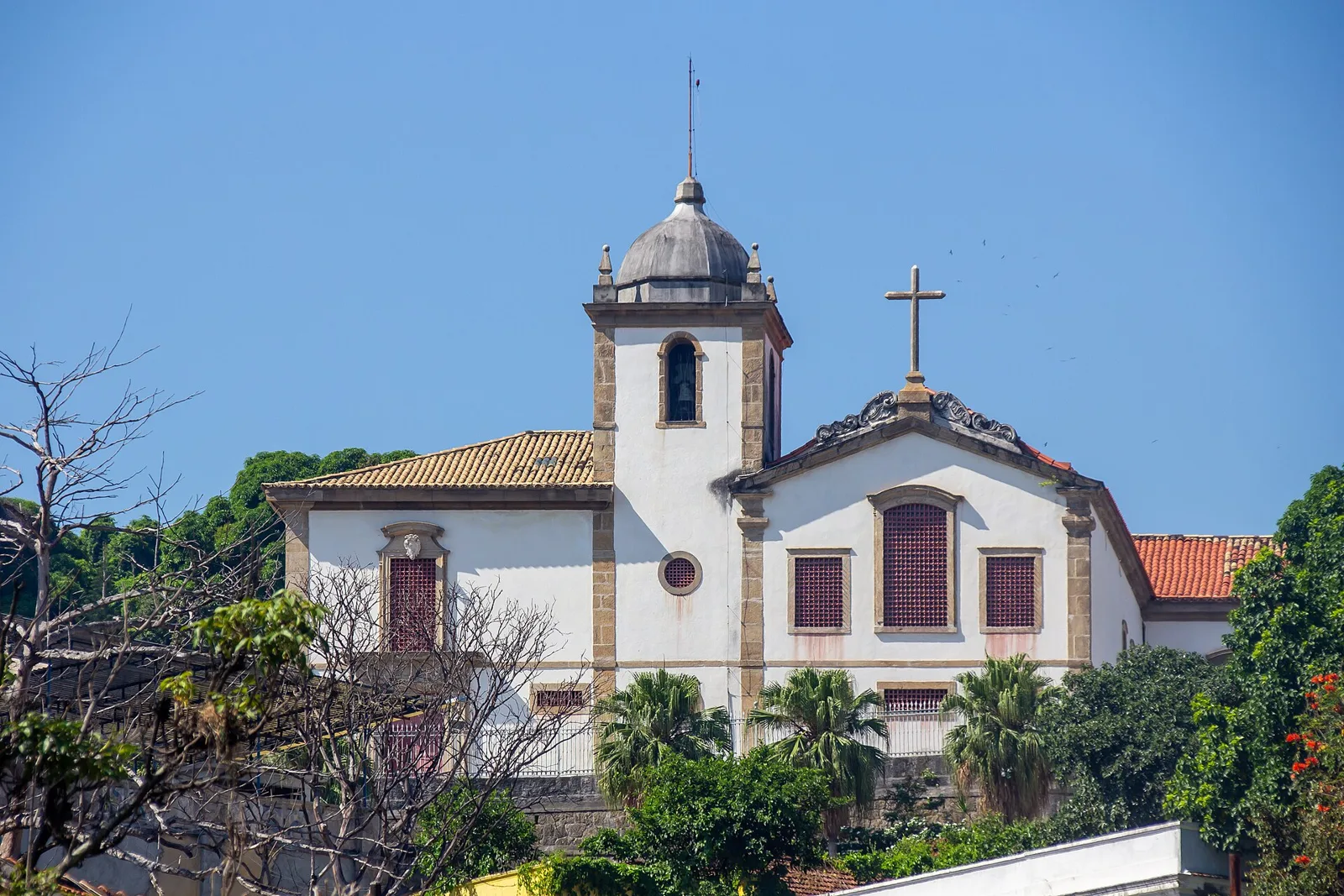
The pockets of the hill
The hill sits over Lapa, Centro, Catumbi, Catete and Glória, and it is less one place than a series of pockets along winding roads. A guide published by a Rio law firm in 2026 maps them this way. The Curvelo end, nearest Centro and Lapa, takes in Largo do Curvelo, Rua Joaquim Murtinho, Rua Dias de Barros and Rua Murtinho Nobre, where Parque das Ruínas and the Chácara do Céu museum sit. Largo do Guimarães and Rua Paschoal Carlos Magno form the commercial heart, with bars and the local cinema. Rua Monte Alegre and Rua Áurea are a second, more residential corridor. Largo das Neves and Rua Paula Matos make up the western pocket toward Catumbi. The upper end runs along Rua Almirante Alexandrino to Largo do França, Rua Aprazível and Ladeira do Meireles, where the larger houses and outlook restaurants are.
Which pocket you choose decides your errands and your evenings. The guide sends you downhill for errands: to Rua Riachuelo for a Mundial supermarket in Bairro de Fátima and a gym, and to Rua Benjamin Constant for the emergency entrance of Glória D'Or. Copacabana and its hospitals feel close on a map and far on those roads in rain. Families with school-age children will generally find Botafogo's schools a drive away. Drive the hill route at the hours you would use it before you buy.
Tram, roads and the water supply
The yellow tram is the neighborhood's emblem and is not a commuter system. It boards at Rua Lélio Gama 2 in Centro, runs weekdays from 8 a.m. to 6:30 p.m. and weekends 9 to 5, takes about 32 people, leaves about every half hour and costs about R$ 20, according to the guide's check of the official page in October 2026. There is no late journey home. The state reopened the Silvestre branch on 11 June 2026 after more than two decades, with about 5.84 km of restored track, still in a supervised start-up phase when reported in September, and it plans to buy ten new vehicles in 2027. Fine news for visitors, though residents who need to reach work still rely on cars, vans and app rides.
Water is the unglamorous question. On 4 January 2026 Rio's public defender's office reported an urgent court order to restore supply to the area after interruptions of more than 72 hours. Ask every seller about the last three summers, and look at the tank size and the pump, with its power backup. If the house is high up the hill, ask how many hours the tank can last. Slopes need the same attention. In the April 2010 storm that killed 256 people citywide, the Morro dos Prazeres area on this hill saw deaths from landslides, and a Geo-Rio report led the mayor to order evacuation, which the public defender's own expert disputed. The landslide checks guide explains how to get the official record. Pay for a geotechnical opinion for any house with a retaining wall.
What the protection rules mean for a house
The hill falls under a municipal cultural protection district that a local history site dates to 1984. Treat that year as unconfirmed, because the research for this page never reached the decree itself. A council record from November 2013 says only that preservation started in 1984 with the downtown Corredor Cultural and later reached this hill. Ask your architect to pull the text from IRPH, the city's heritage institute. In practice, the law firm's guide says facades, roofs, additions, demolition, vegetation and change of use may all raise approval questions, and that each property's status must be checked one by one. The 2021 IRPH resolution allows 20 days for a first answer and another 10 once you comply, and it has a separate checklist for buildings older than 1938, which may include many houses here. Its article 11 exempts some interior work on those older buildings from prior review, so ask IRPH whether that reaches a house inside this district. Plan on several rounds.
The same guide warns that short-stay or guesthouse use raises licensing and heritage questions on top of the contractual ones. A property advertised with a hotel license needs that license read and checked with the city before you pay for it. A title search has extra importance here, too. The hill includes possession-only arrangements, informal divisions and unregistered works, so a seller's contract must match the matrícula. The difference is set out in the guide to possession and title. Reviver Centro's tax breaks stop at the zones the city set for Centro, so do not assume they reach this hill without checking.
Crime counts and the walk home
Reported counts help frame this better than reputation does. Police-recorded figures for January to September 2026, compiled in that guide, show the Santa Teresa station area with 162 pedestrian robberies, 110 phone robberies and 184 phone thefts. The neighboring Centro, Lapa and Paquetá area had 832, 847 and 2,507, and Catete to Laranjeiras had 390, 329 and 1,157. The counts are not adjusted for residents or visitors and do not measure personal risk. A 2017 report had residents naming Rua Monte Alegre, Ladeira do Castro, André Cavalcante, Ladeira de Santa Teresa and Joaquim Murtinho as the places they were robbed most. That list is old, but it shows how the problem tends to sit on the links between the hill and the flat city.
Police operations in January 2026 in Prazeres and Escondidinho involved reported gunfire, and an operation in Prazeres in March led to an inquiry after deaths that included a resident. A visitor guide advises taking a cab home at night and not walking down to Lapa. Before you buy, visit after dark, talk to AMAST, the residents' association, and find out where your block sits against the hillside communities.
Who buys, and how it rents
Buyers here tend to be owner-restorers, artists and would-be guesthouse operators, and as a general observation they accept the logistics for the setting. Long-term rent data is thin: only 13 apartments were on offer in November 2026, at a median of R$ 49/m², and the typical rental was 65 m² at R$ 3,000. A dated October 2026 listing on Rua Almirante Alexandrino gave a furnished 143 m² apartment at R$ 3,600 base rent and about R$ 5,560 all in. Secovi's nearby Centro figure was R$ 48.03/m² in December 2025, up 35.9%, so the wider central zone has seen a sharp rise. Santa Teresa's own figures do not show the same strength, and the rental pool for a big old house is small.
Events bring visitors at set times. The Carmelitas bloco opens Carnival on the hill, climbing the steep path below the Carmelite convent, with a smaller residents' parade the next morning. Local bars and restaurants such as those along Paschoal Carlos Magno and Rua Aprazível draw weekend traffic, so choose your side of the street accordingly. On resale, the buyer is usually another occupier, because protection rules leave developers little to do; expect fewer viewings than in Ipanema or Leblon, and budget for a long sale. The Rio guide covers citywide rules, and the owner-sale guide helps with a direct purchase.
Questions about Santa Teresa
How much does a house in Santa Teresa cost?
Asking prices in November 2026 averaged R$ 5,608/m², so a 300 m² house would ask about R$ 1.7 million before restoration. The range is wide, and a single dated listing can sit far above it.
Can I use the tram to get to work?
Not in most cases. It runs daytime hours about every 30 minutes, holds about 32 people and costs about R$ 20, and it does not run late in the evening.
Can I change the facade of my Santa Teresa house?
Only after checking with the heritage institute. Facades, roofs, additions and demolition can all need approval, and buildings older than 1938 have their own checklist.
Does Santa Teresa have water problems?
There have been outages: in January 2026 the public defender reported a court order to restore supply after more than 72 hours. Check the tank, the pump and the last few summers with the seller.
Is Santa Teresa cheaper than Botafogo?
Yes, by about half per m² on asking medians, though restoring an old house can close that gap fast.
Sources
- Oliveira Lawyers, Santa Teresa guide, checked October 2026
- A Corrida dos Bairros, Santa Teresa, November 2026
- Diário do Rio, Silvestre tram branch reopened, September 2026
- I Love Rio, Santa Teresa property and APAC note
- IPS, Morro dos Prazeres evacuation dispute, May 2010
- Brasil de Fato, robberies in Santa Teresa, January 2017
- Africanews, Carmelitas opens Carnival, February 2026
- Gringo Rio, Santa Teresa guide
- IRPH Resolution 3 of 2021 (Normas Brasil)
- Instituto Pereira Passos, city council minutes, November 2013
- Secovi Rio CEPAI, rent per m² by neighborhood, December 2025
- Rede D'Or, hospitals in Rio de Janeiro
Written by Lucas Andrade. Updated November 2026. General information, not legal, tax or investment advice.